Two Strange Gifts That Working at a Mega Church Gave Me

For one strange reason or another, my first full-time ministry job (or part-time ministry job, for that matter) was at Willow Creek Community Church, at the time one of the largest churches in North America. At the time Willow was (and still is, in many ways) the flagship of the Evangelical, mega-church world. The statistics are probably old, but I do remember doing 12 Easter services over two days; we had a “conference season” during which we hosted a Small Groups Conference, Student Ministries Conference, Arts Conference, the Church Leadership Conference and, eventually, the Global Leadership Conference.

It was crazy, and tremendously exciting.

Looking back now, I’m struck with how that time at Willow (I worked for their “Axis” ministry, one of the first GenX/post-modern/post-college gatherings in North America) shaped me. I definitely internalized “The Willow Way” in regards to excellence and leadership, but I also received a couple of very different gifts that have significantly impacted my approach to ministry since.

Platform

Before I had 2 years of leading a worship ministry under my belt, I was teaching at Willow’s Arts Conference; before I really knew what post-modern worship was (do I know now?), I was conducting seminars and trying to help other pastors “figure it out.” Though practically all of us at Axis were wet behind the ears and learning to do ministry on the run, hundreds and hundreds of leaders from around the world sought us as experts. Though we were very vocal with our ignorance, and very up front with the idea that we were also just trying to figure things out, we also didn’t shy away from the attention.

In addition, I personally fielded invitations to come and lead worship at a variety of different camps, conferences and other churches. Again, I was honest enough to be somewhat humbled at the invitations given my inexperience, but I still accepted what I could and was privileged to lead in these different environments.

In short, Willow’s reputation within the evangelical world (again, well-deserved in almost all respects) was such that we were perceived as insightful experts on ministry. People listened to what we had to say; they paid attention the questions we were asking (because a good post-modern only asks the questions; never answers them).

In short, we were given a platform, and a pretty big one at that.

For the years that I taught and led around the Willow circle, it was amazing. But over time, I realized that it’s very easy to mistake having a platform for being a pastor. Platform and ministry can get so dangerously intertwined that when one diminishes, you start to question your effectiveness in the other. If you’re not careful, you start to believe that doing ministry equals having a platform, or somehow entitles you to be an expert. What’s more, in my case at least those invitations and opportunities began to feed an unhealthy ego, and I began to believe that I was entitled to have a voice. Rather than seeking an opportunity to serve my local community, I was raging with the thought that I was “too special” to be contained in only one church: I deserved to be traveling, to be playing at conferences and festivals.

This was about as far from Jesus as you can get.

Eventually, the platform went away. As “Willow Creek” moved lower and lower on my resume, the invitations came less and less frequently, and it was actually pretty depressing, until I came to realize what most people know already:

That practically every pastor in the world simply does his or her work, week in and week out, with no expectation of a platform:

  • no speaking engagements
  • no article writing
  • no leading seminars
  • no perception of being “an expert”

… and this is okay. 

I’m pretty embarrassed to admit this, but it’s the truth. Being a pastor does not mean you are an “expert” in ministry. It means that you’re a shepherd, trying to help people navigate their life in an effective, gospel-shaped and meaningful way.

Downward Mobility

The first strange gift from being on staff at Willow—or rather its loss—would have been difficult to navigate had it not been for the second gift.

In the process of becoming a member at Willow, Shana and I received a workbook to fill out that contained many of the values and principles that Willow sought to embody.

In its pages had a statement that we were charged with embracing and embodying as Willow Creek members:

“I will embrace the idea downward mobility as a way of life.” 

(Or something very similar to that.)

Wrap your heads around that for just a moment.

This mega church in the affluent Northwest suburbs of Chicago was asserting that the normal way of life for a follower of Christ was to embrace, not affluence and “prosperity”, but generosity and even poverty.

I have never, ever seen this statement in any other church membership material. Ever. 

For all of its reputation of “easy spirituality” and “cheap grace,” Willow was advocating a much more radical discipleship, and that statement has haunted me ever since I read it. It’s a simple assumption that every new ministry opportunity should be bigger, or more prestigious, than the last, but that short little sentence and concept reminds me that this was not the model of Jesus’ ministry. 

His ministry ended up with him being deserted by all of his followers and dying alone.

True downward mobility.

(Note that I am not saying all “up-and-to-the-right” ministry paths are bad; I’m just saying that you can’t evaluate success or failure this way.)

Obviously, this second gift made putting the first gift into context a bit easier. It was still difficult, but over time it made more and more sense. These days, I feel like I’m still doing “recovery work” from the first gift, and doing the difficult and challenging work of staying engaged with a community over the long haul. I’ve been blessed to do a couple of things here and there outside my church, but I can no longer pretend to be an expert on anything, and that’s really okay. Frankly, my spirit is much healthier when there are none.

Lastly, let me say that there were other gifts that I got from Willow as well: a baptism, a mentor, a vision for ministry, amazing friends and colleagues, the opportunity to be a part of a truly great team, to work under an amazing leader (and to see other amazing leaders work as well), and many, many others.
Five (and a half) Resources to Boost Your Creativity (especially you, pastor)

Creativity Resources

Creativity Resources

If you know me at all, you’d know that I think more creativity in any field is a good thing, especially ministry. Creativity unlocks new approaches and new ideas, as well as improves existing ones. It’s almost an issue of stewardship, since it involves (I believe) reaching the full potential of our resources.

Seth Godin writes in Linchpin that we should approach our daily work like it’s a treasure: “It’s our one and only chance to do something productive today… A days’ work is your chance to do art, to create a gift, to do something that matters.”

Now, Seth Godin didn’t write any of the Gospels in my Bible, but there is some wisdom in this. Any vocation can benefit from additional vision and creativity, including ministry, whether in discipleship conversations, preaching, or even arranging our schedule.

Here are a few resources that can jump-start your creative journey.

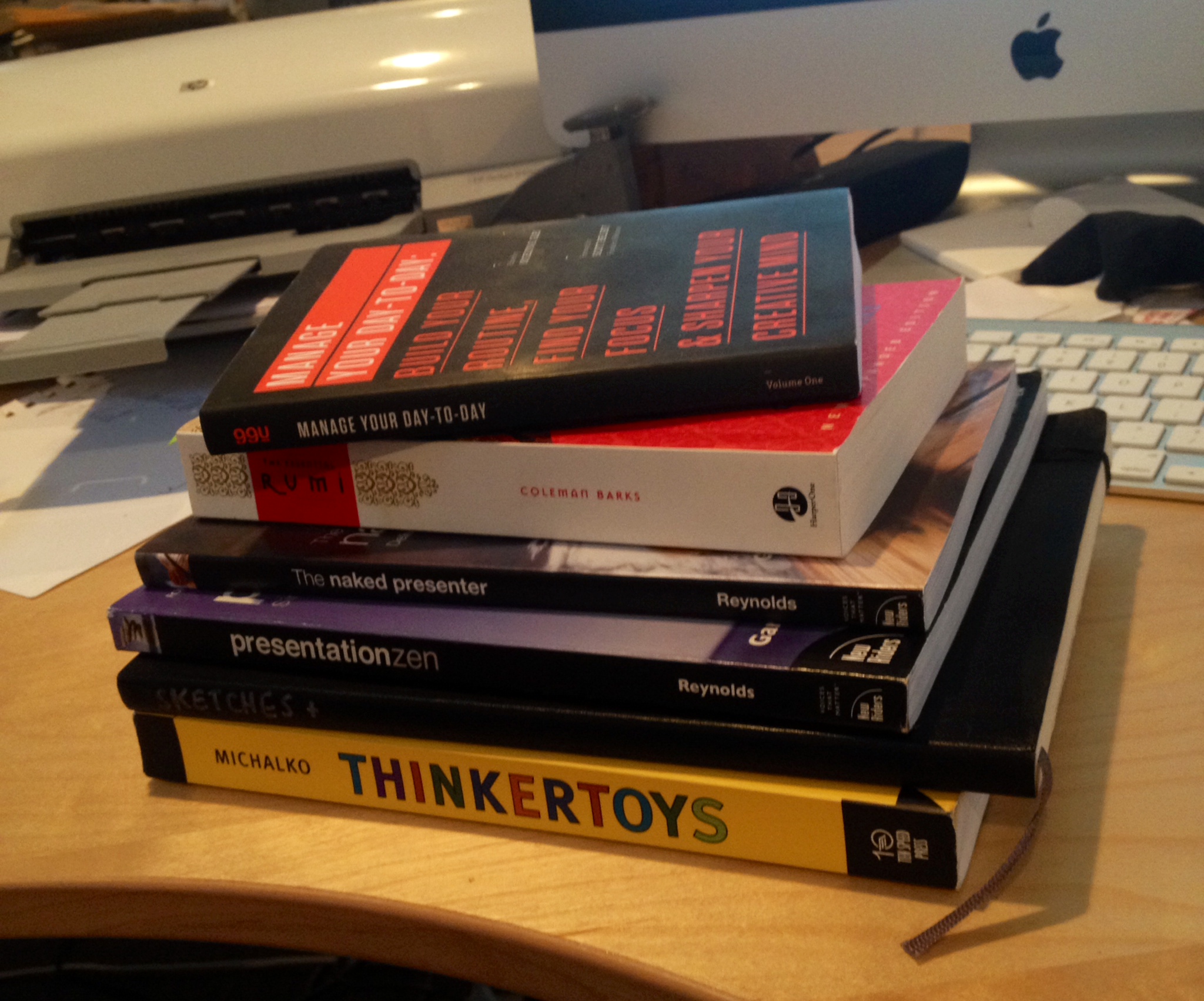
  1. Sometimes we get bogged down with solving the same problems with the same solutions (which isn’t really solving them at all, is it?). Thinkertoys, by Michael Michalko, is a collection of creative brain exercises to help you examine problems and opportunities from radically different perspectives. The exercises will seem odd and counter-intuitive, but they bear much fruit over the long run.
  2. Are you bringing your best energy to the most important part of your day? Manage Your Day-to-Day is a collection of short essays and articles from business and thought leaders (including Seth). It’s a very hands-on, “tactical” book that can help you reevaluate how you are spending your time. The chapters are short enough to read in 10 minutes, and they include summer pages and key takeaways. This book is really, really critical to putting all of the theory into action.
  3. I think everyone should have a collection of poetry nearby. This may be a little out there, but poetry engages a different part of our brain than prose, and in order to bring all of our resources to bear on our challenges, we should be willing to stretch our creative muscles (i.e., our brains) a little. I picked up an anthology of works by Rumi, who is a widely respected Persian poet and mystic from the 13th century. I read 3 or 4 poems a week, always out loud (the way poetry is meant to be read), just treasuring the way the words are strung together. (Note: you don’t have to understand poetry it to benefit from it.)
  4. These two works are combined into one resource: PresentationZen and The Naked Presenter, both by Garr Reynolds, are invaluable works on public speaking or “presenting” (read: “Preaching”). The quality of our message—whatever that message is—is repeatedly compromised by our inabilities to clearly and effectively communicate it. What’s more, our tendency is to add more— more slides, more images, more bells and whistles (animations? ugh)—when a better approach would be to take away. Clear the deck, so to speak. Provide space. Clarity. Reynolds ruthlessly shows how to arrange thoughts and information in ways that shout by whispering.
  1. Lastly, I present the lowly Moleskine sketch book. Early on when I began preaching, I instinctively began using sketches (as opposed to
    Moleskine // Jonah Sketch

    Moleskine // Jonah Sketch

    outlines) to develop my thoughts. As Mind Mapping has shown, our brain doesn’t work linearly, it works through “webs”, and to the degree that we try to visualize our problems with an outline or some other “linear” display, we are actually working against our minds. My sketchbook allows me to work with the brain’s natural tendencies, rather than against them. The next time you are trying to map a project or construct a talk, try sketching the ideas first, rather than outlining them. (Obviously, a nice white board works well too.)

These are just a few tools and tricks that help me approach my work from a more creative space. If you have any others, feel free to share them here.


+e


Sometimes I Just Get Tired

In some way, I think I’ve always wanted to be a writer. Books, along with music, were my constant companions when I was growing up, and regular trips to the library are some of my earliest and fondest memories. It seemed as natural as the progression of days that I would someday write a book of my own, though I wasn’t exactly sure when.

Hint #1: I’m working on a book (actually two) right now.

Hint #2: Writing a book is really hard. 

On my way to writing more prose, I learned to become a songwriter. I’d written songs off and on in my twenties and early thirties, but in 2006 I decided to really throw myself into my craft, and managed to churn out somewhere around 30 or 40 in a few years. It could’ve been more, but I did the best I could.

Now, along the way the internet happened and, as writers like Seth Godin pointed out, everything changed: the world, as far as creators went, was on its way to becoming truly flat, and we could publish to anyone anywhere (as long as you could managed to get heard over the noise).

I started a blog somewhere in 2009 or so, and launched thisisericcase.com in 2013.

In other words, I was doing the same thing as about 60 million other people.

No big.

I read all the people—Seth, Michael Hyatt, and others—who gave the proper advice on “how to blog/write/self-publish/etc, and I’ve dabbled here and there with their suggestions. Overall it’s been pretty cool to see people read my words, and occasionally have them seem to mean something to people.

But lately…

Lately, I’m just tired.

I did a Strengths Assessment in 2013, when I discovered that though I have a high drive to collect information, my drive to create things—Tweets, blogs, books, songs, etc.—is not so high.

My nature works against my aspirations.

It’s hard work.

A dear, dear friend of mine told me the other day, “The truth is, I haven’t read your blog lately, because you’ve been a bit boring; I miss the times when you used to make me cry.”

They are right (this post isn’t about them; it’s about me). I’ve been a bit off. Writing doesn’t feel like the release and exercise in self-expression that it should be.

I guess I’m better at producing quantity, but it feels like more of a chore now.

This space is supposed to be about “Faith, Creativity, and Collaborative Leadership”. Lately, it seems that whatever is happening to me faith-wise is too subtle to name and describe (or that it’s simply to “small” and boring to relate). Creatively, I feel a little bit lost, as I’m in an “in between”. It seems that I’m slowly leaving music behind, but there’s really not anything else yet. There are sporadic sermons and Sunday creative endeavors, but not nearly enough to be engaging, and the books and blog posts… well, we’ve been through that haven’t we?

As far as leadership goes… hmmmmm… I feel less like a “leader” than ever. Someone once said that if you call yourself a leader but no one is following you, you’re just going for a walk.

What if you don’t even feel like you’re walking? What if you feel like you’re just crawling? Do leaders crawl? 

I can name dozens and dozens of men and women who are infinitely better leaders than I am, and mostly I’m left treading water to try and just “get things done” and see one or two people occasionally take steps to following Jesus more closely.

So what’s the point? Nothing really. It may be just an effort to write my “word quota” for the day/week.

I suppose I’ll get up tomorrow and write again.


10 Things My Mother Taught Me

I’m not going to speak for you: I can’t say what your mom taught you. But here’s what Margaret Vondelle Hearne Case taught me:

  1. It’s good to go to church (even better to be Methodist but hey I can’t do everything right).
  2. Try not to speak bad about anyone.
  3. Education is important; really important. So much so that you sacrifice—say your entire paycheck—so that you can send your son to a private university.
  4. Sometimes, cookies—in particular snicker doodles or peanut butter—do say, “I love you.”
  5. Even though it’s hard, you should never leave the room when your favorite team (in her case, University of North Carolina, the Steelers, or team USA in the Olympics) is in any championship.
  6. Always respect everyone regardless of culture or skin color. 
  7. Family is the most important thing.
  8. It’s never too late to heal and grow.
  9. Family dinners at home are really, really important.
  10. Never think too highly of yourself (I’m still working on this one)…

Happy Mother’s Day Mom!

Two Questions That Have Governed My Spiritual Life

I am 45 now. Wow. Somehow, I am still coming to terms with that fact. Believe it or not, I am getting to the point where, every once in a while, I can claim to have a little wisdom. A few years of reflective, thoughtful living will do that to you.

Anyway, as I was reflecting on some current reading, I got to thinking about how you could divide my life, spiritually-speaking, into two phases. Each of these phases were marked by one governing question, and furthermore I think in my case they were influenced by age (or lack thereof).

Overall, I have a tension with sweeping generalizations: on the one hand they eliminate and minimize subtlety and detail; on the other hand they are remarkably useful in saying an awful lot with a few number of words.

With that in mind, I’d like to offer up the two questions that the spiritual/Christian life asks. They are not necessarily age-bound, but I believe they tend to be, because they simply require different modes of thinking that aren’t always available at certain ages. When we are young, we can afford to think dualistically or in black and white; the consequences just aren’t that great (I once quit a band because they wouldn’t go to the chord I wanted), and we can afford to have our world be as simplistic as we’d like.

As we get older, and (ideally) encounter more and more of the world in all of its diversity and complexity, most of us learn that binary, dualistic thinking just won’t explain what we are seeing. We see marriages fall apart, and though black and white thinking would have us blame “one or the other”, in truth we know that most of the time both parties have contributed to the hurt and pain that kills a relationship. We need a better explanation for how the world works (and one that fits with our Christian worldview, I might add).

So with that in mind, here are the two questions that I have heard from life:

1. How do I get to heaven? 

I grew up in the church, so it wasn’t a huge reach for me to start thinking about “heaven” and some kind of after life. As I’ve told a lot of friends, I prayed “the sinner’s prayer” at least a half dozen before I was 21; as I figured it, if there was a heaven (or hell), it sure couldn’t hurt to be sure I had that taken care of.

“How do I get to heaven?” definitely helped me ask some of the right questions, and it guided me to certain churches and individuals over time that helped me answer it.

However, there is a definite “on or off” nature to this question: you get to heaven by doing/believing X and Y.

It’s almost like a math equation, and to my mind at the time, a math equation was actually pretty comforting (as my wife likes to point out, one of the ways to calm yourself during an anxiety attack is to, ahem, do math problems). 

But I have to be honest: math gets old after a while. 

Furthermore, as I got older, life stopped asking me the “heaven question” over and over.

Things got complicated: marriages ended; children struggled; addictions reared their head; friends died unexpectedly; people lost faith (and in some cases found it again).

These things were all happening people who were indeed “going to heaven”—they’d got the answer to the question right—but the math equation was no longer relevant.

For a while, this caused a lot of despair: Was Jesus not enough to explain these very complicated, messy situations? 

We all needed a different question.

2. How am I supposed to live? 

Over time, the “heaven” question receded, and a new question took its place. This new question was not nearly as concerned with the math equation. In fact, the equation wouldn’t even line up behind this question, almost as if was a different discipline altogether:

“6-4 = the color blue”

This question has nothing to do with binary thinking; it embraces the complexity of life, without giving easy answers.

It’s content is qualitative, rather than quantitative.

It is not black and white.

Essentially, this question started to come up after I’d answer the first one fairly certainly: I knew I was going to heaven, that Jesus would embrace me when my time had come. However, what was really vexing me was trying to figure out why, given that truth, my life was still such a mess. 

Why was I still struggling with repetitive sin? Why was I still given to bitterness, cynicism, arrogance and a radical self-centeredness that threatened to consume everything I held dear?

I knew I was “saved,” but somehow that question no longer seemed relevant, and as I began to ask the second, some amazing things began to happen, first and foremost that I realized (at least for me) that answering the first question left me “in heaven” but really a passive actor in my own spiritual life. After all, I was in heaven now—why bother about “the rest of the stuff”.

To put it another way, I was a “good Christian”, but my heart (and certain parts of my life) was really a mess.

I was going to heaven, but I was taking a hell of a lot of baggage with me.

Maybe it’s normal, but I began to be less concerned with the first question, and really embraced the second. I wasn’t nearly as concerned with “doctrine” as I used to be, but much more focused on does this work? Does it transform me into someone who looks JUST A LITTLE MORE like Jesus than before? 

These are not black and white math problems.

These answers involve silence, meditation, focus, prayer, and embracing ambiguity (I am simultaneously a “sinner and a saint”).

Slowly but surely, I think it’s working.

Finally, there was something ultimately profound in wrestling with these two questions.

Focusing on the first question, doesn’t necessarily lead to the second. But when you focus on the second, most of the time you will get the answer to the first thrown in. 

You may get to heaven, but your life may never change or evolve.

If you focus on transforming your life, with partnering with God for your spiritual growth, you will most likely find yourself fit for “eternal life” (and what’s more, for the “eternal life now” that Jesus talks about in the gospels.

Our spirituality should always ask us the deepest questions; what is your spirituality or faith asking you?


+e


Science Mike, The Liturgists, and the Silence that is Saving My Life

Otto Greiner [Public domain], via Wikimedia Commons

Otto Greiner [Public domain], via Wikimedia Commons

A good friend of mine sent me a link to something he’s been working on with the folks from the band Gungor. There’s a spoken word piece on the power of prayer, and in particular a practice called “Centering Prayer”. This is an ancient form of prayer practiced by many of the church fathers and desert monks. The spoken word piece talks about prayer from the point-of-view of science, and discusses some of the proven benefits of silence and meditation on our health.

This was so encouraging to encounter, because I had discovered centering prayer about a year ago, and it is a discipline that has taken root in a deep and powerful way in my life, and while I’m not a scientist, this approach to prayer has had profound and significant effects for me.

Mike can explain all of the silence behind praying; for me it has been all about me learning to recognize and quiet the pathology that is inside me. The prayer has helped me begin to recognize the lies that I so easily believe:

+ That I am the center of my world.
+ That I have more to say to God than He could ever possibly say to me.
+ That my words can somehow control or manipulate God.
+ That God—and grace—can be understood and controlled.

All of these ideas—in some circles they are known as “the false self”—and more start to crack and crumble in the face of 20 minutes of absolute silence and a quiet mind and heart. They evaporate in the presence of a God who dwell in “deep darkness” (1 Kings 8:12; 2 Chronicles 6:2; Psalm 97:2, ).

After a while, you can even begin to see that God is working in you to heal you, to grow and transform you in something resembling Jesus Christ.

(This is a good thing.)

If you wanted to get started with the practice of centering prayer, I’d suggest a few things:

  1. Check out The Liturgists: either live or recorded and rest in the peace of what they are doing.
  2. Read Richard Foster’s book Prayer, which has chapters on The Prayer of the Heart, Meditative Prayer, and Contemplative Prayer, which are somewhat related.
  3. Read Open Mind, Open Heart by Thomas Keating
  4. Have a conversation with someone who has experience with it. You can sometimes find these folks in monasteries, or in certain local faith communities (Catholic, Eastern Orthodox, etc.).

Two brief words in closing:

  1. Gungor/The Liturgists have taken this meditative approach to worship and prayer on the road, and I’ve seen some great responses to it. If they come someplace near you, you should definitely go, but at the same time, keep in mind that experiencing mystery, silence, and contemplation one time in a theatre or arena is not the same as incorporating it into your daily life. If you had to choose between a daily encounter and a one-time tour stop, choose the daily encounter.
  2. There is a certain nervousness in the west (North America) about disciplines like centering prayer and contemplation, and I suppose I can understand this. My response is first, this is not a new (nor a “new age”) practice, but one that has long standing connections to our faith tradition. Just because it is alien to us in our North American mindset does not mean that it is wrong, or something to be feared. Second, this is merely a way for us to “work out our salvation with fear and trembling.” Jesus’ work on the cross was complete and takes care of the brokenness that is inside me. That being said, Jesus (and Paul as well) was also passionate about change and growth and maturity. Prayer is probably the key mechanism for that growth and maturity.

I’ll stay silent, and wait on God.

========================

Wonder (again)

Without mentioning any names, I have an acquaintance who plays drums in a pretty well-known and successful rock band. Around 2003/2004, as they were ascending the charts and their popularity was really taking off, they played a concert at the Hard Rock in Chicago, and he gave me a couple passes to the show, which was pretty much sold out. Afterwards, he met me and a buddy down in the lobby to just say, “Hi” and touch base (I hadn’t seen him in a couple years).

As I walked up to him, he just gushed with gratitude and thanks that I’d come, “Wow, it’s so awesome that you came out!”

As I congratulated him on the band’s success he continued to seem almost overwhelmed by everything that was going on, and continued to thank me for coming out to see the show.

Meanwhile, I kept thinking, “This guy is totally ‘living it,’ and just played a sold out show and he is grateful that I came… for free?!??!”

His wonder and gratitude of what was going on in his life was so childlike and innocent. It blew me away, and it continues to haunt me to today. When I think about how ungrateful I am for my “normal” life, I am convicted. When I refuse to see the wonder and beauty of my life… the moments in lifetimes—weddings, funerals, baptisms—I get to share, when I get to see people grow and become more like Christ, when I get to see people find their vocation and then embrace it… all of these things are miracles in and of themselves, yet I choose to overlook them for something else “out there”. 

It’s a rejection of grace, in a way.

One of my favorite—and most convicting—quotes about wonder is from Abraham Joshua Heschel:

“Never once in my life did I ask God for success or wisdom or power or fame. I asked for wonder, and he gave it to me.”

Which comes first? The success or the wonder? I’m beginning to think that success follows wonder, rather than the other way around.

Actually Kids Really LIKE Vegetables

I remember the first time my wife set some steamed broccoli on my plate.

Our daughter was about a year old, and she was starting to eat regular food.

But broccoli? 

I looked at Shana with my eyebrows raised.

“Our children are going to go up eating healthy, and Emily needs to see us eating vegetables.”

But broccoli?

Like many other kids who grew up in the—oh let’s face it who grew up anytime in the last 50 yearsbroccoli was the food that we all made fun of.

No one ever actually ate it, did they? 

Well, regardless of my history, I took a bite.

It wasn’t bad.

And so began our long running association with fruits and vegetables.

At one point, things got so bad that we got Emily a “Costco-sized” can of Del Monte Green Beans for her birthday and she acted like we’d just gotten her a car simply because she was so used to eating fresh or frozen green beans that the added preservatives in the can was like eating cake to her. 

Really.

But you know what? Kids really like vegetables.

We think they only like fish sticks and pizza, but when kids get a taste of real food, they tend to want more.

It’s like that with true spirituality.

Last June I went on a mission trip with some folks from my church. We ranged in age from 15 to 45, with most of us (okay: them) in their 20s. We built houses all day, and hung out with some kids in villages around Panajachel, Guatemala. At night we would sit up on the roof of our hotel and just unpack the day.

There was an older gentleman who wasn’t really a part of our church, but he’d traveled with our team to see what Porch de Salomon was up to. This guy—he has since become a spiritual mentor/director to me—would sit with us, and while most of us were just trying to recover from the day or crack bad jokes, he would start to ask us very simple questions:

“So how did you grow spiritually today?”

“Where did you see God today?”

These were not crazy, earth-shattering questions, and yet somehow they were the questions we needed to answer. 

And as we began to answer, the most amazing thing began to happen:

tears were shed…

poignant stories—of vulnerability and roundedness—began to be shared…

fears were exposed…

hopes were laid out…

All from these simple questions, and an older individual who refused to let us stay on the surface, and who was unafraid to lead us to tender places.

Even when what we thought wanted was just a chance to knock back a beer or two and laugh.

What we really needed was to go into our souls.

It revolutionized my understanding of what people are seeking.

I thought people—in particular younger people—were in search of superficial, tepid spirituality. I thought they wanted to work and drink and laugh and then shop and then go home.

But I was wrong.

What I learned is that people are hunger, even desperate for something real and deep and life-changing.

They want to cry. They want to tell their stories. And share their fears. They—we—want to be known.

I see so much in church “discipleship” that is designed to get people serving, and giving, and participating, but I’m not sure I see efforts to cultivate spiritual directors, or mentoring. I’m not sure I hear people relentlessly asking the basic spiritual questions we are all hungry for.

“How have I grown spiritually today?”

“Have I been honest with myself and others?”

“Have I hurt someone today? Do I need to ask forgiveness from someone?”

These are the thoughts that people want to think about.

Sometimes it seems like the church is convinced that people want “Happy Meals” or some kind of GMO perfection, but what we want is something earthy, connected, and trusted.

Like vegetables.

My First Lesson in Creative Sermon Prep

I am an unapologetic geek when it comes to certain things. For instance, when I got called for jury duty, I spent half the day marveling at the privilege of participating in “trial by peers”, and thinking about how unique this experience was to the rest of the world.

I know, it’s that bad.

Well, I got picked, and we heard our (short,civil) trial and began our deliberation.

(As an introvert, this is where it got awkward for me: putting me in a room full of people I don’t really know and then asking me to work and speak with them for hours on end… ugh.)

There was an older gentleman there, and during a break he started talking about how he’d worked in newspapers (remember those), and how he was a news junky. Then he asked us a question:

“Do you guys know how to find out what’s really going on in the United States?”

Let’s face it, we knew that we were not supposed to say “Yes.” So we all shook our heads.

He said, “You find out what’s going on in the United States by reading the news from Europe. Want to know how to find out what’s going on in Europe?”

“Sure.”

“You read the Russian news.”

He then lead us all around the world: Russia, Asia, etc. (I can’t remember the entire sequence, but you get the point.)

The point he was trying to make was that only when you got a little objectivity could you really see what was going on in a country. The best way to find out about a “thing” is not necessarily to read about the thing from people who know it best, but to read about it from people who aren’t really as connected to it. 

I think it’s a little like that with sermon prep.

I know there’s lots of websites out there that help with sermon prep, but I think a little more objectivity is required.

So to think about teaching the Bible, I go to “Europe”: which (for me) means

I collect and distill ideas and stories into Evernote, and then tag them and store them until they are needed.

Since I feel like the gospel touches all of life, it’s not always a huge chore to connect our inability to walk in a straight line to discipleship, or Nine Inch Nail’s record The Downward Spiral to the story of Samson.

Or, I suppose, to connect jury duty to sermon prep.

The Gift of Isolation

What’s the nature of our life together?

For years, I was under the impression that “community” meant a sort of seamless “inter-meshing” of lives; a true uniting of individuals.

I’ve now come to understand that this belief has caused a tremendous amount of stress and strain in my life.

I was speaking with my counselor this summer (don’t have a counselor? Get one. Trust me.), and I was talking about my dad.

Here’s what you need to know about my dad: he had a big personality. He was a salesman (a really good one), and it showed through in most of the dynamic of our lives. He dominated—albeit benevolently—our family for decades.

Then he had a stroke.

A big one.

He really shouldn’t have survived but he did (and we are grateful). Furthermore, he’s made a remarkable recovery: he gets around, and talks and interacts and everything.

But much of the “largeness” of that personality was taken from him in 2004, AND FROM OUR FAMILY AS WELL.

We were sort of left reeling. There was a void at the center and point of our family, and also in my life as a man. All of a sudden, the man that was supposed to help me navigate fatherhood (not to mention my 40s and 50s) was gone. In its place there was now a wall, a barrier, that was just spray-painted with the word, “Stroke.”

I could no longer get to the man that I’d grown up with. I was left outside. I felt that, deeply.

I felt very alone.

I was relating all that to my counselor (again: don’t have yet? get one. trust me.), and he reflected back that to me: “So what you’re saying is that since your dad’s stroke you feel isolated from him?”

“Yeah,” I replied, “That’s it.”

Then he hit me with the big guns.

“Well, all he’s done is pointed out a central truth of our existence: the truth is, we are all isolated from each other. We can’t know perfect union or relationship in this lifetime. To be human is to be isolated—to some degree or another—from each other.”

.To be human is to be isolated—to one degree or another—from each other.”

That hit me like a ton of bricks.

And then it set me free.

It’s easy to labor under the illusion that we can expect perfection:

  • perfect families
  • perfect jobs
  • perfect community
  • perfect relationships

In actuality, we live in an “in between” world:

  • in between Genesis and Revelation
  • in between brokenness and beauty
  • in between fracture and healing
  • in between isolation and reconciliation

This is the human condition. Freedom comes when we begin to accept it, and release those around from the burden of being perfect.

(Including ourselves.)

It may sound like a sad or depressing to think of ourselves as ultimately isolated from each other, but it really shouldn’t. I think it’s really simply choosing to accept and to live in the reality that God has given us.

The truth of the matter is that we will know this someday.

Just not quite yet.

The exciting part is that it can start now; we can begin to move closer to each other.

But only if we know where we are starting from.

Now we see a reflection in a mirror; then we will see face-to-face. Now I know partially, but then I will know completely in the same way that I have been completely known. (1 Corinthians 13v12 CEB)