… Like a Hurricane

Recently, I made a mistake.

A big one.

Those are enough details for now, but it left me thinking about love and forgiveness.

Now, my wife is not perfect, but repeatedly I’ve been blown away, overwhelmed, by her ability to forgive and love me in spite of my faults. She is a fierce lover, and when she is loyal, she is loyal. 

It’s a withering love. And it’s difficult to stand.

In the midst of this, I realized that there is something inside of me that absolutely wants to flee this kind of love. I have a hunch I’m not the only one. I have a theory that this condition is more human than I’d like to admit.

What is it inside of us that makes us flee this kind of acceptance?

It’s obviously similar to the love that Christ has for us/me. To look into the face of a love that is totally accepting and forgiving is excruciating sometimes. We want to hide and run because of all the bad that we have done, but there is something there that says we must stand in it and take it, like a fierce rainstorm.

That’s what love is. That’s what love can be… A hurricane. 

Love him, or hate him, Saint Paul must have learned to stand in that hurricane. Here was a man who had people—innocent people—killed, and then later sought those people out in community, as one of them. Moreover, before that he had to stand in the face of Jesus and accept that love.

He could stand in the face of that storm. He was no longer a man with blood on his hands, with the lives of men, women, and children (!) on his conscience. He was simply a man who was now “In Christ”, and was inviting others to experience this same storm.

I know I’m not naturally wired for it. It makes me want to hide, to go numb, to retreat.

I guess I’m TRYING to learn to withstand it, but it is difficult.

Musically speaking, not that it is anything like this:

But maybe, it’s a bit like this:

peace

2015 Lenten Reflections

Well, we survived.

(At least for the most part.)

We have walked our walk, and made the 40-day journey. It began with Ash on skin and ended with an empty tomb.

We have reflected and yearned, gone hungry and sat in silence.

Some of us have woken up to even new areas of our lives where we are still “in bondage.”

But it’s over. We’re done. It’s Easter now, and time to engage with the power of God’s Spirit in a “resurrection life.” I’ve written about that before, but what I wanted to do for now is to jot down a few notes about my own 40-day journey, and maybe hear from you about yours.

MY SACRIFICE

When we started this journey, I encouraged you guys to thoughtfully choose something to give up, to “limit yourselves” in some way…

… I also encouraged you all to keep it a secret. 

I did that. I didn’t really tell anyone about my fast; however, since we are on the other side now, here’s what I did..

I decided to give up all media. That meant that for 6 days a week I watched no TV, listened to no music or podcasts, and visited no “news or entertainment” websites. Now, I had to do some of this for my work, so exceptions had to be made from time to time, but for the most part I was able to make this work. In the time that I gained back from this, I tried to add more prayer, and more reading of spiritual/theological books. On the “seventh day”, I “feasted,” meaning I listened to and watched whatever I wanted for 24 hours.

Here’s what I learned:

NO JOURNEY IS PERFECT

It’s hard to keep this up! As I said, I have to take in some media for my job, and sometimes that spilled over into mindless surfing for a few minutes until I could re-center. Further, sometimes I had to make decisions to be with my family—who were watcing a show of some kind—rather than maintain my fast.

There are always bumps in the road, but you have to constantly re-adust, re-commit and keep pesevering. It’s not going to be perfect, but you can still finish. The point is to not give up. Stay on the journey.

It’s easy to live in an “all-or-nothing” mentality, but spiritually-speaking it ultimately won’t get you very far. Spirituality is seldom (if ever) about “all or nothing.” It’s about staying centered in the midst of failure and disappointment. It’s about continuing to move forward even when you haven’t been perfect. It’s in the “in-between” places that we tend to grow the most.

YOU’D BE SURPRISED WHAT YOU DON’T MISS

As I began to “quiet down”, I was shocked with how much I simply wasn’t missing. Normally, I’m pretty addicted (maybe that’s the key word) to news websites, Tumblr, NPR, ESPN, etc., etc., but as I began to lower those voices, I was shocked with how much I didn’t miss those voices.

My normal life—my everyday conversations, interactions and all the challenges that sometimes accompanies them—were plenty to occupy my mind.

Sure, I missed some “big stories” (that somehow seldom seem to be as big as they first appear to be), but by and large people caught me up as was necessary.

I really didn’t miss all that much, and this was actually pretty surprising.

FASTING SOMETIMES EXPOSES MORE NEED FOR FASTING

When I first pulled back from some of the media I was engaging in, I dove into some fun theology books. However, a week or two into my journey, I suddenly had a nagging thought: “You know, books are a form of media as well.”

Well now…

What I began to realize was that sometimes ”surrending and getting quiet before God means really surrendering and getting quiet before GOd.” 

It doesn’t mean reading more Henri Nouwen.

Pulling back just a little sometimes exposes our need to pull back even more. We discover new ways in which we are distracting ourselves and refusing to listen to the deepest voice in our souls, the One that is calling us to our deepest, truest self.

There’s probably more, deeper things that happened during my time in the desert, but they may take a little time for me to process (and I may not even share them all here), but those were just a couple of things that I learned.

What about you? What was your Lenten season like?
Architecture Teaching Theology (Lessons My Mother Taught Me)

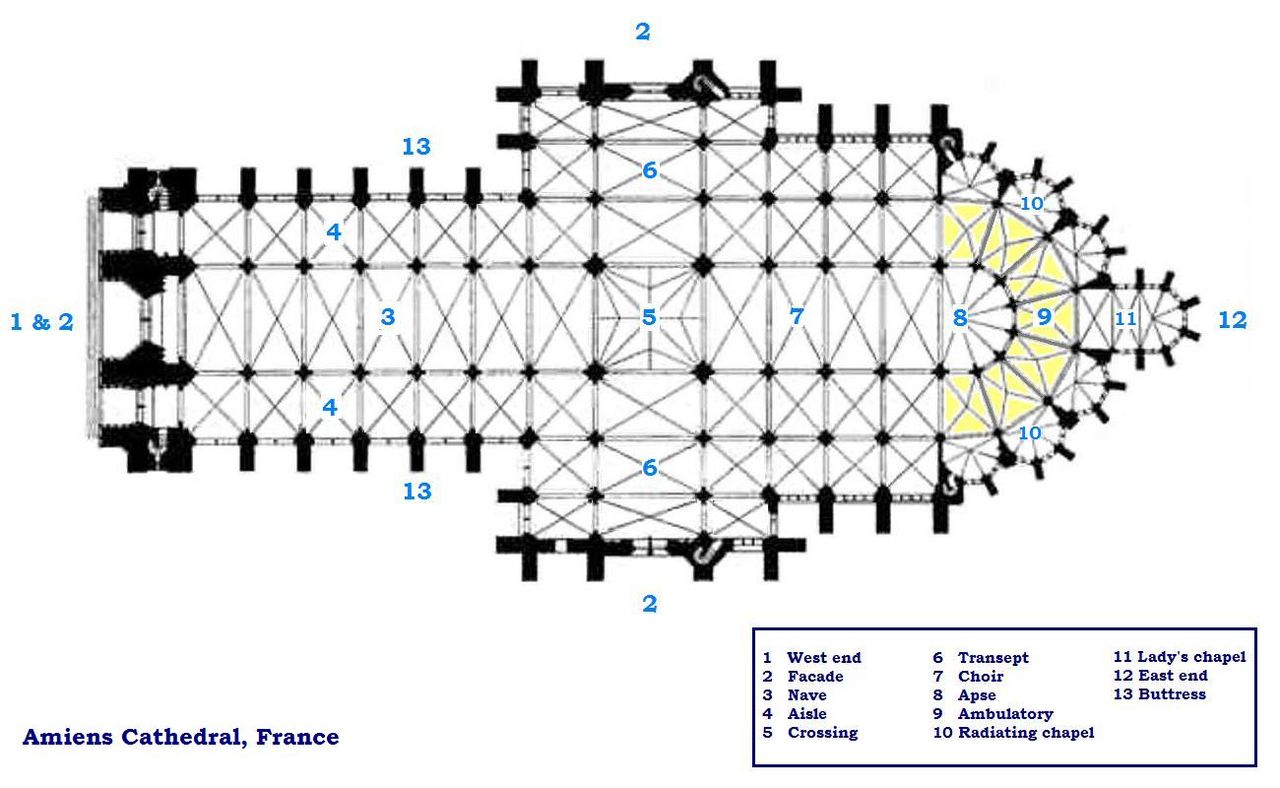
In his excellent historical examination of church worship, Robert Webber points out how the architecture of Christian worship spaces changed as the theology of worship (particularly around the eucharist) changed.

To sum up a very long argument, Webber points out that when the Eucharist was highly participatory, churches tended to meet in informal, interactive spaces, at times almost in the round. As theology of the Eucharist became more and more “elevated,” and as the Eucharist became more and more sacred and separated, worship (and the interaction with the body and blood of Christ became more and more something “that the priests did,” while the congregation observed. Architecture responded accordingly, with higher and higher altars that were more and distinct and separate from the congregation. The areas for

Amiens cathedral floorplan

Amiens cathedral floorplan

priests/“holy people” and the “normal folks” became more and more delineated. Worship threatened to become something that the congregation watched, accept for the moment that the wafer went on the tongue and the wine hit the mouth.

Nowadays, we have stages and platforms, and our worship (at least in most evangelical contexts) is really limited to “song time.” However, most worship leaders of quality do their best to get people involved, and build in times of congregational singing (the singers don’t just sing at the congregation, they sing with them).

However, a friend of mine just recently started attending a mega-church. He’s a musician, and has begun volunteering in their music ministry (needless to say, the musicians are all excellent). One day, we were talking and he remarked that while the musicians were amazing, and the church placed a high value on ministry, nobody seemed to care too much whether anyone was actually participating in worship From his perspective, the band was there to be amazing and inspiring, but there was seldom (if ever?) a call for people to actually sing.

It makes me wonder if we are going through the same “drift” that our mother (The Catholic Church) went through between the early 300s into the medieval era. I wonder if we are becoming content with worship becoming a “spectator sport” as opposed to a participatory event. (NOTE: I understand that not everyone will always participate 100%; this is more about what we, as leaders, are content to accept as normative.)

Worship need not be opposed to excellence. We can (and should) strive to be the best musicians we can be (both on Sundays and on Monday-Saturday); however, our goal, our target should not be only excellence, relevance, or sacredness. It should be participation. We are not worship performers; we are participants with the congregation.

Lent 2015: “The Long Quiet”

So, Lent starts Wednesday.

(We’ve been through this before.)

The Basics: 

  • “Lent” is a season of the church; it starts 40 days before Easter.
  • Historically, this time was set aside for people to prepare join (or, in many cases, rejoin) the church, which they would do on Easter Sunday.
  • To prepare for that really, really joyous day (membership/baptism or restoration), people would take the season of Lent to reflect on the areas of their lives that are in some way “sideways” or somehow out of whack.
  • To address these areas (or in many cases, to help identify them in the first place), it’s helpful to quiet down, to give up some parts of our lives (called “fasting”). Sometimes these things are luxuries (chocolate was always popular in my house growing up), but sometimes we give up—or at least significantly limit—every day parts of our lives too:
    • Coffee
    • Meat
    • Alcohol
    • Television
  • Another way to “surrender” during Lent is to just drastically reduce the amount of food we eat. The idea is to “waken” our spiritual senses by heightening our hunger (literal or otherwise). Sundays are considered “feast days”, meaning you can have the thing or activity on that day, but during the week, you should strive to keep your fast.

This isn’t about a performance. In fact, the most effect Lenten practices are kept secret.

It’s about shaking (or shocking?) ourselves out of our comfortable, anesthesized existence to face (and maybe begin to deal with) things that are wrecking our lives. We fast because most of the time these things are hidden from our face, and we need something to wake us up.

Like being hungry.

Or not watching TV (including Netflix, etc.).

A Few Suggestions:

  • Try it. Prayerfully consider giving something for 40 days and just see what happens. 
  • Share it, but not with everyone. Talk some members of your small community, but don’t necessarily broadcast it on Facebook. “Public Fasting” can feed our egos just as easily as a selfie can.
  • Feast. On Sundays, reengage as an act of worship and celebration.
  • Journal it. Note what God reveals to you during this time. (Note: this does not necessarily mean “blog it” (see above).

May your Lenten journey be rich.

Tough Questions, Tough Answers

What has the power to break you?

What could sink you, or grind up your life?

For some of us, the answer (or answers) to those questions are easy: we point to addictions, to alcohol or drugs or sex or food.

But for others, it’s tempting to draw a blank; to shrug our shoulders and believe that all of the threats are “out there”, maybe in the form of job changes, or terrorist threats, or car accidents, or disease.

Although external threats can certainly be serious, I’m not so sure.

Lately, I’ve been blessed to be hanging around some people who have seen their lives almost destroyed by brokenness. They know the destructive power of sin, and are unafraid (and mostly uninterested) in beating around the bush, or wearing masks to pretend that everything is okay.

On the other hand, it pains me sometimes to see the masks that we wear in our communities of faith, and the lack of awareness (or lack of willingness) to acknowledge the threat that sin has for our lives.

We fail to see selfishness, arrogance, fear, pride or self-centeredness as real issues.

However, surely if we took a few minutes to think about how our lives would play out if they were governed by these qualities we could see what they would do to us:

How well would our marriages survive if we were governed by selfishness?

How well could we parent our children if they grew up in a house that was run by fear and pride?

How long would our friends stay around if they sensed that we are only in relationships for what we want?

I know it’s a heavy question, but how much sin are you willing to tolerate in your life? Not from a “holier-than-thou-I-don’t-drink-or-do-anything-“bad” perspective but from an acknowledgement simply that “sin”—in the form of selfishness, self-centeredness, pride, fear, and arrogance—is not interested in making your life better. From the acknowledge that sin wants to kill you. 

The question that follows is simply: what are you going to do about it?

Why not take off the mask and acknowledge your struggle?

(Because the thing is, once you take off the mask, you find that underneath it you’re only human, and what’s more is that you discover there’s a whole bunch of other human beings around you who are struggling in just the same way.)

Let’s be human together.

Just Something…

There was a a news piece today: roughly 140 children were murdered by the Taliban in Pakistan.

One hundred-forty lives robbed. In the name of religion.

I honestly don’t know what to do with this information: I can’t pretend empathy or remote understanding.

But I want to just say something briefly:

Largely because of violence of ISIS/ISIL, I’ve been doing some reading on Islam lately (I even bought a copy of the Qur’an). I’ve also been doing some reflecting on my own religous tradition (Christianity), and I think I just want to put this out there:

God does not want your (or our) fanaticism.

Whatever revelation you claim—Judaism, Islam, or Christian—the God of Abraham does not want your violence, or your extremism.

I think there is just plenty of evidence that what God offers us—when we really LISTEN and are willing to be humble before Him and His people—is TRANSFORMATION, not fanaticism.

Love, not hate.

Understanding, not close-mindedness.

Love, by nature, EXPANDS, not contracts.

We should be bigger people, not smaller.

Whether your fundamentalism comes in Jewish, Muslim, or Christian forms, it only causes destruction. And I just don’t think God is a god of destruction. He comes to give life and shalom. 

From my own tradition, this—I believe, is why Jesus came—to call us into this wide-open kingdom of grace.

(But then again, they killed him, didn’t they?)

This Just In: I’m Not Perfect

See page for author [Public domain], via Wikimedia Commons

See page for author [Public domain], via Wikimedia Commons

It’s already been an interesting Thanksgiving/Advent season. I’ve experienced two losses in my world: one in my extended family and one in my community here in Tallahassee. Maybe I’ll write more on that later, but suffice it to say for now that my journey towards Christmas 2014 is, for now, marked with a certain sobriety and even somber-ness.

My family spent the holiday weekend in Memphis; on Saturday night we decided to go to church together (since, because of my vocation, we rarely get to sit in a whole gathering as a family).

So we jumped in our car and drove to a United Methodist Church in Memphis that had a Saturday evening gathering. Because it was (a) the south, and (b) rivalry weekend (the gathering was pretty much overlapping the end of the Florida/Florida State game and the beginning of Auburn/Alabama) there really weren’t many people there.

The worship team did their job (sort of, but more on that later), and the preacher got up to speak.

Frankly, I heard some pretty profound things, but it really didn’t have much to do with him.

At one point, the preacher read from one of my all-time most influential authors, Brennan Manning. Here’s what he read:

“I believe that among the countless number of people standing in front of the throne and in front of the Lamb, dressed in white robes and holding palms in their hands (see Revelation 7:9), I shall see the prostitute from the Kit-Kat Ranch in Carson City, Nevada, who tearfully told me that she could find no other employment to support her two-year-old son. I shall see the woman who had an abortion and is haunted by guilt and remorse but did the best she could faced with grueling alternatives; the businessman besieged with debt who sold his integrity in a series of desperate transactions; the insecure clergyman addicted to being liked, who never challenged his people from the pulpit and longed for unconditional love; the sexually abused teen molested by his father and now selling his body on the street, who, as he falls asleep each night after his last ‘trick’, whispers the name of the unknown God he learned about in Sunday school.

‘But how?’ we ask.

Then the voice says, ‘They have washed their robes and have made them white in the blood of the Lamb.’

There they are. There *we* are – the multitude who so wanted to be faithful, who at times got defeated, soiled by life, and bested by trials, wearing the bloodied garments of life’s tribulations, but through it all clung to faith.

My friends, if this is not good news to you, you have never understood the gospel of grace.” (Ragamuffin Gospel)

In that quote, something got triggered inside of me, particularly in the “insecure clergyman addicted to being liked” part.

Because, in so many ways, that’s me.

I am addicted to being liked, and to being perfect (at least in my own mind), and that addiction—and the fear behind it—has been holding me back. 

It’s been holding me back from things that God wants to do in me and, I believe, through me. 

In that moment, I sensed God saying to me, “You’ll never be perfect, Eric, and I don’t expect you to. In fact, I have never expected you to be perfect; that’s something from inside you, not me. Set yourself free from this expectation, and just move forward with the realization that you will be simply who you will be. Imperfect and broken, but trying; it will be okay.” 

Now, lightning didn’t strike or anything, but this was pretty profound, and it happened in an instant. It was certainly food for thought, and I am still working out the implications.

But that’s a good thing to hear, and also a good thing for all of us to remember: God is not surprised by our imperfections or our brokenness. We can/will never be perfect parents,

or children,

or pastors,

or spouses,

or friends,

or Christians.

I guess that just means we are left with being human: which is the beginning of something pretty special.

——————–

Hurry Up… and Stop

Advent starts tomorrow.

Maybe your “Christmas season” started at 4:30am on Friday morning; maybe it started online on Thursday night.

Maybe you are already running at 150 miles and hour.

Maybe you are already stressed out due to family tensions and too-many-parties.

But maybe it doesn’t have to be that way.

Here’s a reminder: Advent is about waiting. 

If you don’t come from a liturgical background (I don’t, by the way), you may not realize that Christmas actually begins on December 25 and lasts for 12 days (hence the annoying song). The season that leads up to December 25 is called “Advent”, which literally means “the coming into being.”

If you follow the Christian calendar, Advent is a period of time reflect on the significance of the arrival of Jesus Christ into the world.

(Which is kind of a big deal…)

So maybe your holiday season has already begun with a frenetic—even pathological—tone. However, it does not need to remain that way.

After all, it doesn’t take a ton of effort to engage in some moments of reflection and thoughtful contemplation this season.

So here’s my question/challenge: What will you do over the next 25 days to slow down, to reflect, to rise above (or stay below, as the case may be) the Christmas (not Advent) madness? 

What if you set aside 10-20 minutes in the morning to reflect and stay silent (or maybe even begin a practice of centering prayer)?

What if you lit a candle each evening at dinner to remind yourself of this light that is “coming into the world”? (see John 1)?

What if you went through a book of Advent reflections?

What if you chose to read through a Gospel (or 2 even) during this season?

Christians are fond of saying, “Jesus is the reason for the season”, but most of us really don’t do anything to actually act like it. We tend to go about our business in much the same way as the rest of the world.

Could this December be different?

Lessons I Learn (… over and over again)

August to November was a difficult season, but somehow some of the clouds are parting and some light is creeping through…

I was sitting with some friends of mine recently—older men who have gone round and round with life and lived to tell about it—and unpacking the things I’ve seen and heard and done.

Most of it revolves around buying into the same lies I’ve bought into countless times before, namely that I can somehow control the brokenness inside me. Some of us—I’m not the only one—lose sight of the fact that our false self is manipulative and sneaky, and largely seeks to just throw us off our path.

It hits me again and again; it’s a strange thing when you can’t trust your own thoughts (because “your own thoughts” are really the thoughts of your false self).

One of the amazing gifts of centering prayer and meditation is that gradually you can learn to identify these tricks of your false self as such, and steer clear of them, but sometimes…

… Sometimes you still drift.

In his letter to the church in Rome, Paul uses the phrase “the old self” (6:6). I used to understand this phrase theologically, as a reference to “just” our sin. Now, however, I realize that Paul is actually wading into to pretty deep psychological waters: the “old self” = the “false self”. It’s the part of ourselves that seeks to find its solace in security and control; in acceptance and affection; in power. Technically (and theologically) it has no power over us except the power that we give it. 

When we buy into what the false self is selling, we tend to reap the consequences.

The only cure for it is to deliberately (and painfully) return to rejecting this false self through meditation and prayer, and to choose to live in reality instead of the illusion of the false self.

(By the way, this is called repentance: it’s really not as scary of a word as you might think.)

And guess what: reality is actually kind of refreshing and peaceful.

Noticed in November, Pt 7 :: “I Don’t Wanna”

Hear all the songs here.

So… I started playing guitar probably in 1982 or 1983; this means that I am, more or less, a musical child of the 80s. This means a couple of things: first, I definitely know how to play guitar solos. It was like essential musical knowledge for us. A lot of that changed literally after Nirvana’s “Smells Like Teen Spirit,” but before that, the notes and the fingers were a-flyin. 

Secondly, I’m influenced by the way music was played in the 80s. To make a long story very short, the 80s were a study of musical contrasts. On the one hand, some bands were very distant and style-conscious. Music could be very cold and precise. On the other hand, there were a handful of artists that rebelled against that detachment and chose to wear their hearts boldly on their sleeves. In a documentary on the making of U2’s The Joshua Tree, Brian Eno said that U2 recognized that “being cool was a sort of detachment from yourself,” and they decided to reject that. Their music is full of vulnerability and “grand-ness.”

But they weren’t alone.

There were other bands who leaned into this engagement. They decided to make music that was big and emotive. In ways it was very un-pretentious, and it lacked self-awareness. It just… was. People jumped around on stage; there was no shame in “being into” the music. Enthusiasm was welcomed.

The other two bands that most readily come to mind that made this kind of music were The Alarm (from Wales) and a band from America called The Call. (If you listen to The Call’s, “What Happened to You“, you can actually hear a young singer from Dublin who named himself Bono singing backup.)

Neither of these bands achieved anywhere close to the longevity of U2, but for those of us who were there, we realized that bands like these were touching something inside us that was innocent and excited to be alive.

Sometimes I wonder where music like that is now; it seems like bands—and music in general—exist in this calculated, “always on” zone where “being cool” is always necessary. At its extreme, it can feign humility and flirt with some kind of false embarrassment about being in a band, like enjoying art is some kind of crime.

The Call’s “I Don’t Wanna” is about as simple of a song as they come: it’s two chords, for crying out loud. Over a tribal drum beat, singer Michael Been sings tortured lines to someone or something. 

Truth be told, I don’t know the exact story behind the lyrics, but they are powerful to me, particularly these:

I ain’t here to tell you what you need
I ain’t gonna take a noble stand
I ain’t here to look you in the eye
Or beg for you to understand
I can only tell you what I’ve seen
I can only tell you how it felt
When my heart was crushed so bad inside
Till I felt the hatred slowly melt

I need this, have felt it once or twice, that moment when something presses down on you so heavily that all of a sudden the walls come down and you feel something break and release inside you.

It’s sort of what it means to be alive, I think.

Enjoy.

The video below is their first single, “The Walls Came Down”. (The studio track surprisingly featured Garth Hudson from The Band on keyboards, whom I wasn’t to discover for another decade.)

*Postscript: Singer Michael Been tragically passed away just a few years ago at the age of 60. However, his son was in one of my other favorite bands from the early 2000s: Black Rebel Motorcycle Club. He did some shows fronting the Call in a tribute to his father. Legit.