Two Strange Gifts That Working at a Mega Church Gave Me

For one strange reason or another, my first full-time ministry job (or part-time ministry job, for that matter) was at Willow Creek Community Church, at the time one of the largest churches in North America. At the time Willow was (and still is, in many ways) the flagship of the Evangelical, mega-church world. The statistics are probably old, but I do remember doing 12 Easter services over two days; we had a “conference season” during which we hosted a Small Groups Conference, Student Ministries Conference, Arts Conference, the Church Leadership Conference and, eventually, the Global Leadership Conference.

It was crazy, and tremendously exciting.

Looking back now, I’m struck with how that time at Willow (I worked for their “Axis” ministry, one of the first GenX/post-modern/post-college gatherings in North America) shaped me. I definitely internalized “The Willow Way” in regards to excellence and leadership, but I also received a couple of very different gifts that have significantly impacted my approach to ministry since.

Platform

Before I had 2 years of leading a worship ministry under my belt, I was teaching at Willow’s Arts Conference; before I really knew what post-modern worship was (do I know now?), I was conducting seminars and trying to help other pastors “figure it out.” Though practically all of us at Axis were wet behind the ears and learning to do ministry on the run, hundreds and hundreds of leaders from around the world sought us as experts. Though we were very vocal with our ignorance, and very up front with the idea that we were also just trying to figure things out, we also didn’t shy away from the attention.

In addition, I personally fielded invitations to come and lead worship at a variety of different camps, conferences and other churches. Again, I was honest enough to be somewhat humbled at the invitations given my inexperience, but I still accepted what I could and was privileged to lead in these different environments.

In short, Willow’s reputation within the evangelical world (again, well-deserved in almost all respects) was such that we were perceived as insightful experts on ministry. People listened to what we had to say; they paid attention the questions we were asking (because a good post-modern only asks the questions; never answers them).

In short, we were given a platform, and a pretty big one at that.

For the years that I taught and led around the Willow circle, it was amazing. But over time, I realized that it’s very easy to mistake having a platform for being a pastor. Platform and ministry can get so dangerously intertwined that when one diminishes, you start to question your effectiveness in the other. If you’re not careful, you start to believe that doing ministry equals having a platform, or somehow entitles you to be an expert. What’s more, in my case at least those invitations and opportunities began to feed an unhealthy ego, and I began to believe that I was entitled to have a voice. Rather than seeking an opportunity to serve my local community, I was raging with the thought that I was “too special” to be contained in only one church: I deserved to be traveling, to be playing at conferences and festivals.

This was about as far from Jesus as you can get.

Eventually, the platform went away. As “Willow Creek” moved lower and lower on my resume, the invitations came less and less frequently, and it was actually pretty depressing, until I came to realize what most people know already:

That practically every pastor in the world simply does his or her work, week in and week out, with no expectation of a platform:

  • no speaking engagements
  • no article writing
  • no leading seminars
  • no perception of being “an expert”

… and this is okay. 

I’m pretty embarrassed to admit this, but it’s the truth. Being a pastor does not mean you are an “expert” in ministry. It means that you’re a shepherd, trying to help people navigate their life in an effective, gospel-shaped and meaningful way.

Downward Mobility

The first strange gift from being on staff at Willow—or rather its loss—would have been difficult to navigate had it not been for the second gift.

In the process of becoming a member at Willow, Shana and I received a workbook to fill out that contained many of the values and principles that Willow sought to embody.

In its pages had a statement that we were charged with embracing and embodying as Willow Creek members:

“I will embrace the idea downward mobility as a way of life.” 

(Or something very similar to that.)

Wrap your heads around that for just a moment.

This mega church in the affluent Northwest suburbs of Chicago was asserting that the normal way of life for a follower of Christ was to embrace, not affluence and “prosperity”, but generosity and even poverty.

I have never, ever seen this statement in any other church membership material. Ever. 

For all of its reputation of “easy spirituality” and “cheap grace,” Willow was advocating a much more radical discipleship, and that statement has haunted me ever since I read it. It’s a simple assumption that every new ministry opportunity should be bigger, or more prestigious, than the last, but that short little sentence and concept reminds me that this was not the model of Jesus’ ministry. 

His ministry ended up with him being deserted by all of his followers and dying alone.

True downward mobility.

(Note that I am not saying all “up-and-to-the-right” ministry paths are bad; I’m just saying that you can’t evaluate success or failure this way.)

Obviously, this second gift made putting the first gift into context a bit easier. It was still difficult, but over time it made more and more sense. These days, I feel like I’m still doing “recovery work” from the first gift, and doing the difficult and challenging work of staying engaged with a community over the long haul. I’ve been blessed to do a couple of things here and there outside my church, but I can no longer pretend to be an expert on anything, and that’s really okay. Frankly, my spirit is much healthier when there are none.

Lastly, let me say that there were other gifts that I got from Willow as well: a baptism, a mentor, a vision for ministry, amazing friends and colleagues, the opportunity to be a part of a truly great team, to work under an amazing leader (and to see other amazing leaders work as well), and many, many others.
Five (and a half) Resources to Boost Your Creativity (especially you, pastor)

Creativity Resources

Creativity Resources

If you know me at all, you’d know that I think more creativity in any field is a good thing, especially ministry. Creativity unlocks new approaches and new ideas, as well as improves existing ones. It’s almost an issue of stewardship, since it involves (I believe) reaching the full potential of our resources.

Seth Godin writes in Linchpin that we should approach our daily work like it’s a treasure: “It’s our one and only chance to do something productive today… A days’ work is your chance to do art, to create a gift, to do something that matters.”

Now, Seth Godin didn’t write any of the Gospels in my Bible, but there is some wisdom in this. Any vocation can benefit from additional vision and creativity, including ministry, whether in discipleship conversations, preaching, or even arranging our schedule.

Here are a few resources that can jump-start your creative journey.

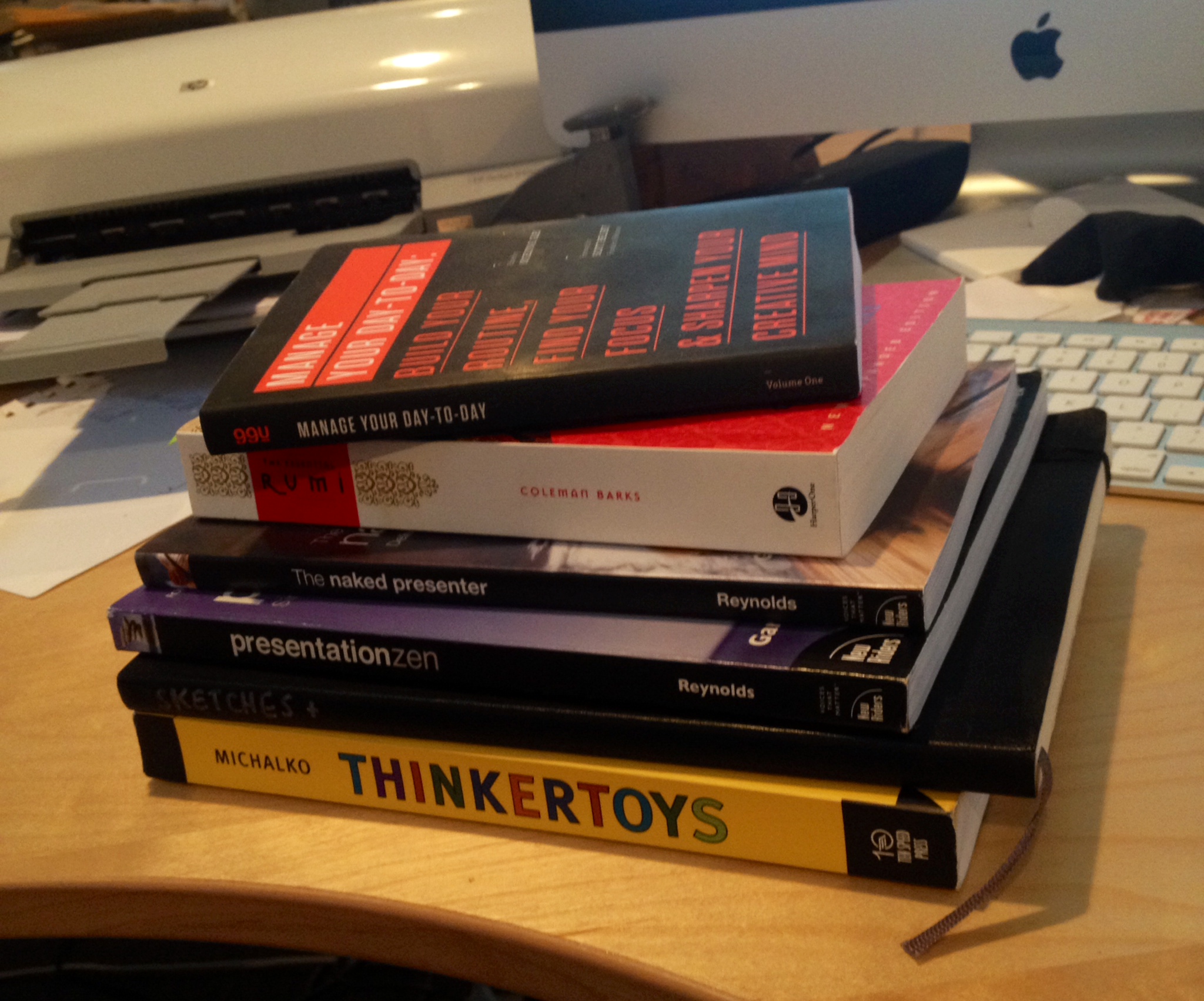
  1. Sometimes we get bogged down with solving the same problems with the same solutions (which isn’t really solving them at all, is it?). Thinkertoys, by Michael Michalko, is a collection of creative brain exercises to help you examine problems and opportunities from radically different perspectives. The exercises will seem odd and counter-intuitive, but they bear much fruit over the long run.
  2. Are you bringing your best energy to the most important part of your day? Manage Your Day-to-Day is a collection of short essays and articles from business and thought leaders (including Seth). It’s a very hands-on, “tactical” book that can help you reevaluate how you are spending your time. The chapters are short enough to read in 10 minutes, and they include summer pages and key takeaways. This book is really, really critical to putting all of the theory into action.
  3. I think everyone should have a collection of poetry nearby. This may be a little out there, but poetry engages a different part of our brain than prose, and in order to bring all of our resources to bear on our challenges, we should be willing to stretch our creative muscles (i.e., our brains) a little. I picked up an anthology of works by Rumi, who is a widely respected Persian poet and mystic from the 13th century. I read 3 or 4 poems a week, always out loud (the way poetry is meant to be read), just treasuring the way the words are strung together. (Note: you don’t have to understand poetry it to benefit from it.)
  4. These two works are combined into one resource: PresentationZen and The Naked Presenter, both by Garr Reynolds, are invaluable works on public speaking or “presenting” (read: “Preaching”). The quality of our message—whatever that message is—is repeatedly compromised by our inabilities to clearly and effectively communicate it. What’s more, our tendency is to add more— more slides, more images, more bells and whistles (animations? ugh)—when a better approach would be to take away. Clear the deck, so to speak. Provide space. Clarity. Reynolds ruthlessly shows how to arrange thoughts and information in ways that shout by whispering.
  1. Lastly, I present the lowly Moleskine sketch book. Early on when I began preaching, I instinctively began using sketches (as opposed to
    Moleskine // Jonah Sketch

    Moleskine // Jonah Sketch

    outlines) to develop my thoughts. As Mind Mapping has shown, our brain doesn’t work linearly, it works through “webs”, and to the degree that we try to visualize our problems with an outline or some other “linear” display, we are actually working against our minds. My sketchbook allows me to work with the brain’s natural tendencies, rather than against them. The next time you are trying to map a project or construct a talk, try sketching the ideas first, rather than outlining them. (Obviously, a nice white board works well too.)

These are just a few tools and tricks that help me approach my work from a more creative space. If you have any others, feel free to share them here.


+e


Here Be Dragons

On some ancient maps, unknown territories were marked by the phrase, “Here Be Dragons” (or as on this map, they Psalter_World_Map,_c.1265were simply drawn in). It was a way to alert people to the fact that beyond the pale, there was no way of knowing what you might encounter.

Silence and meditation—or mindfulness, ̛as it’s becoming known—is becoming popular spirituality, and its qualities are becoming widely known (I wrote it about a few months back). However, part of my experience with the practice of silence has definitely been along the lines of “Here Be Dragons.”

One of the first lessons I learned when I began to practice silence was that I was really good at covering stuff up. The noise in my life serves as anesthesia to the uglier parts of my soul. The more distracted I am, the less I need to look at the brokenness that flows through my life like a stagnant and rank river. Who wants to smell that? So I add more and more to my life, in the form of iPods, movies, television shows, Netflix, radio, iPhones, constant connectivity, and more and more meetings, people, and parties, all so I can ignore the junk. 

All so I can pretend the dragons don’t exist.

Silence and contemplation aren’t all peaceful, comfortable minutes of bliss.

For me, when I begin to quiet my spirit, my vision inevitably drifts beyond the known borders of my life, into the unknown.

Where the dragons are.

Does this sound overly scary or melodramatic? Maybe. I don’t know.

But I know that when you stop being distracted, stop numbing yourself, there’s nothing to take your gaze away from the stuff that lurks inside you.

Now here’s the good news.

When contemplation and silence is done right, you know you’re not alone. It’s tough sure, because lets face it, dragons are just scary (even when voiced by the oh-so-dreamy Benedict Cumberbatch), but we know that we don’t have to fear being crushed or destroyed, because … and this is amazing… 

God dwells beyond the borderlands as well.

Scripture tells us repeatedly that God is entirely at home silence, darkness, and wilderness. The monastics unabashedly declare, “Silence is God’s first language.”

All this adds up to the idea that, true, we may be strolling into Smaug’s lair, but we don’t walk alone.

It’s our job to sit,to quiet the distractions, and to find the scary parts of our souls.

But ultimately it’s God’s job to slay the dragons.


+e


Sometimes I Just Get Tired

In some way, I think I’ve always wanted to be a writer. Books, along with music, were my constant companions when I was growing up, and regular trips to the library are some of my earliest and fondest memories. It seemed as natural as the progression of days that I would someday write a book of my own, though I wasn’t exactly sure when.

Hint #1: I’m working on a book (actually two) right now.

Hint #2: Writing a book is really hard. 

On my way to writing more prose, I learned to become a songwriter. I’d written songs off and on in my twenties and early thirties, but in 2006 I decided to really throw myself into my craft, and managed to churn out somewhere around 30 or 40 in a few years. It could’ve been more, but I did the best I could.

Now, along the way the internet happened and, as writers like Seth Godin pointed out, everything changed: the world, as far as creators went, was on its way to becoming truly flat, and we could publish to anyone anywhere (as long as you could managed to get heard over the noise).

I started a blog somewhere in 2009 or so, and launched thisisericcase.com in 2013.

In other words, I was doing the same thing as about 60 million other people.

No big.

I read all the people—Seth, Michael Hyatt, and others—who gave the proper advice on “how to blog/write/self-publish/etc, and I’ve dabbled here and there with their suggestions. Overall it’s been pretty cool to see people read my words, and occasionally have them seem to mean something to people.

But lately…

Lately, I’m just tired.

I did a Strengths Assessment in 2013, when I discovered that though I have a high drive to collect information, my drive to create things—Tweets, blogs, books, songs, etc.—is not so high.

My nature works against my aspirations.

It’s hard work.

A dear, dear friend of mine told me the other day, “The truth is, I haven’t read your blog lately, because you’ve been a bit boring; I miss the times when you used to make me cry.”

They are right (this post isn’t about them; it’s about me). I’ve been a bit off. Writing doesn’t feel like the release and exercise in self-expression that it should be.

I guess I’m better at producing quantity, but it feels like more of a chore now.

This space is supposed to be about “Faith, Creativity, and Collaborative Leadership”. Lately, it seems that whatever is happening to me faith-wise is too subtle to name and describe (or that it’s simply to “small” and boring to relate). Creatively, I feel a little bit lost, as I’m in an “in between”. It seems that I’m slowly leaving music behind, but there’s really not anything else yet. There are sporadic sermons and Sunday creative endeavors, but not nearly enough to be engaging, and the books and blog posts… well, we’ve been through that haven’t we?

As far as leadership goes… hmmmmm… I feel less like a “leader” than ever. Someone once said that if you call yourself a leader but no one is following you, you’re just going for a walk.

What if you don’t even feel like you’re walking? What if you feel like you’re just crawling? Do leaders crawl? 

I can name dozens and dozens of men and women who are infinitely better leaders than I am, and mostly I’m left treading water to try and just “get things done” and see one or two people occasionally take steps to following Jesus more closely.

So what’s the point? Nothing really. It may be just an effort to write my “word quota” for the day/week.

I suppose I’ll get up tomorrow and write again.


10 Things My Mother Taught Me

I’m not going to speak for you: I can’t say what your mom taught you. But here’s what Margaret Vondelle Hearne Case taught me:

  1. It’s good to go to church (even better to be Methodist but hey I can’t do everything right).
  2. Try not to speak bad about anyone.
  3. Education is important; really important. So much so that you sacrifice—say your entire paycheck—so that you can send your son to a private university.
  4. Sometimes, cookies—in particular snicker doodles or peanut butter—do say, “I love you.”
  5. Even though it’s hard, you should never leave the room when your favorite team (in her case, University of North Carolina, the Steelers, or team USA in the Olympics) is in any championship.
  6. Always respect everyone regardless of culture or skin color. 
  7. Family is the most important thing.
  8. It’s never too late to heal and grow.
  9. Family dinners at home are really, really important.
  10. Never think too highly of yourself (I’m still working on this one)…

Happy Mother’s Day Mom!

Seth Godin and Spiritual Transformation

I read this from Seth Godin in one of my favorite books, Manage Your Day-to-Day: Build Your Routine, Find Your Focus & Sharpen Your Creative Mind

Lots and lots of people are creative when they feel like it, but you are only going to become a professional if you do it when you don’t feel like it. And that emotional waiver is why this is your work and not your hobby.

  • Substitute the word spiritual for the word creative, 
  • substitute the phrase truly transform for become a professional, and
  • substitute the word life for work… 

… and you have the secret to spiritual transformation:

Lots and lots of people are spiritual when they feel like it, but you are only going to truly transform if you do it when you don’t feel like it. And that emotional waiver is why this is your life and not your hobby. 

That’s why I believe that the best thing we can do as spiritual people is choose to become “professional Christians“, and do the work, day in and day out.


Two Questions That Have Governed My Spiritual Life

I am 45 now. Wow. Somehow, I am still coming to terms with that fact. Believe it or not, I am getting to the point where, every once in a while, I can claim to have a little wisdom. A few years of reflective, thoughtful living will do that to you.

Anyway, as I was reflecting on some current reading, I got to thinking about how you could divide my life, spiritually-speaking, into two phases. Each of these phases were marked by one governing question, and furthermore I think in my case they were influenced by age (or lack thereof).

Overall, I have a tension with sweeping generalizations: on the one hand they eliminate and minimize subtlety and detail; on the other hand they are remarkably useful in saying an awful lot with a few number of words.

With that in mind, I’d like to offer up the two questions that the spiritual/Christian life asks. They are not necessarily age-bound, but I believe they tend to be, because they simply require different modes of thinking that aren’t always available at certain ages. When we are young, we can afford to think dualistically or in black and white; the consequences just aren’t that great (I once quit a band because they wouldn’t go to the chord I wanted), and we can afford to have our world be as simplistic as we’d like.

As we get older, and (ideally) encounter more and more of the world in all of its diversity and complexity, most of us learn that binary, dualistic thinking just won’t explain what we are seeing. We see marriages fall apart, and though black and white thinking would have us blame “one or the other”, in truth we know that most of the time both parties have contributed to the hurt and pain that kills a relationship. We need a better explanation for how the world works (and one that fits with our Christian worldview, I might add).

So with that in mind, here are the two questions that I have heard from life:

1. How do I get to heaven? 

I grew up in the church, so it wasn’t a huge reach for me to start thinking about “heaven” and some kind of after life. As I’ve told a lot of friends, I prayed “the sinner’s prayer” at least a half dozen before I was 21; as I figured it, if there was a heaven (or hell), it sure couldn’t hurt to be sure I had that taken care of.

“How do I get to heaven?” definitely helped me ask some of the right questions, and it guided me to certain churches and individuals over time that helped me answer it.

However, there is a definite “on or off” nature to this question: you get to heaven by doing/believing X and Y.

It’s almost like a math equation, and to my mind at the time, a math equation was actually pretty comforting (as my wife likes to point out, one of the ways to calm yourself during an anxiety attack is to, ahem, do math problems). 

But I have to be honest: math gets old after a while. 

Furthermore, as I got older, life stopped asking me the “heaven question” over and over.

Things got complicated: marriages ended; children struggled; addictions reared their head; friends died unexpectedly; people lost faith (and in some cases found it again).

These things were all happening people who were indeed “going to heaven”—they’d got the answer to the question right—but the math equation was no longer relevant.

For a while, this caused a lot of despair: Was Jesus not enough to explain these very complicated, messy situations? 

We all needed a different question.

2. How am I supposed to live? 

Over time, the “heaven” question receded, and a new question took its place. This new question was not nearly as concerned with the math equation. In fact, the equation wouldn’t even line up behind this question, almost as if was a different discipline altogether:

“6-4 = the color blue”

This question has nothing to do with binary thinking; it embraces the complexity of life, without giving easy answers.

It’s content is qualitative, rather than quantitative.

It is not black and white.

Essentially, this question started to come up after I’d answer the first one fairly certainly: I knew I was going to heaven, that Jesus would embrace me when my time had come. However, what was really vexing me was trying to figure out why, given that truth, my life was still such a mess. 

Why was I still struggling with repetitive sin? Why was I still given to bitterness, cynicism, arrogance and a radical self-centeredness that threatened to consume everything I held dear?

I knew I was “saved,” but somehow that question no longer seemed relevant, and as I began to ask the second, some amazing things began to happen, first and foremost that I realized (at least for me) that answering the first question left me “in heaven” but really a passive actor in my own spiritual life. After all, I was in heaven now—why bother about “the rest of the stuff”.

To put it another way, I was a “good Christian”, but my heart (and certain parts of my life) was really a mess.

I was going to heaven, but I was taking a hell of a lot of baggage with me.

Maybe it’s normal, but I began to be less concerned with the first question, and really embraced the second. I wasn’t nearly as concerned with “doctrine” as I used to be, but much more focused on does this work? Does it transform me into someone who looks JUST A LITTLE MORE like Jesus than before? 

These are not black and white math problems.

These answers involve silence, meditation, focus, prayer, and embracing ambiguity (I am simultaneously a “sinner and a saint”).

Slowly but surely, I think it’s working.

Finally, there was something ultimately profound in wrestling with these two questions.

Focusing on the first question, doesn’t necessarily lead to the second. But when you focus on the second, most of the time you will get the answer to the first thrown in. 

You may get to heaven, but your life may never change or evolve.

If you focus on transforming your life, with partnering with God for your spiritual growth, you will most likely find yourself fit for “eternal life” (and what’s more, for the “eternal life now” that Jesus talks about in the gospels.

Our spirituality should always ask us the deepest questions; what is your spirituality or faith asking you?


+e