Words: “Good News” 

I like words. I’m fascinated with them, how they change, how they come into and out of daily use. (In fact, I believe I am solely responsible for introducing “wonky” into our vernacular.)

But some words, to me, are more important than others, particularly in regards to faith. In this realm, the stakes can be high, and also very much prone to mis-use and misunderstanding. I thought I’d spend some time here with some particular words that have may have drifted over the years. Now, these are good words: they are rich and full of meaning, but they have, in a variety of cases, been stolen, manipulated, abused and mis-communicated to the point where we are afraid of them, or just avoid them altogether.

The first word I’d like to look at is the word gospel. Now, this is a basic word, a “Faith 101” word. We think we know what it means, but it strikes me that maybe there are some nuances we might have missed over the years.

“Gospel” appears 95 times in the English New Testament. It’s sprinkled through the four gospels (though, strangely, not in John’s) and in the book of Acts. But it’s Saint Paul who really goes to town with it: it pervades every single one of his letters; he constantly mentions the word.

Growing up, I understood “gospel” to mean, “good news”. I was told that the good news was that Jesus died to set us free from sin: his death paid the price for my brokenness. We didn’t need to work to pay off our sins (in fact, we couldn’t). The subtle communication was that Paul’s “good news” was theological, and mainly focused on the Jews: they preferred the law over the freedom of the gospel. (I’m grossly summarizing, but you get the point.)

However, the more I learned and studied, I learned that gospel actually had a specific and more nuanced meaning in the first century (to Paul’s—and the Bibles—first readers)

In Greek “gospel” is the Greek euangelion, and that word had a particular use in the first century. Some people may be familiar with the definition “glad tidings”, but what most people don’t realize is that “gospel” was particularly used by the Roman empire to announce military and civic victories.

In other words, the first century already had a gospel, and it was decidedly Caesar’s. 

The word gospel was about who protected the world. Who provided ultimate peace and security for people who lived in the Roman kingdom. 

What this does, however is bring another dimension to our use of the word as well: a dimension of victory and celebration, of faith and peace.

“Gospel” isn’t only about grace versus the Law, it’s about a victory. It’s about who wins. 

(Hint: it’s love, and it’s Jesus.)

So, when Paul (and Mark as well) writes the word gospel he’s doing at least two other things (besides talking about grace). First, he’s drawing a contrast: the emphasis is on whose gospel. It’s not Caesar’s gospel, it’s Jesus’ gospel. Second (and relatedly), he’s saying Jesus is the one who provides peace and security. Don’t find security in the state, in the empire. Jesus is the one (the King) who provides for you.

The message of euangelion is that Jesus has won a victory, that he is King, and that he cares for his subjects. It’s not only about “believe and go to heaven” (though that is a nice benefit), it’s about a long-lasting existence in the Kingdom of Jesus.

Why I Don’t Give Up

Let’s be honest: there are a lot of reasons to throw in the towel on faith.

  • a book that is thousands of years old that is difficult to penetrate and understand
  • a God that claims to be good in the midst of a world that is torn apart with suffering and hatred
  • my own repeated personal failures (too numerous to mention)

(As Marvin said, “it makes me wanna holler, and throw up both my hands.”)

For a lot of people, that’s just a trifecta of negatives, and I’ve seen them check out of this “faith thing.”

If I’m honest, sometimes I’m tempted too.

So far, I’ve been able to hold on, and though I’m no great apologist, here are a few reasons why:

  • Though I can’t explain why, I know that we are more than “just” flesh and bones. I believe I have some unseen soul, and so I tend to it.
  • Though I have, in fact, failed countless times, I’ve come to the conclusion that only something supernatural can heal the sickness I have: only “letting the light” in (through those pesky cracks) will allow me to be a little less jealous, a little less self-centered, a little more patient, a little more peaceful today than I was yesterday (and we’ll let tomorrow worry about itself).
  • The Bible is, in fact, difficult in places to wrap my head around. That being said, there are some ways to “keep it simple,” starting with this guy named Jesus: he helps me make sense of the Bible.

All in all, I haven’t given up because I have this desperate faith and sense that it is possible to be a better human being, and I think one of the greatest gifts we can give the world is a person that has become as full and complete of a human being as possible.

And only faith gets that job done.


Just because #PeterGabriel


Be a Part of Shana’s Birthday…

Hey all…

Maybe you know my wife; maybe you don’t. Either way—she wants to do something pretty amazing. Here’s how she puts it:

Sabera was just entering school when we started sponsoring her. We originally did it as a way to teach our daughter about being generous and about other cultures.   It has turned in to much more than that.  We’ve been writing back and forth, learning about her, her family, friends and school, for well over a decade.   It was a letter she wrote last year that caused me to take pause.  She did something she’s never done before – she asked for something. She asked if we could meet her.

For the first time, another sponsor had visited her school and it must of touched her.   As I read her request it made my heart smile, and a little sad all at the same time.  She lives in East India – 1000’s of miles away.  Trying to get 2 of to see her would be a feat, so I dismissed it.   There is no way 2 of us can go to India! The thing is, the feeling hasn’t left me alone, and I’ve learned to listen to whispers of that sort.  She is graduating soon and will be leaving the program, so it is now or never.

I’ve taught my kids, “it doesn’t hurt to ask”, so now I am doing the asking.  Instead of birthday presents celebarting me and my life, I am asking you to be a part of the movement to help us meet Sabera; to celebrate her life.

I have a feeling the pictures of her smile will be a picture of pure joy.

Please take a moment and go here and see what she wants to do.

For now, I’d love to ask everyone to do two things:

  1. Consider being a part of this with us http://www.gofundme.com/a2jz0k
  2. Forward/Re-tweet to others who might want to participate.

Thanks!


========================


Wonder (again)

Without mentioning any names, I have an acquaintance who plays drums in a pretty well-known and successful rock band. Around 2003/2004, as they were ascending the charts and their popularity was really taking off, they played a concert at the Hard Rock in Chicago, and he gave me a couple passes to the show, which was pretty much sold out. Afterwards, he met me and a buddy down in the lobby to just say, “Hi” and touch base (I hadn’t seen him in a couple years).

As I walked up to him, he just gushed with gratitude and thanks that I’d come, “Wow, it’s so awesome that you came out!”

As I congratulated him on the band’s success he continued to seem almost overwhelmed by everything that was going on, and continued to thank me for coming out to see the show.

Meanwhile, I kept thinking, “This guy is totally ‘living it,’ and just played a sold out show and he is grateful that I came… for free?!??!”

His wonder and gratitude of what was going on in his life was so childlike and innocent. It blew me away, and it continues to haunt me to today. When I think about how ungrateful I am for my “normal” life, I am convicted. When I refuse to see the wonder and beauty of my life… the moments in lifetimes—weddings, funerals, baptisms—I get to share, when I get to see people grow and become more like Christ, when I get to see people find their vocation and then embrace it… all of these things are miracles in and of themselves, yet I choose to overlook them for something else “out there”. 

It’s a rejection of grace, in a way.

One of my favorite—and most convicting—quotes about wonder is from Abraham Joshua Heschel:

“Never once in my life did I ask God for success or wisdom or power or fame. I asked for wonder, and he gave it to me.”

Which comes first? The success or the wonder? I’m beginning to think that success follows wonder, rather than the other way around.

Some New Music: “The Stumble Sessions”

The Stumble Sessions

The Stumble Sessions

Hey all…

During my sabbatical earlier this year I decided to go into the studio with some good friends to document some songs and ideas that had been stirring and stewing in my soul for a while.

I’m putting the results on Bandcamp; you can click here to find them (hope you like them!)

A few are straight-up corporate worship songs. A few are ideas that are meaningful to me in other ways. At least one blurs the line; I leave it up to you to put them into categories if you’d like.

To me it’s just music that comes from a place inside me called, “Soul”.

I’d be lying if I said we didn’t have fun laying these down; they represent some guitar tones that a man my age should have no business toying with, but nonetheless it’s what was required, and I’ve never been known to say, “No” to a fuzz pedal.

Enjoy.

Full-disclosure #1: I’m selling all of these for $4. But I sure would like to make more music (which costs money), so IF YOU’D LIKE TO SPEND MORE than $4, please feel free. Everything goes into the “Let’s-Make-More-Music” Category of our zero-based budget.

Full-disclosure #2: I would love to have these songs reach a bunch of people, if for no other reason than the sheer fun of having people hear it. So feel free to re-tweet/share/like etc.

Full-disclosure #3: Two of these songs will appear in a few weeks on my home church’s worship CD. I have to be honest.

Please enjoy the tunes either way.

+e

Good Friday, 2013

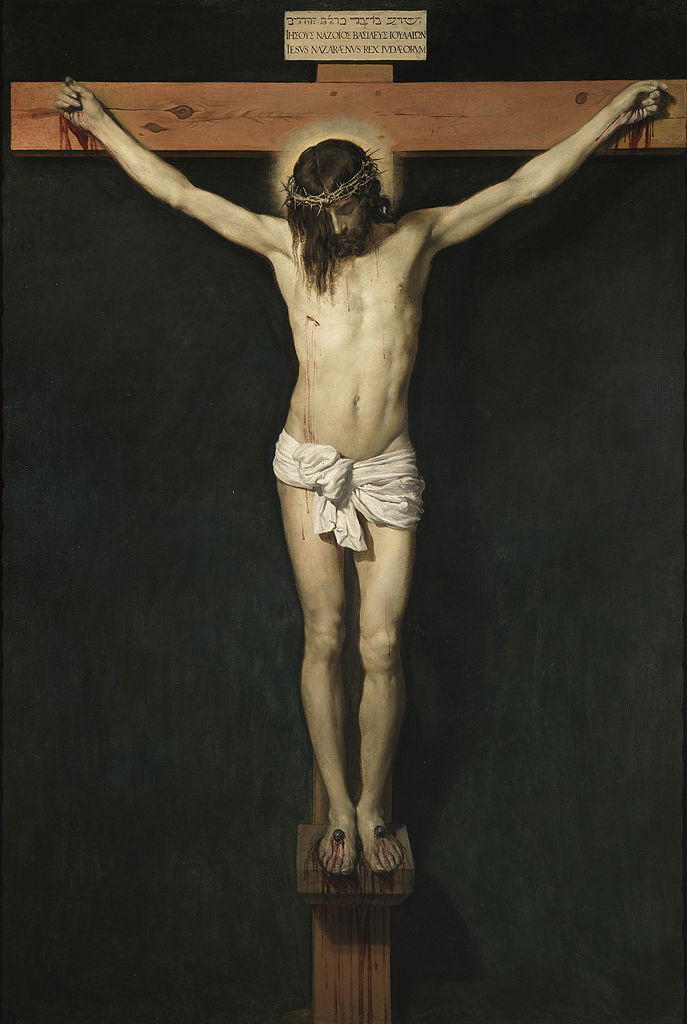
Cristo Crucifado by Diego Velásquez

Cristo Crucifado by Diego Velásquez

There’s lots that I could say today.

But I’ve decided I really won’t.

My words pale in comparison to the response that this day deserves. So just this: stumbled across this quote yesterday:

Jesus Christ is born in a stable. He has to flee to Egypt. He passes thirty years of his life in the shop of a craftsman. He suffers hunger, thirst, weariness. He is poor, scorned, abject. He teaches the Kingdom of Heaven, and no one listens to him. All the great and the wise pursue him, take him, and make him suffer frightful torments. They treat him like a slave, make him die between two thieves, after having preferred a thief to him. That was the life that Jesus Christ chose, and we, we have a horror of the slightest humiliation.

– François de Fenelon

Christian folk: find yourself a space today to sit in front of the cross of your Savior. Take some time to think on him, and to thank him.

Because no one really did at the time, and now we know better. Or should.

============================================

The Sin of Narcissism, The Narcissism of Sin

Narcissus, by Caravaggio. Image from Wikipedia Commons

In the legend of Narcissus, a youth who is consumed with his own beauty is tricked into gazing at a reflection of himself. Unable to leave the beauty of the reflection, he eventually dies.

——————-

As I wrote a few weeks ago, in a very real way I think the key to spiritual growth is found in Colossians 3:1-16, particularly verses 1 and 2:

Since you have been raised to new life with Christ, set your sights on the realities of heaven, where Christ sits in the place of honor at God’s right hand. Think about the things of heaven, not the things of earth.

I really do believe that the source of spiritual growth is in fixing our hearts and minds on  “realities of heaven”. This “prime mover” drives all of our disciplines—meditation, service, confession, etc.—and keeps them from disintegrating into mere outward motions.

But what happens when we stumble, when we sin?

One of the unexpected effects of brokenness in our lives is that it short circuits Colossians 3:1-2. Instead of focusing on critical things like “tender-hearted mercy, kindness, humility, gentleness, and patience” (3:12), we instead focus on us, specifically our brokenness and shortcomings. Ironically, this may lead to more difficulties, because we’ve turned our gaze away. We ponder our own shame, the consequences of our sin, what we might do differently.

But in all of this we’re looking at ourselves, not God, not heaven, not Jesus. We’re not listening and/or watching for the Holy Spirit.

We become sinful narcissists.

Sin surely should trigger sorrow and regret. Our repentance surely should involve a conscious “turning back” towards God, and a renewed appreciation of the cross and God’s mercy.

But we should be determined to not let our confession and repentance descend into narcissism. As we make our confession and repent (turn), we need to make sure we don’t become consumed with our brokenness, our mistakes, our sin. We need to get our eyes back “up”, back to the Father, Son, and Holy Spirit.

We don’t live and grow by focusing our depravity; we live and grow by fixing our eyes on the realities of heaven and following God’s Spirit, even through our mistakes and brokenness.

Easter, from John Chrysostom

St. John Chrysostom’s Easter Homily, circa 400AD

Easter Homily

by St. John Chrysostom

Let all pious men and all lovers of God rejoice in the splendor of this feast; let the wise servants blissfully enter into the joy of their Lord; let those who have borne the burden of Lent now receive their pay, and those who have toiled since the first hour, let them now receive their due reward; let any who came after the third hour be grateful to join in the feast, and those who may have come after the sixth, let them not be afraid of being too late; for the Lord is gracious and He receives the last even as the first. He gives rest to him who comes on the eleventh hour as well as to him who has toiled since the first: yes, He has pity on the last and He serves the first; He rewards the one and praises the effort.

Come you all: enter into the joy of your Lord. You the first and you the last, receive alike your reward; you rich and you poor, dance together; you sober and you weaklings, celebrate the day; you who have kept the fast and you who have not, rejoice today. The table is richly loaded: enjoy its royal banquet. The calf is a fatted one: let no one go away hungry. All of you enjoy the banquet of faith; all of you receive the riches of his goodness. Let no one grieve over his poverty, for the universal kingdom has been revealed; let no one weep over his sins, for pardon has shone from the grave; let no one fear death, for the death of our Saviour has set us free: He has destroyed it by enduring it, He has despoiled Hades by going down into its kingdom, He has angered it by allowing it to taste of his flesh.

When Isaiah foresaw all this, he cried out: “O Hades, you have been angered by encountering Him in the nether world.” Hades is angered because frustrated, it is angered because it has been mocked, it is angered because it has been destroyed, it is angered because it has been reduced to naught, it is angered because it is now captive. It seized a body, and, lo! it encountered heaven; it seized the visible, and was overcome by the invisible.

O death, where is your sting? O Hades, where is your victory? Christ is risen and you are abolished. Christ is risen and the demons are cast down. Christ is risen and the angels rejoice. Christ is risen and life is freed. Christ is risen and the tomb is emptied of the dead: for Christ, being risen from the dead, has become the Leader and Reviver of those who had fallen asleep. To Him be glory and power for ever and ever. Amen.

Amen, indeed.

(found at http://www.ewtn.com/faith/teachings/resub1.htm)

Holy Week :: Holy Saturday and Rock and Roll

I used to know you for a long, long time
I felt your heart beat inside mine

We were together for three good years
Now all I have is a blanket of tears

Stuck inside a Saturday rain
Scared things won’t ever be the same

So I’m waiting on love
Waiting on love
Waiting on love… to come back down

Walk resurrection,
Sing freedom songs
Tell all of your brothers and sisters…
Come along

I used to know you for a long, long time
I felt your heart beat inside mine

For any Maida Vale fans: A little insight into “Walk Resurrection”.

I wrote this song for Holy Saturday…

A place between grief and hope, between promise and fulfillment.

Between Jesus’ death and the promise of the Holy Spirit.

The song started out inspired by a cover of “Glad and Sorry” by Golden Smog (a midwestern Americana “super group” including Jeff Tweedy and members of the Jayhawks).

But we really, really struggled with the song, with trying to make it sound and feel like “Maida Vale.”

At one point it had ballooned into 60 recorded tracks of music, including African choirs, and multiple keyboard parts (in one moment of inspired lunacy, we actually did a remix!).

But we didn’t give up on the song. We deconstructed it and rebuilt it from the ground up, taking inspiration from the blues, White Stripes, and something more primal.

For the vocal/guitar session (simultaneous, absolutely live, and one take), I had actually never played the version before. I had a vision in my head, picked a tempo, and told the engineer to start recording.

Today: reflect a little while longer…

Tomorrow: Walk Resurrection. 

Walk Resurrection

Brennan Manning on the Cross

In 1963 a friend gave me an expensive crucifix. A French artist had carved in wood, carved very delicately, the hands of Jesus on the cross. On Good Friday the Roman artists carved—O God, how they carved!—our brother Jesus with no trouble at all. No art was needed to bang in the nails with hammers, no red lead to make real blood gush from his hands, feet, and side. His mouth was contorted and his lips twisted simply by hoisting him up on the crossbeam. We have so theologized the passion and death of this sacred man that we no longer see the slow unraveling of his tissue, the spread of gangrene, this raging thirst… Jurgen Moltmann writes, ‘We have made the bitterness of the cross, the revelation of God in the cross of Jesus Christ, tolerable to ourselves by learning to understand it as a necessity for the process of salvation.’ (Brennan Manning, The Ragamuffin Gospel)