Trump vs. St. Paul, Round 1

trump-make-america-great-again

It’s election year in United States, and the other day I was having a conversation with my spiritual mentor about the current state of politics in our country. Quite frankly, it’s difficult for me to listen to any of the candidates talk because nobody seems to be interested in talking about any policies or worldviews that are not short cited, or too simplistic and nationalistic solutions to complex into related problems. I don’t feel like anyone speaks for me or to me., And that’s just the reality. Parentheses on a more positive note, I was listening to a the Ted Radio Hour recently that advocated looking at the municipal level-mayors, council people, etc.-to see a place where politics is still working in United States. If you’re interested check it out Ted Radio Hour).

Donald Trump is a decidedly disturbing presidential candidate to me. To be quite honest, with his nationalistic and practically fascist statements he reminds me of the rise of Hitler. However, I was thinking recently about his campaign slogan, “Make America Great Again,” and it struck me how odd the slogan is. It’s easy to say “let’s make America great again”, but it’s also just as easy to ask, when was America great? Were we great in the 1950s and 60s when we were oppressing people of color in our country? Were we great in the 1980s, when we were struggling to keep up with the environmental damage done by unregulated factories? I’m not saying our country isn’t great. I love the United States, and still cry profusely whenever I sing the national anthem. I am blessed and grateful to have grown up here. But life isn’t about making America great. Life is about simply being the best citizens we can be and trying to make this world a better place. But there’s something at stake that’s even more significant, and that is the question of where we put our ultimate trust. America doesn’t need to be great for me to have a great life. My trust is placed somewhere else. This is not a new thing.

In Paul’s firsts letter to the church at Thessaloniki, he makes a decided dig against the nationalistic leanings of the Roman empire. He makes a remark about people claiming peace and safety when there is none and then a change will come instantly. Though it’s easy to assume that this is somehow about the end of times, it’s enlightening to realize that peace and security was actually a political slogan of the Roman empire, and what Paul is actually doing here is confronting people with the question of where they put their faith. If you decide to put your faith in the Roman empire  (or the United States) you will be decidedly shocked and disappointed when that empire is incapable of really protecting you. The only Kingdom where we have actual security is the Kingdom of God. Granted, that security isn’t always tangible or evident, but ultimately God is calling us to a deeper security, based in eternity.  Regardless, it’s a great reminder that neither our trust nor our security comes from any earthly “greatness”. America can be great (if it decides to take care of the least of these and the outcasts) or it can be not great. Either way, I am called to live my life wisely, to do my best to provide for my family, but most of all to place my trust in a King and Lord whose name is not Cesar nor Trump nor Mr. President.

Please get here soon election day; let’s get this over with.
+e

Clean Cups, Clean Hearts

Jesus is pretty ambivalent about housekeeping.

In a few different episodes, he takes religious leaders to task about their emphasis on external/irrelevant purity in comparison with the more difficult (and necessary) task of personal, INTERIOR life change.

In one instance, he puts it in terms of washing dishes: don’t focus so much on the cleaning the outside of your cups (the part that everyone can see), when what is inside the cup is so filthy and corrupting.

In another instance, he contrasts the cultural/religious emphasis on avoiding certain foods (again, what everyone can see) with the thought that it’s not what goes INTO a person that corrupts them, but rather what comes OUT of hearts (and mouths) that breaks us down and hurts ourselves and others.

It seems to me that Jesus is clear on his priorities: internal, SPIRITUAL growth and transformation as opposed to mere external (and sometimes arbitrary and artificial) holiness.

But “bad religion” has a peculiar habit of falling back on the externalities whenever it fails at the harder interior work. Sometimes I feel like the church in North America, with its uncomfortable alliance with consumerism, nationalism, and comfortable affluence, has fallen prey to this peculiarity.

I think it haunts us as a people: our spiritual systems and theologies that demand little to no life change have failed to produce the internal, heart-level transformation that Jesus is looking for (and that secretly we all crave), and so we do what religion has always done: We look at external “markers” of holiness.

It’s not malicious, it’s just the way religion works.

Cups are easy, hearts are hard.

I’m not saying I’m not guilty of this, by the way. I know that I fall victim to it again and again. But somewhere along the way I got tired of washing dishes. Somewhere along the way I decided to let Jesus challenge the deep things in my heart: my pride, my selfishness, my self-centeredness, my narcissism, my arrogance.

I decided to give up control and let Jesus fight those battles.

“Are you still so dull?” Jesus asked them. “Don’t you see that whatever enters the mouth goes into the stomach and then out of the body? But the things that come out of a person’s mouth come from the heart, and these defile them. For out of the heart come evil hearts—murder, adultery, sexual immorality, theft, false testimony, slander. These are what defile a person; but eating with unwashed hands does not defile them.” (Matthew 15:16-20)


+e


Into the Silence

HNCK0599

In just a few days, due to the amazing generosity of people in my life, I am driving up to the Monastery of the Holy Spirit, outside of Atlanta, Georgia, for a few days of solitude and silence.

This particularly monastery is a Trappist (or Cistercian) monastery. Now, there are different monastic orders: Franciscans, Benedictines, etc. From what little I’ve learned, the different orders have different emphases: study, poverty, service, etc. Broadly speaking, the Cistercians are focused on prayer and silence. They are not the “most silent” monastic order—my understanding is that the Carthusian monks get that distinction—but silence is a major theme of their life. When you are at the monastery, visitors are generally expected to eat in silence and to talk very quietly, and then only when necessary.

In other words, this is not a place that  is interested in reinforcing my life “as it is.”

If you know me at all, you’d think that my introverted self would be chomping at the bit for this: silence and solitude! No people! Woo hoo!

Well, you’d be wrong.

In a way, I am absolutely eager and ready to go. I am hungry for this, and have been trying to get something like this to happen for months now.

But in other ways, more than ever I know that (a) wherever you go, you bring yourself (or your SELF), and (b) when you really get alone and quiet, you can easily encounter some of the uglier parts of your soul.

As I’ve written before, the “solitary chair”” can be terrifying, because most of us subtly surround ourselves with enough noise to keep us distracted from the real issues in our lives: our brokenness, our deep emotional/spiritual struggles. There are simply things we do not want to see, confront, or deal with.

Silence exposes those things.

On one hand, going away to someplace like a monastery or a campsite or wherever seems like an easy exercise in getting away from the noise of life. But for me, I need to be honest with myself and admit that I can easily carry other “noise” with me: books, music, and my “monkey mind.”

Noise doesn’t always look like Netflix and McDonald’s.

So next week, I am traveling with the absolute bare minimum: no computer, a journal (handwritten!), only the Bible and 1 other text.

My choice is to let God speak and to not distract myself. To try and go deeper, to the next level of foundation in my spiritual life. I want to see more clearly: both God, Christ, other people, as well as my own brokenness and shortcomings.

This is not necessarily something to look forward to.

But I do know that I need it.

(You do too.)

I’m hoping for a deeper revelation of love; a deeper experience of healing and peace; and more centeredness, loving detachment, and clarity in my life.

But I also realize that what I carry into the monastery (including expectations) is not what might be waiting for me. So I hold all of those things loosely, and say (as Mary did), “LET IT BE DONE TO ME.”

If you’ve never gotten quiet and taken the time to really let God speak to you, I’d say (1) I understand; it’s probably pretty scary, and (2) what are you waiting for? 

As C.S. Lewis said of Christ, “No, he’s not tame: he’s dangerous… but he’s good.” 


+e


How Weird WAS Jesus? 

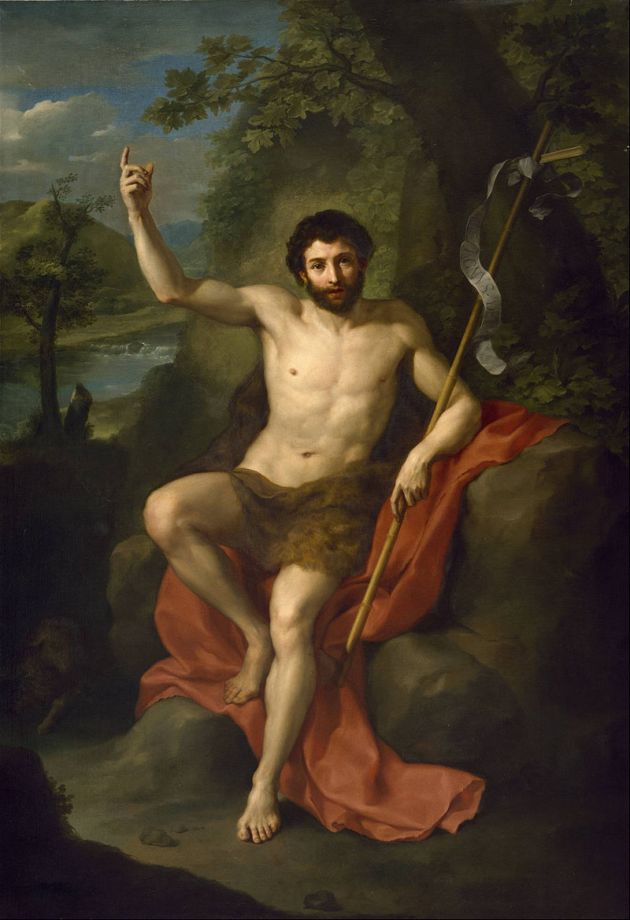
Anton_Raphael_Mengs_-_St._John_the_Baptist_Preaching_in_the_Wilderness_-_Google_Art_Project

“St. John the Baptist Preaching in the Wilderness” by Anton Raphael Mengs

I was reading a book recently by a popular Christian leader, and he had this to say about John the Baptizer:

Several things about John stand out right away. He was an unusual dresser with strange eating habits. Just in case you’re uncertain, wearing clothes made of camel’s hair was not the height of fashion, even during the time of Jesus. We are told he ate locusts and wild honey. I suppose the wild honey was to help get the locusts down. (Erwin McManus, The Barbarian Way)

Overall, I get what the point he was trying to make: John (as well as Jesus) was a provocative character. However, I think McManus overlooked a crucial point. First, this is what the New Testament actually says about John’s dressing habits:

In those days, John the Baptist came, preaching in the wilderness of Judea…. John’s clothes were made of camel’s hair, and he had a leather belt around his waist. His food was locusts and wild honey. (Matthew 3:1, 4-6)

Second, Jesus has this to say about John:

For all the Prophets and the law prophesied until John. And if you are willing to accept it, he is the Elijah who is to come. (Matthew 11:14)

Lastly, notice this description of Elijah—a prophet—from the Hebrew Bible (our Old Testament):

‘He (Elijah) had a garment of hair and had a leather belt around his waist.’ (2 Kings 1:8)

When you consider the thread between those three passages, you begin to notice that something else may be going on which is  a bit beyond the outsider, “barbarian” nature of faith (which I happen to believe in, by the way). If John was conscious dressing like Elijah—and I believe he was—the Baptizer wasn’t merely trying to shock people; he was trying to signal something to them, namely, here comes a prophet. 

Prophets were a unique breed in Jewish culture; they showed up to put the people (and, more specifically, the religous and political leaders) on notice that they had strayed from the Instruction (Torah), and (most often) that they were neglecting the poor and the outsider. Moreover, prophets tended to embody their message, meaning that they didnt’ just speak or write it; oftentimes they acted it out, in sometimes disturbing (and thoroughly gross) ways: nakedness, human feces, and broken pottery were involved.

When you understand the message that John was bringing to the people around Jerusalem, it’s pretty easy to see that he (and later his cousin, Jesus) saw himself as carrying on that tradition.

So when the people of Jerusalem came down to the Jordan river, their reaction actually wasn’t, “Wow this guy is weird.” Rather it was more like, “Wow, there’s a prophet!”

John made perfect sense in his context.

However, as I thought more about this passage and what it said, I actually became troubled on a different level. I started to wonder what this approach to people in the Bible (“Wow these people were weird! They were like from another planet! You wouldn’t even know what to do with them!”) actually says about God and His mission in the world.

You see, the more that we turn people in the Bible into something resembling spiritual space aliens, the easier it is to convince ourselves that there is something unique and special about “those people,” something that we ourselves could never measure up to.

Nothing could be further from the truth.

One of the names that Jesus embodies for believers is “Emmanuel”, or “God-With-Us,” and that phrase means everything, because it is the essence of the Gospel: God enters into humanity, takes on our limitations, embraces our junk and dirt, walks through the muck and the mire of life on earth and ultimately says, “You are okay.”

As Church father Athanasius put it, “God came down to humanity in order to raise humanity up to God.”

Let me spell it out clearly: The Incarnation (“God-With-Us”), along with the Biblical record, means that Jesus (and John the Baptist) made perfect sense in his context. It means that God is somehow perfectly at home within humanity. Now, it doesn’t mean that Jesus wasn’t provocative, or that he didn’t stretch people’s perceptions or understandings.

But he certainly wasn’t a space alien.

Furthermore, the message here is that in a way we are in the same boat as John the Baptist, or even Jesus: John wasn’t a space alien; Jesus wasn’t a space alien… neither am I, and (presumably) neither are you.

God uses normal human cultural context, and “normal” human beings, to bring about amazing, unforeseen changes. Even as a prophet, John made perfect sense in 1st century Judaism.

You make perfect sense in the 21st century.

What does God want to do through you?


++++++++++++++

9 BOOKS I’M EXCITED ABOUT READING in the first part of 2016


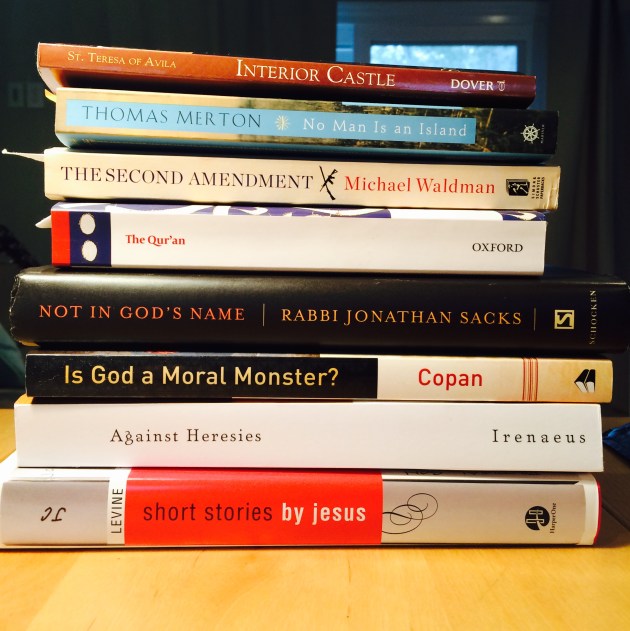
FullSizeRender

I’m almost embarrassed about the numbers of unread books I have in my house. I have a pretty voracious curiosity, and sometimes before I consume a book totally (I’m not the fastest reader), my attention moves on to something else.

So here is a short list of books that I currently already own, but haven’t read yet. Maybe you might want to read one or two as well…

  1. Not in God’s Name: Confronting Religious ViolenceI love what Rabbi Sacks is highlighting with this book, namely (and I am greatly paraphrasing here) that the solution to religious violence (whether perpetrated by Jews, Muslims, or Christians in particular) can only be found in religion as it is properly understood. He shows how the “Abrahamic Faiths” (Muslims, Jews, and Christians) all share a story of a God who is radically inclusive and accepting. So far, this is inspiring and engaging.
  2. The 2nd Amendment: A Biography. As a self-avowed pacifist and (at least) “non-gun-owner”, the 2nd amendment—and specifically how it has been co-opted by the NRA to fight any type of gun control legislation—is pretty interesting to me. Waldman shows how the original amendment was written to balance “standing armies” and “well-regulated militias,” as well as how the 2nd Amendment took a significant turn (in regards to gun ownership) relatively recently.
  3. Against Heresies. St. Iranaeus was a bishop and church father from the 3rd century. His theology has had a significant impact on me personally, and I’m reading this in order to get things straight from the source, so to speak. The gist of his theology is a bit too deep to get into here, but suffice it to say that Irenaeus emphasizes spiritual growth and transformation in such a way that I think will be significant for the 21st century.
  4. Is God a Moral Monster? Copan tackles one of the more difficult subjects in the Bible: namely the apparent sanction of war and even genocide in the books of Joshua and Judges. Haven’t read too much of this yet, so I don’t have much to say, except that Copan appears to show that those “sanctions” or endorsements aren’t quite as clear-cut as we’d like to think.
  5. The Qur’an. Ever since the rise of ISIS in 2014, I’ve been trying to better understand Islam. (A super helpful book, by the way, is called The Great Theft: Rescuing Islam from the Extremists by Khaled Abou El Fadl.) One of my theology professors told me that he reads the Qur’an every year in order to have profitable conversations with Muslims, and he offered a reading plan that would help me navigate the text.
  6. Interior Castle. St. Theresa of Avila wrote this masterwork of Christian mysticism and prayer. I started this in November as part of my morning prayer time.
  7. No Man Is An IslandThomas Merton (along with Brennan Manning and Henri Nouwen) is one of my “g0-to” writers for meditation and contemplation. God continues to use him to challenge me to let go and become better at detachment. I read him constantly through the year.
  8. Short Stories by JesusAmy-Jill Levine is a professor at Vanderbilt Divinity School. She is the “next-level” in understanding Jesus in terms of Jewishness (Levine is Jewish). She brings a thoroughly fresh (and often very challenging) perspective to the parables and stories of Jesus. Really great stuff.
  9. The Ninth Book I’m excited about is the one I’m going to write this year. I have a few things “in process”, and this year is going to be about overcoming “The Resistance” and pushing through the end of this. It’s time to produce. To Make Stuff.

So this is how I’m starting my year; I invite you to engage with any of these with me, and let me know what you think!

What I’ve been up to (or “A Requiem for 2015 and Words for 2016”) 

Well folks, it’s THAT day. January 1. First day of the year. The “threshold day”, where you can look back at what was and look ahead to what might be.

In between. Liminal. (One of my favorite words, btw.)

It’s as good a day as any to set some words down and send them out into the inter-worlds.

What have I been up to? Where have I been? What will I be up to?

These are the questions I’m thinking about today, and the first few days of 2016.

What have I been up to?

Healing, mostly. Doing a lot of “soul work.” Mining in the darkest places (my heart and yours, folks) for the stuff that has been driving and haunting me for most of my life. I find them down there in the caverns and tunnels and nooks and crannies of my memory and consciousness, and then I haul them (with a fair amount of sweat and tears) up to the surface where they can lay in the sun, where the most amazing thing happens…

Because there they get changed. It’s funny how when the sun strikes something it changes it. If you hold it up to the light, it changes to light.

Things are healed and transformed. Wounds become scars which become stories which become the means by which we offer the world around us hope and healing and strength to go on for another day.

Trouble is, most of us don’t like to go to the mines… Mines are, by nature, dark, scary, and places of sweat, toil, and really hard work.

But that’s where the coal is. (And the diamonds.)

I’ve also been finishing Seminary. I shut down almost all creative output (“making”) around June/July in order to focus on the essentials: teaching and music on Sundays, being a husband/father, and cranking through the last few hours of my masters degree.

I ran a little bit more in 2015 than I ever have before. I ran two races: the first was a 10k in March that was difficult (actually, it kicked my butt), but I managed to finish without too much difficulty.

However, I had also committed to running a half-marathon in 2015, so on October 31 we drove up to Boston, Georgia, and I started running. Two and a half hours (and 13.1 miles) later, I staggered across the finish line, exclaiming, “This is the stupidest thing I’ve ever done.”

In a few ways, it was, but in many ways it was actually one of the more profound experiences of my life. I learned that the limits that we impose on ourselves are often more illusory than we believe. We can push back on the boundaries (some of which we impose on ourselves, some of which are imposed by others), and accomplish much, much more than we otherwise think.

I also learned that the only race you can run is your own. You can’t worry about other people. I was passed by grandmothers, and I passed teenagers. I learned that I had no control over what other people did: I could only put one foot in front of the other.

Lastly, I learned that, well, sometimes you can’t be “cool.” When I was pushing through the last 3 miles of that race, I had gone well beyond what I thought I was capable of, and I started breaking down, both physically and emotionally. I was in a fair amount of pain, had nothing left in the tank, and couldn’t see the finish line (at least in part because I run without my glasses), and I was on the verge of tears.

But I kept going, and the more I ran, the less I was capable of thinking about what other folks thought of me. For a person who admittedly makes “image” a part of their life (due to a calling that puts me on stages and in pulpits in front of people), this was really significant to me. I had no control over my image. I was a mess.

And I was okay.

I survived, and stumbled across the finish line, and lived to tell the tale.

So that’s a little bit of my 2015.

Looking forward, I have some thoughts about going into 2016. I’m not going to share all of my personal goals (at least yet), but here are some things that I’m passionate about, and that I’m challenging myself (and maybe you as well) to this year.

CHALLENGES for 2016

  • Seek beauty. Start with Hymn to the Cherubim (those Orthodox!)
  • Seek wholeness. Go to the mines yourself. The world desperately needs people who are on the journey towards healing, wholeness, transcendence, enlightenment. They don’t just need a holy club that’s going to heaven. They need (as Jesus would put it), people who are producing “fruit” (and fruit, on the whole tastes good). So go see a counselor. Get quiet. Become aware of the “thoughts” you’re having that aren’t really thoughts so much as they are reactive video tapes.
  • Elevate your thinking. Don’t be satisfied with what the media tells you (whether you are partial to FoxNews, MSNBC, Huffington Post or the Drudge Report). Look beyond the headlines, and evaluate what you hear and read. Have a conversation that makes you think, and that helps you consider something from another point of view.
  • Make something. The only way we are going to impact the culture is to make more of it. I’m paraphrasing author Andy Crouch, and I fully believe in it. The world is not going to change and evolve on its own; and spiritual people are called to help this world grow in love, compassion, and connection. So, write a blog; make some music; make some peace; make some crafts and give them away. Bless the world. 
  • Read something spiritual. Every day. My choice is the Bible, among other things, but you get the point: embrace Spiritual thinking and a Spiritual mode of being in the world.
  • Walk a little. Get physically healthy. We are unified beings: our physical health affects our spiritual health which effects our emotional health which effects our physical health and so on and so on.

So here we go, 2016! Let’s do this people!

Five Books That (Re) Shaped My Spirituality

I don’t know if you’re looking for something to read (I know I always am), but I thought I’d share some reads that have been pretty foundational in my life.

These five books really were responsible for some “left turns” in my life. They marked pretty large “sea changes” in my spirituality and belief. If you’re looking for something to challenge (and maybe even change) you, maybe pick them up and give them a read. Let me know what you think.

  1. Signature of Jesus. This book really changed the whole game for me. I’ve written about this before, but I just can’t begin to describe how much this book impacted me when I first read it. It called me deeper, beyond merely nodding “yes” (or shaking my head “no”) on a Sunday to a life of pursuing the rabbi from Nazareth. (Note: I’m still stumbling along.)
  2. Adam’s Return. I actually just read this a couple years back, but this was one of my initial exposures to Richard Rohr. More significantly, however, this was a powerful description of mature, Biblical masculinity. Though I read a lot of the popular evangelical attempts at this (Wild at Heart being the most popular), there was something in them that didn’t ring true to me. I could understand the barbarian/warrior metaphors but I also felt like they had a tendency to be destructive in my life. Rohr takes masculinity to the place where it most needs to go: to the cross and into the baptismal waters with Christ, and shows how our masculinity needs to be transformed—particularly in the vein of ego surrender and death to self—so that we can grow (old?) gracefully.
  3. The Illumined Heart. This little book was my introduction to the Eastern Orthodoxy. It was also a pretty significant step forward in my quest for a practical spirituality, an approach to faith that can be lived out in every day life.
  4. Surprised by Hope. Though I’d read a couple NT Wright books before, this was really the first one that catalyzed my understanding of his theology and started to re-shape my own. To be brief, Wright refutes the “practical gnosticism” in the church today that states that our ultimate destination is some kind of disembodied heaven. Wright reminds us that the Biblical view is that of resurrection. Our bodies matter; this world matters. When you understand that the point is not for us to be burned up, or that God’s just not going to throw the earth onto a trash heap, you realize that what you do now—whether it’s justice or art, discipleship, or service—has implications into eternity.
  5. The Divine Conspiracy. This book is a bit deep, and not always the easiest read, but this book planted inside me the revolutionary truth that Jesus wants to live his life through me. Spirituality is not “out there”, and Christianity is not something that is only lived through “special people” or “holy lives.” Rather, my life, right now, is where God wishes to take up residence.

So there they are. If you’re looking to open yourself up to some new ideas and/or new approaches to God and spirituality, I challenge you to dig into one (or more) of these.

Let me know how that works out for you…

Beck Spills Some Musical Truth

“It’s never for the glory, it’s for the satisfaction of blowing up a gig. a lot of people are satisfied with a video. Those who aren’t satisfied with a video will buy the album, and then there’s a few who get the album who will go to the show. That’s where it’s human beings, and that’s what we live for. That’s where it gets sick. If it’s all on video or all on record everything is proper and everyone is minding their manners. We like to get in there and cause a commotion. That’s music; that’s the way it’s meant to be.” Beck.

I love this quote. It actually came off of a show called Sessions at West 54th that used to air back in the 90s. It featured really great bands and musicians  playing absolutely live and in the round. It was an intimate venue that allowed great artists to put killer abilities on display.

At some level I will always be a live musician. I used to be intimidated by the studio, but got over that fear (thanks to a lot of work with a metronome, amongst other things), but it still always comes down to the live event, the exchange of sweat and blood and volume and energy that happens when you’re just pouring it out on a stage, and people are soaking it up and nodding their heads up and down and moving with energy. It’s always great to just let the moment take you, to throw aside perfection in favor of the power of a moment.

That’s still where it’s at.

“Give Me That Old Time Religion…” 

“Religion”, in and of itself is not a bad thing. Remember: the word itself can mean “re-connecting” (re-ligature), and don’t we all need some sense of that?

Reconnection with our heart, soul, mind, bodies?

Reconnection with a power that is greater than ourselves? Reconnection with each other?

I don’t know about you, but I know I sure do.

I stumbled across this video this week, and it’s a powerful reminder of what “religion”, in the form of ritual can do.

A teacher at a school for boys in New Zealand passed away tragically and unexpectedly. As a hearse bore his body to the school for tribute, hundreds of current and former students gathered and performed a traditional haka—a traditional Maori dance—to honor his influence on their lives. To be blunt, I found this video profoundly moving. I sat with tears in my eyes, wondering at the power of this gathering.

Watch it. Watch it all. 

Here’s what I noticed.

  • It is simultaneously aggressive and tender. The haka is associated with war and warriors (the New Zealand “All Blacks” rugby team use it to challenge their opponents). It is meant to intimidate an enemy or opponent, and many of the young men are making aggressive, angry faces. Yet, at the same time, some are obviously sad and weeping. Religion and ritual seems to have a way of “baptizing” our pain and even our aggression. It names something—our teacher has died—but it doesn’t leave us in our pain. It channels it.
  • It is simultaneously ancient and now. The tradition of the haka is pretty old, but it has been sustained in Maori and New Zealand culture. It strikes me that this video is not 20, 30 or 50 years old. By all accounts, these young men should be staring at cell phones and cutting up. But they have given themselves to this “old time” practice and the results are sobering and arresting. Silence. Attention. Gravity and gravitas.
  • It is simultaneously individual and communal. The moves are coordinated and synchronized, but you can see variation in expression. Each young man is processing the pain in his own way while at the same time he’s a part of a larger collective.
  • It is simultaneously tribal and multi-cultural. The haka is decidedly Maori, but the students transcend ethnicity. Though there are some controversies with how the haka has been used, the ritual is not limited to just Maori people. When it’s good, religion and ritual can transcend our tribal, ethnic and cultural captivity and help us express joy and pain in a collective way, as human beings.

Sometimes, I fear that in our quest to be relevant and conversational our North American churches have discarded way to much of our traditions and rituals, and in doing so, we may have cast aside our most powerful tools for “re-connecting” people with their souls and with each other. Many Christian “faith tribes” have whittled down the number of rituals and traditions to two (Baptism and Communion), when there are so many to still choose from. Corporate worship helps, but even that is occasionally being cast aside as “performance art” rather than collective ritual.

Practiced rightly, Christian “ritual” like communion can do all of the things listed above: it can gather us up in a collective but individual experience, simultaneously acknowledge pain, joy and hope, and transcend our ethic and cultural differences. It is certainly ancient and current (and even future, as it proclaims Jesus’ return).

And communion isn’t the only place this happens.

So a thought for you is this: how much ritual is in your life? In particular, how much religion and ritual do you participate in, and do you look at it as a way to give your life (especially your joy and pain) meaning?

Many of us discard ritual and religion, and treat them as disdainful things; things that we did “in that boring Church.” Many of us instead have embraced a conversational, casual faith that is pregnant with emotional engagement and spiritual mountaintops.

My response is, how is that working for you? 

If the main point of spirituality is change and transformation (and I believe it is), is your casual, conversational faith changing you into the likeness of Jesus Christ?

Are your mountaintop experiences accompanying you though the valley of the shadow?

Sometimes I think for a realistic, day-to-day faith and spirituality, we need the old stuff.

The vintage gear.

Not so that we can retreat back into 1950 or 1850 or 1500 or 150CE, but so we can move through today with faith and transcendence.

Where Do I Send the Bill?

I stumbled across this article on Salon.com that was shaming the New York Times for, well, shaming Serena Williams for her body image.

After I read the article, I had two immediate thoughts:

  1. I really can’t believe how stupid people can be.
  2. Can someone pay for the 3 minutes of my life that I spent skimming it? (In all fairness, the Salon.com piece was good, but I couldn’t believe how many other articles they referenced, and I’m glad I didn’t spend the time reading those links as well.)

I used to be a fan back in the Borg-Connors heyday, and it was classic. (Also was a big fan of Ivan Lendl, but hey who’s counting?)

These days? Not so much.

But this weekend, when Serena won her 6th Wimbledon title, I tuned in, and I watched Twitter a little. What I saw (mostly) were tributes to possibly one of the greatest athletes of all time (oh yeah, and she’s female).

When I saw an interview with her, I saw a female, African-American athlete at the peak of her powers. Her body is her instrument. Her “femininity” has everything to do with who she is, and at the same time nothing. She has trained her instrument to perform at the highest level, and she has succeeded.

Who talks about Aaron Rodgers’ “body image”? Does anyone comment on how “masculine” (or not) Lebron James looks?

Is Cristiano Ronaldo in danger of not looking manly enough?

Now, I know this is the unfortunate reality of what it means to be a woman: to be judged according to standards of body shape and image, but (and I can’t believe this still has to be written)… those standards are ridiculous and de-humanizing. 

Serena is a woman athlete; perhaps one of the greatest of all time. Her body reflects her passion, her craft, and her achievements.

Period. 

Maybe it goes without saying, maybe not: Ladies, your bodies are your own. Tune them and shape them into whatever tools they need to be in order to accomplish your dreams. Go for it. 

Oh yeah, I get it: please don’t send me a bill for your time.