40 Words: “Human” (02.18.2016)

800px-Da_Vinci_Vitruve_Luc_Viatour.jpg

Leonardo Da Vinci, Vetruvian Man 

In a way, this is a continuation of yesterday’s thoughts on hunger.

Jesus, full of the Holy Spirit, left the Jordan and was led by the Spirit into the wilderness, where for forty days he was tempted by the devil. He ate nothing during those days, and at the end of them he was hungry. (Luke 4:1-2)


For we do not have a high priest who is unable to empathize with our weaknesses, but we have one who has been tempted in every way, just as we are—yet he did not sin. (Hebrews 4:15)

As we go through our own 40 day journey, it’s helpful to remember that Jesus did not sail through his time in the desert without hardship. The text clearly says that he was hungry. The writer of Hebrews confirms this thought when she writes that Jesus was tempted in every way, just like we were and are.

I think this aspect of Jesus—his humanity, and the true impacts of that fact—is one of the most explosive and neglected aspects of our faith.

Actually, I daresay we are terrified of it.

Though every Christian creed and central belief of the faith clearly states that Jesus was 100% human and 100% God, and though we see it clearly in Scripture, I think we shy away from the human part because of what it could mean for us.

It’s easier to have Jesus only exist “up there” in his perfection, in his “God-ness”. That means that he’s up there to help us in our times of need.

(And he certainly is.)

But…

He is not just “up there.” He’s “down here” too. He’s walked our earth, breathed our air, encountered our troubles.

This isn’t just so he could get crucified.

It’s so he could show us what a human being is capable of. 

And that scares us.

Because it means that we are capable of more.

The incarnation not only says that it’s okay to be human, it actually says that our humanity—it’s brokenness, unpredictability, it’s fragility, etc.—is where salvation takes place.

Not in heaven.

Here.

Now.

That challenges me.

In a way, I’d rather have Jesus as some kind of distant God that I could never aspire to.

But that’s not what I got.

I got a Jesus—a human being—that was hungry. 

I get hungry.

But the incarnation says, “Don’t wait; God wants to redeem and change and grow you—I almost want to say evolve you—into something more Christlike right now. 

Not when you are “spiritual enough.”

Lent reveals your humanity. Revel in that. And then seek ways to grow to be more like Christ, the ultimate human being, the “2nd Adam,” who has come down in order to raise us up, not only when we die. 

BUT RIGHT NOW. 


+e


40 Words: “Hungry” (2.17.2016)

IMG_3790

If you are fasting, you are going to get hungry…

(that’s kind of how this deal works)…

So we shouldn’t be surprised.

When I fast, I use the hunger pangs to remind me of my brokenness, of how much I don’t long for God. How much I numb my true desires with things like food or entertainment or unhealthy emotions…

Distractions.

But when you fast, you get reminded of what true longing and hunger means.

You, God, are my God,
earnestly I seek you;
I thirst for you,
my whole being longs for you,
in a dry and parched land
where there is no water. (Psalm 61:1 NIV)

We, on the other hand, live in a land that is decidedly not dry and parched.

At least on the surface.

We satisfy every need. Or so we think.

We eat and drink and entertain ourselves into a state of half awake, half dreaming, and then try to convince ourselves that we have found “life.”

Lent—and fasting—brings an opportunity to wake up and discover what true life, true food and water really look like.

Come, all you who are thirsty,
come to the waters;
and you who have no money,
come, buy and eat!
Come, buy wine and milk
without money and without cost.
Why spend money on what is not bread,
and your labor on what does not satisfy?
Listen, listen to me, and eat what is good,
and you will delight in the richest of fare. (Isaiah 55:1-2)

If you are fasting today, don’t dread the coming hunger; the approaching desires for a sandwich.

Welcome them as signs of a truer, deeper hunger and longing that is within you.

Offer your hunger up as a prayer to God.

He listens.

40 Words: “Darkness” (02.16.2016)

“The LORD has said that he would dwell in a dark cloud…” (1 Kings 8:12 NIV)

The Bible is full of “light and dark” metaphors: light is mostly good; dark is mostly, well, you get the picture…

This is so consistent that it can be tempting to make a rule of “light and dark”, and assume that darkness always equals some kind of negative or uncertainty. Then, when we get confronted in your life with something that somehow corresponds to darkness, or unknowing, or a cloud, we can too quickly jump to the conclusion that “this is not God.”

And yet, the Bible is also pretty clear that God is not always to be found in the light; sometimes, God is found in clouds, in darkness, in obscurity.

(The Bible tells me so…)

Following Jesus through Lent sometimes means following him into uncertainty. Jesus gets to the point in the Garden of Gethsemane when he cries out to God to take the impending cup of suffering from him.

God says, “No,” and Jesus faithfully accepts his path, believing that his God will ultimately vindicate him.

But there is that moment where he asks… There is that moment where it’s dark, and not light.

Twilight.

Choosing disciplines like silence and solitude means often to opt for knowing and experiencing less, not more, which is a kind of darkness, and in that darkness of our own we sometimes think that this a time of neglect or punishment or distance from God.

Yet, as Solomon prays in 1 Kings, God dwells in a dark cloud (or “deep darkness”), which means that when we enter the clouds…

…of Lent

… of suffering

… of loss

… of confusion

… of doubt

… God is not less present to us. He actually may be more present, if for no other reason than darkness deprives us of some of our human efforts. 

When we can’t see, we need to trust. 

And in the realm of faith and spirituality, trust tends to be a good thing.

Embrace the cloud. You may be surprised what (and who) you find there.

40 Words #2: “40” (2.11.2016)

UnknownSo, I’m blogging every day (except Sunday) of Lent.
Don’t expect too much.

I just want to put some thoughts out there; thoughts that resonate with me, and that might resonate with you.

Hopefully, they’ll give you something to think about.

Maybe they will draw you a little closer to God, and to your true self.

Today’s word is “forty” (okay, or “40”).

In other words, the length of our Lenten journey.

(Also, a pretty cool U2 song.)

Forty is a pretty significant number in the Bible: it’s the number of years Israel wanders in the desert, and the number of days Jesus, who is re-enacting Israel’s journey, spends in the wilderness.

Days or years, it’s a long time. Jesus got hungry in the wilderness. Israel got angsty.

But it occurred to me that 40 is significant for another reason.

Experts—people who know a lot of stuff—will tell you that it takes somewhere between 30 to 60 days to form a habit.

I’m no mathematician, but 40 falls somewhere in between both of those.

This is important because Lent is (potentially, anyway) about much more than giving up chocolate, or ice cream, or Netflix.

Lent can be about getting over brokenness in our lives; about shining a light on areas of our lives that we need to face.

So many of these areas of brokenness started out as habits.

And habits can be broken, and/or replaced by new ones.

Which takes about 30-40 days.

Which means that Lent is a great opportunity for you to sow some new habits. Which means you can sow some new character traits.

Are you willing to surrender your old habits? Are you willing to embrace something new?

These 40 days are your gift. This season is an opportunity.

+e


Lent is Coming (Don’t Look Busy)

Ash Wednesday is this week, which means that the season of Lent is upon us.

Lent is the season of the church that leads up to Easter. It is a time of preparation, meant to prepare us both to remember Jesus’ crucifixion as well as his resurrection. Historically, lent was a season where people who had left the church for one reason or another were re-integrated. The bottom line is that traditionally God’s people have used this season to reflect on areas of their lives that might need some “cleaning up”, and also to slow down in order to shed light on any new areas that might need addressing.

Part of lent is slowing down and strategically making space in your life to hear God’s voice. Usually this means “fasting” in some form or fashion.

But actually fasting—and lent—should be a little more than that. For many Christians, fasting is only half of the equation: the other half is engaging in or giving back resources, in the form of “time, talents, and treasures” that have been freed up by the fast.

So you might consider:

  • giving up lunch once a week, but then giving the money you saved to your local church or a local ministry
  • giving up Facebook or Netflix, but then giving the time you freed up to Bible study or a local mission or charity that needs help
  • giving up an hour of sleep in the morning, but then giving the time to prayer and meditation
  • giving up a snack and instead buying food that you can keep in your car to give to the hungry and homeless that you might encounter as you drive around

These are just a few examples, but I think you see the point. Lent isn’t just about giving up Chipotle or chocolate or ice cream; it’s really about carving up space to see God move in different ways. It’s about bringing some of our physical appetites under control so that we can give to needy folks. It’s about becoming aware of where we are still held captive by those same desires, and where we continually need God’s Spirit to help us, to refine us, to grow us into the people that He wants and needs us to be in His world.

I would encourage and even challenge you to be thoughtful and intentional over the next 40 days. Pick something that will open up space in your life for God to speak and move.

Personally, I am giving up a few things, one of which is Facebook (not a huge sacrifice for me, which is why there are multiple activities for me this year). But, I am also engaging in some activities that, God willing, will allow me to draw closer to God as well as to others.

(By the way, I will continue to write and publish over Lent, so feel free to subscribe here and get my blogs delivered straight to your inbox.)

If you’d like to share your ideas for Lent here, go right ahead. We’re listening. Otherwise (as Gandalf would say), “Keep it safe, keep it secret.”

May your Lenten journey be rich, and full of peace where you need it and challenge you where you need it as well.
+e


 Soul Music

I was 9 or 10 when my maternal grandfather died. We made the trip from Texas to North Carolina to celebrate his life and to lay him to rest. I knew him as a kind, soft-spoken southern gentleman (my mother has different memories, as usual).

I’m not sure how a 10 year old interprets “death”. Though I had visited him and spent a little time with him, we grew up in Pennsylvania before Texas, and so I didn’t have the connection I had with my dad’s parents, who grew up two houses down the road (my uncle lived in between us). My mom was pretty devastated, and it hurt to see her so torn up, but we did our best to keep it together and to mourn in a healthy way. Meals were brought; hugs were given and received; stories were through moist eyes and shaking voices.

There was a viewing; I’d never been to one before (my maternal grandmother died when I was probably 4 or 5, and I don’t remember anything about that except hearing my mother receive the phone call and knowing instantly as I heard her cry, “What?!?!?!” that something was seriously wrong. (Is there a word for that tone of voice? The tone where the unthinkable has happened? It’s not “sad”; it’s not just “shocked”; it’s something from beyond. Beyond the pale of normal, “safe” human interaction.)

Anyway, the viewing. To say it disturbed me is to understate things. The casket was open, but I was, well, horrified, as I realized what I was supposed to do: walk up and look and “pay my respects”. Shamefully, my parents had to virtually drag me up to the casket; I’m sure my mom was so embarassed, but something irrational had captured me, and I couldn’t get past it.

Somehow we got through that night. The next day was the funeral proper. I remember a typical rural southern church: white wooden walls, vaulted ceilings, pews with cushions, everything very clean and arranged. I sat down next to my mother and the service began. Everything was fine until…

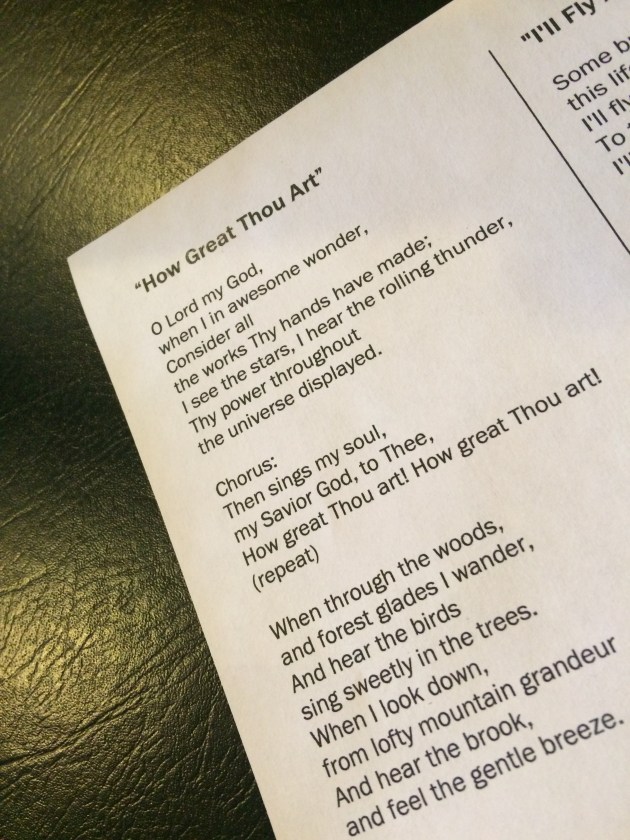
… They started playing, “How Great Thou Art,” an old hymn. I don’t know if it was one of my grandfather’s favorite hymns; I don’t know if it was an afterthought: “Hey everyone knows this one!” All I know is that as the music began and people started singing, I lost it.

I mean, lost it. 

I mean, not like you get the, “Fa-fa-fas” or the tears stream silently down your face. I mean irrational, super ugly, uncontrollable wailing. 

Even to this day my mom says, “We didn’t know what was happening! It was just beyond the normal level of human weeping; you were unconsolable!”

I couldn’t tell you what had happened, except that in that moment, I realized the power of music. I was experiencing something that was communicating to me beyond words, beyond speech, beyond even a human embrace. There was something in the combination of melody, rhythm and words that drilled its way so far beyond my defenses that I was devastated before I even knew what was happening.

It was like being attacted by emotional/spiritual ninjas.

That, my friends, is “soul music.”

Believe it or not, I think in that moment I was captured by music: its power and its ability to break down walls and defenses; to speak the unspeakable and express the unexpressable.

Once you touch a moment like that (theologians might call it numinous or transcendent) you really can’t go back. It changes you; lets you know what’s truly possible, beyond this world that we can see and touch. There was something beyond all of that, and I wanted it. Not only did I want to experience it again, I wanted to be a part of creating it for others.

It’s been a long road since then, but a few days ago I stood up in a small chapel—only 45 people or so—where family and a few friends had gathered to remember “Grandma Alice.” Alice passed away at 94, the grandmother of some friends of mine from my community. Amazingly, I was also Grandma Alice’s worship pastor. Somehow, this woman in her 80s (at the time) worshiped under the leaership of a rock and rolling, guitar playing, melancholic and introspective pastor (that’s me). She was great at giving hugs and giving encouraging words, and I was honored to be a part of remembering her.

The family chose two songs for the service. I don’t know if she had a part of picking them or not. The last song in the service was “I’ll Fly Away.”

Any guess as to what the first one was? IMG_4153

+e

Monastery Reflections: Molehills Out of Mountains

IMG_4108

Two-and-a-half days in a monastery. No media. No work. Silence. About as simple and stripped-down of a life as you could get. That’s what I went to embrace. I went to hear the voice of God, my Father, and to just rest. On the one hand, I had no expectations: just to go and “be.” On the other hand, let’s be honest: silence? solitude? hours of prayer? MONKS, for crying out loud?

Surely, this is the place where God is going to speak, to say something profound.

Either way, I was ready.IMG_4094

When I came back home, a few people were prompting me about the experience. By and large, however, my experience was pretty subtle. God surely spoke, and I wrote some things down; things that will have (hopefully) long-term positive effects in my soul and my life…

But this was no “mountaintop.”

This was stretching, but it wasn’t a shock to my system. These days were an extension of practices I’ve already tried to put in place in my “every day” life.

So there was no great upheaval.

… And I loved it.

I think that somehow we’re predisposed to seek the mountaintop. We expect to soar high and then drift back to earth.

But that makes for a pretty up-and-down, almost schizophrenic spirituality. We binge and purge, so to speak, rather than dine regularly on healthy spiritual disciplines.

IMG_4113For the past few years, I have tried to cultivate an attitude of peace in my daily life. I build practices in order to help me maintain that peace, clarity and centeredness. On a retreat, those practices are enhanced and extended (hopefully), but not necessarily, introduced.


Alan Watts says that the only zen you find on a mountaintop is the zen you carry up with you.

For those who may be uncomfortable with that language, you could just as easily say it this way: “They only spiritual peace you find on a mountaintop (or in a monastery) is the spiritual peace you carry up (in) with you.”

love retreats: I’m planning on going back in a few months for an even longer stay.

But I’m planning on carrying in a lot of peace with me then as well, if for no other reason than I can’t stay in a monastery forever.

My life is not lived on the mountain. It’s lived in the swamp (almost literally?). It involves cranky kids and bad jokes; taking out the trash and washing the dishes; waking up early and sometimes staying up too late.

All of that can be just as beautiful as a mountaintop (or just as hellish, depending on how I’m doing on a given day).

My hope is that more of us stop running after mountains, and start cultivating that interior, detached peace that is offered to all of us, regardless of our geography.

+e

Room With a View

IMG_4095

Some of you know that, for my graduation, I was given a retreat to a monastery by some friends and family. I went up to the Monastery of the Holy Spirit outside of Atlanta, Georgia. I’ve been there once before, but only stayed one night; this trip would be two days and two nights of silence and solitude (for me, this is a good thing).

When I checked into my modest room, I quickly went to the window and looked out. This IMG_4093was the scene that greeted me: the graves of the monks who have died in the monastery since its founding in the 1940s.
A room with a view, indeed.

I don’t know how this strikes you. Morbid? Disturbing?

For me, it was amazingly clarifying.

In Adam’s Return, Richard Rohr suggests that one of the key facts that a man must come to terms with is the fact that he (I) will die.

Two days of looking out a window at gravestones helps with this perspective.

Rohr does not suggest this to threaten us with judgment, or to insinuate that we all “get busy.” Rather, it’s meant to plant the seed that everything has the same end, and that part of my journey as a man (or human?) is to learn to release: my stuff, my agenda, my dreams, my family, my control, my ego.

I do believe in the resurrection, but I also know that the mortality rate is still right about 100%, and that, as best I can tell, you still can’t take it with you. It seems to me that we try as hard as we can to convince ourselves otherwise, but I wonder what it costs us. We think that we can maintain control and accumulate more and more and more and that we will never need to release.

And yet those gravestones point to a different reality.

In fact, so much of our spirituality has evolved to keep death as separate from us as possible. Last Christmas I was visiting my parent’s (psuedo) country church up in Virginia, and I was struck by the fact that there was a graveyard beside it.

Graveyards are no longer in the design plans of our safe suburban churches.

But what have we lost?

Have churches bought into the cultural message that promises eternal life, if not youth, and encourage us to attach, attach, attach to everything around us?

I am coming to believe that at some point much of life needs to be about surrender. Knowing that someday I will need to make the ultimate surrender helps just a little bit with that.

I’ll take the room with graveyard view, please.


+e

Into the Silence

HNCK0599

In just a few days, due to the amazing generosity of people in my life, I am driving up to the Monastery of the Holy Spirit, outside of Atlanta, Georgia, for a few days of solitude and silence.

This particularly monastery is a Trappist (or Cistercian) monastery. Now, there are different monastic orders: Franciscans, Benedictines, etc. From what little I’ve learned, the different orders have different emphases: study, poverty, service, etc. Broadly speaking, the Cistercians are focused on prayer and silence. They are not the “most silent” monastic order—my understanding is that the Carthusian monks get that distinction—but silence is a major theme of their life. When you are at the monastery, visitors are generally expected to eat in silence and to talk very quietly, and then only when necessary.

In other words, this is not a place that  is interested in reinforcing my life “as it is.”

If you know me at all, you’d think that my introverted self would be chomping at the bit for this: silence and solitude! No people! Woo hoo!

Well, you’d be wrong.

In a way, I am absolutely eager and ready to go. I am hungry for this, and have been trying to get something like this to happen for months now.

But in other ways, more than ever I know that (a) wherever you go, you bring yourself (or your SELF), and (b) when you really get alone and quiet, you can easily encounter some of the uglier parts of your soul.

As I’ve written before, the “solitary chair”” can be terrifying, because most of us subtly surround ourselves with enough noise to keep us distracted from the real issues in our lives: our brokenness, our deep emotional/spiritual struggles. There are simply things we do not want to see, confront, or deal with.

Silence exposes those things.

On one hand, going away to someplace like a monastery or a campsite or wherever seems like an easy exercise in getting away from the noise of life. But for me, I need to be honest with myself and admit that I can easily carry other “noise” with me: books, music, and my “monkey mind.”

Noise doesn’t always look like Netflix and McDonald’s.

So next week, I am traveling with the absolute bare minimum: no computer, a journal (handwritten!), only the Bible and 1 other text.

My choice is to let God speak and to not distract myself. To try and go deeper, to the next level of foundation in my spiritual life. I want to see more clearly: both God, Christ, other people, as well as my own brokenness and shortcomings.

This is not necessarily something to look forward to.

But I do know that I need it.

(You do too.)

I’m hoping for a deeper revelation of love; a deeper experience of healing and peace; and more centeredness, loving detachment, and clarity in my life.

But I also realize that what I carry into the monastery (including expectations) is not what might be waiting for me. So I hold all of those things loosely, and say (as Mary did), “LET IT BE DONE TO ME.”

If you’ve never gotten quiet and taken the time to really let God speak to you, I’d say (1) I understand; it’s probably pretty scary, and (2) what are you waiting for? 

As C.S. Lewis said of Christ, “No, he’s not tame: he’s dangerous… but he’s good.” 


+e


“Give Me That Old Time Religion…” 

“Religion”, in and of itself is not a bad thing. Remember: the word itself can mean “re-connecting” (re-ligature), and don’t we all need some sense of that?

Reconnection with our heart, soul, mind, bodies?

Reconnection with a power that is greater than ourselves? Reconnection with each other?

I don’t know about you, but I know I sure do.

I stumbled across this video this week, and it’s a powerful reminder of what “religion”, in the form of ritual can do.

A teacher at a school for boys in New Zealand passed away tragically and unexpectedly. As a hearse bore his body to the school for tribute, hundreds of current and former students gathered and performed a traditional haka—a traditional Maori dance—to honor his influence on their lives. To be blunt, I found this video profoundly moving. I sat with tears in my eyes, wondering at the power of this gathering.

Watch it. Watch it all. 

Here’s what I noticed.

  • It is simultaneously aggressive and tender. The haka is associated with war and warriors (the New Zealand “All Blacks” rugby team use it to challenge their opponents). It is meant to intimidate an enemy or opponent, and many of the young men are making aggressive, angry faces. Yet, at the same time, some are obviously sad and weeping. Religion and ritual seems to have a way of “baptizing” our pain and even our aggression. It names something—our teacher has died—but it doesn’t leave us in our pain. It channels it.
  • It is simultaneously ancient and now. The tradition of the haka is pretty old, but it has been sustained in Maori and New Zealand culture. It strikes me that this video is not 20, 30 or 50 years old. By all accounts, these young men should be staring at cell phones and cutting up. But they have given themselves to this “old time” practice and the results are sobering and arresting. Silence. Attention. Gravity and gravitas.
  • It is simultaneously individual and communal. The moves are coordinated and synchronized, but you can see variation in expression. Each young man is processing the pain in his own way while at the same time he’s a part of a larger collective.
  • It is simultaneously tribal and multi-cultural. The haka is decidedly Maori, but the students transcend ethnicity. Though there are some controversies with how the haka has been used, the ritual is not limited to just Maori people. When it’s good, religion and ritual can transcend our tribal, ethnic and cultural captivity and help us express joy and pain in a collective way, as human beings.

Sometimes, I fear that in our quest to be relevant and conversational our North American churches have discarded way to much of our traditions and rituals, and in doing so, we may have cast aside our most powerful tools for “re-connecting” people with their souls and with each other. Many Christian “faith tribes” have whittled down the number of rituals and traditions to two (Baptism and Communion), when there are so many to still choose from. Corporate worship helps, but even that is occasionally being cast aside as “performance art” rather than collective ritual.

Practiced rightly, Christian “ritual” like communion can do all of the things listed above: it can gather us up in a collective but individual experience, simultaneously acknowledge pain, joy and hope, and transcend our ethic and cultural differences. It is certainly ancient and current (and even future, as it proclaims Jesus’ return).

And communion isn’t the only place this happens.

So a thought for you is this: how much ritual is in your life? In particular, how much religion and ritual do you participate in, and do you look at it as a way to give your life (especially your joy and pain) meaning?

Many of us discard ritual and religion, and treat them as disdainful things; things that we did “in that boring Church.” Many of us instead have embraced a conversational, casual faith that is pregnant with emotional engagement and spiritual mountaintops.

My response is, how is that working for you? 

If the main point of spirituality is change and transformation (and I believe it is), is your casual, conversational faith changing you into the likeness of Jesus Christ?

Are your mountaintop experiences accompanying you though the valley of the shadow?

Sometimes I think for a realistic, day-to-day faith and spirituality, we need the old stuff.

The vintage gear.

Not so that we can retreat back into 1950 or 1850 or 1500 or 150CE, but so we can move through today with faith and transcendence.