The Hard Edge of Grace

Grace makes me uncomfortable sometimes.

There, I said it.

Rare coming from a “believer,” rarer still coming from a pastor.

But when I really boil it down to the essentials, grace hits me hard, and challenges me.

Obviously, I don’t mind grace at all when I need it, when I call out to God and acknowledge my brokenness and shortcomings to Him or to other people. At that point, I’m truly grateful for free forgiveness.

But when I think about the ramifications of a truly loving, forgiving God, of what grace truly IS, it hits me hard, basically because it makes me think of those people that I tend to judge, those people that I try to “cut off” from grace.

It’s one thing when all the “good people” (and believe I know: who is really “good”, after all) get grace, but as my 12-step sponsor likes to remind me, “either it’s grace or it’s not,” and if it IS grace, then that means an awful lot of people get grace that simply don’t fit into my “good” category. These are the people that *I* like to judge, the people who aren’t spiritually curious, who are content in their anger and apathy, who are consumed by revenge and who would choose to remain small-minded and fearful about the universe.

Even they get grace.

It’s similar to the old adage, “Justice or mercy? Mercy for myself, justice for everyone else.”

My own mind doesn’t like that. I’d much prefer a hoop to jump through, or some kind of judgment first.

But then that’s not “grace” is it?

Grace is free. FREE. And WE don’t get to determine who gets it, and frankly the more I learn about this God in whom I live and move and have my being, the more I learn that He tends to be a lavish giver, and He will not be restrained.

I actually think He’s harder to avoid and reject than to discover. He’s sort of relentless that way.

I think when I see the Kingdom fully-realized, there will be so many there… Not just the drug dealers and gay people and transsexuals and church people, but also people from the right and the left, people who have THOSE bumper stickers… The list goes on and on.

Why?

Because GRACE, that’s why.

Morning.

I woke up this morning at… well, 3:15.

I tried to go back to sleep, but by 3:45, I realized it was pointless, and I went ahead and woke up. One of my mentors has always maintained that we should assume that when we wake up, God wants us awake and we should respond accordingly.

They probably never saw me as a teenager when my parents tried to wake me up.

God may have wanted me awake, but that didn’t necessarily mean I had to be thrilled about it.

MOST of the time, in fact, I am able to stave off God, and you know what? He actually respects that. It’s as if He’s like a child: He pokes and prods me like a 5 year old on Christmas morning. “C’mon, c’mon, c’mon get up, it’s happening! It’s here!” Except “It” is simply just another day, and not the once-a-year mad festival of gifts.

But the metaphor breaks down, because for me most of the time if I simply ignore him once or twice, he leaves me alone and I go back to sleep. If he was truly a child he’d bug me unceasingly until I woke up and got the coffee brewing. But as a spiritual master once said, “God is a perfect gentleman,” and so when he occasionally whispers, “Psssst. Hey: why don’t you wake up? I have some amazing things to talk to you about!” And I respond with disinterested grunts, and then roll over to squeeze another 45 minutes of time out of my night, he actually says (with really no disappointment, but with an amazing, unending disinterested love, “Okay… Maybe next time!”

That’s pretty much God. Always there. Always wanting to meet with me. Always willing. Never disappointed. Never shaming. Never quilting.

Just wants to know that he wants to meet with me. Pretty much any old time.

And then again, that’s pretty much me. Frumpy. Slightly lazy. REALLY, REALLY into what I’m doing at the moment, rather than looking up from my work (or my pillow) to see this bright-eyed child who just wants to sit with me, who really just wants me to know that, “Hey, I love you.”

40 Words: Failure.

“Failure” is not a pleasant word; not even close to something like, “Illustrious” (which was my favorite word as a 9th grade English student), or “Sublime” (not so much the band, but the adjective), or “Craftsman” (one of my former bandmates called me that referring to my approach to music, and it remains one of the highest compliments I’ve ever received… or could give).

Nope, “Failure” is a word we like to avoid.

It’s the “DNF” in the race (Did Not Finish).

I’m probably more familiar with failure than I’d like to admit.

It’s easy for me to focus on my “wins” and my achievements, especially over the last 12 months or so:

  • Graduating Seminary (with a 3.8 GPA, even!)
  • Running my first half-marathon
  • Raising two pretty decent kids
  • Becoming a better husband
  • Wrestling with some long-time demons, and achieving some semblance of sanity for the maybe the first time ever
  • Mentoring and teaching a variety of people in my community

Those things are all important, and I’m proud and grateful to have completed them, but I also have to admit that I have a pretty significant history of being someone who struggles to “finish.”

I’m great at starting.

But it’s that middle that tears me up.

I committed to blogging Lent. I did. I can’t take that back. I put it out there for all of the internets to see…

And then I failed.

I lasted what, two or three weeks?

I don’t even know. I don’t want to know, to tell you the truth.

And so the tapes begin:

“You see… you never finish anything

… You quit. You’re a quitter.

… You bail out as soon as things get hard.

… You don’t have enough grit.”

Those are some tapes that play in my head. Lovely, isn’t it? We all seem to have them—little quotes and sayings that invade our headspace whether we want them there or not, and remind us off all the bad things we are and all the good things we are not.

But I also know that’s not the whole story.

It seems to me that there comes a point where you have to make a choice about what it means to be human: are we the sum of our actions and deeds? Are we “sowing a destiny,” so to speak?

OR…

Or are we far more complex than that? Am I more than a failure, even when I fail?

I’d like to think that I am, and I’d like to think that God thinks so too.

So yeah, I failed. I started, and didn’t finish. I had the best of intentions, and they didn’t pay off.

But here I am: Holy Wednesday. I will walk towards that Cross on Friday, and I know that Jesus died for this “failure”, mostly because He knows that being human means not getting it right sometimes (most of the time?), and that we all need a little help.

40 Words #3: “Wilderness” (2.12.2016)

Psalter_World_Map,_c.1265.jpg

from the Psalter World Map c.1265 http://www.wikipedia.org

Yesterday’s word was “40”, referring to the length of Lent as well as the length of time both Jesus (days) and the nation of Israel (years) spent in the wilderness.

In Biblical terms, the wilderness is never a comfortable place to be. In the ancient world, there were a lot harsher boundary markers between civilization and the wilderness; there weren’t convenience stores, or cell phone coverage, or highways.

There was, however, a lot of darkness; of wild animals; of the unknown.

One of my favorite images is on medieval maps: outside the borders of known areas, cartographers would put a drawing of a dragon and indicate, “Here Be Dragons.” (Which, by the way is also the name of an excellent historical fiction series by Sharon Kay Penman… I gave you that for free.)

To enter the wilderness is to enter a place where you are no longer comfortable, where you come face to face with mortality and with dangerous creatures that you don’t normally have to face in your “normal” world.

Kind of like Lent.

In the 40 days of Lent, many of us pursue disciplines that are designed to reduce our comfort (like fasting), and contemplate the brokenness in our lives. What’s more, sometimes in Lent you  unexpectedly come face to face with a “beast” that you don’t normally see… And usually the beast is you.

Lent is designed to open your eyes, to bring you into proximity with the areas of your life that you’d rather avoid.

But here’s the thing: In the Bible, the wilderness is also the place of growth. Israel spends 40 years in the wilderness, not just as punishment, but as preparation to be the people of God in the land of Canaan (clearly, they didn’t learn very well). Jesus goes into the wilderness to be “tested” (furthermore, he only goes into the wilderness after his baptism, and hearing his father pronounce him “Beloved”), and afterwards moves directly into ministry.

The wilderness may be dangerous, but most of the time it’s necessary, and even beneficial.

As you go through your journey, resist the temptation to leave the wilderness before the wilderness teaches you everything you have to learn.

Not To Get All “Biblical” on You…

… but wow…


Listen! Listen to the roar of his voice,
to the rumbling that come from his mouth.

He unleashes his lightning beneath the whole heaven
and sends it to the ends of the earth.

After that comes the sound of his roar;
he thunders with his majestic voice.
When his voice resounds, he holds nothing back.

God’s voice thunders in marvelous ways,
he does great things beyond our understanding.

Job 37:2-5

Trump vs. St. Paul, Round 1

trump-make-america-great-again

It’s election year in United States, and the other day I was having a conversation with my spiritual mentor about the current state of politics in our country. Quite frankly, it’s difficult for me to listen to any of the candidates talk because nobody seems to be interested in talking about any policies or worldviews that are not short cited, or too simplistic and nationalistic solutions to complex into related problems. I don’t feel like anyone speaks for me or to me., And that’s just the reality. Parentheses on a more positive note, I was listening to a the Ted Radio Hour recently that advocated looking at the municipal level-mayors, council people, etc.-to see a place where politics is still working in United States. If you’re interested check it out Ted Radio Hour).

Donald Trump is a decidedly disturbing presidential candidate to me. To be quite honest, with his nationalistic and practically fascist statements he reminds me of the rise of Hitler. However, I was thinking recently about his campaign slogan, “Make America Great Again,” and it struck me how odd the slogan is. It’s easy to say “let’s make America great again”, but it’s also just as easy to ask, when was America great? Were we great in the 1950s and 60s when we were oppressing people of color in our country? Were we great in the 1980s, when we were struggling to keep up with the environmental damage done by unregulated factories? I’m not saying our country isn’t great. I love the United States, and still cry profusely whenever I sing the national anthem. I am blessed and grateful to have grown up here. But life isn’t about making America great. Life is about simply being the best citizens we can be and trying to make this world a better place. But there’s something at stake that’s even more significant, and that is the question of where we put our ultimate trust. America doesn’t need to be great for me to have a great life. My trust is placed somewhere else. This is not a new thing.

In Paul’s firsts letter to the church at Thessaloniki, he makes a decided dig against the nationalistic leanings of the Roman empire. He makes a remark about people claiming peace and safety when there is none and then a change will come instantly. Though it’s easy to assume that this is somehow about the end of times, it’s enlightening to realize that peace and security was actually a political slogan of the Roman empire, and what Paul is actually doing here is confronting people with the question of where they put their faith. If you decide to put your faith in the Roman empire  (or the United States) you will be decidedly shocked and disappointed when that empire is incapable of really protecting you. The only Kingdom where we have actual security is the Kingdom of God. Granted, that security isn’t always tangible or evident, but ultimately God is calling us to a deeper security, based in eternity.  Regardless, it’s a great reminder that neither our trust nor our security comes from any earthly “greatness”. America can be great (if it decides to take care of the least of these and the outcasts) or it can be not great. Either way, I am called to live my life wisely, to do my best to provide for my family, but most of all to place my trust in a King and Lord whose name is not Cesar nor Trump nor Mr. President.

Please get here soon election day; let’s get this over with.
+e

Clean Cups, Clean Hearts

Jesus is pretty ambivalent about housekeeping.

In a few different episodes, he takes religious leaders to task about their emphasis on external/irrelevant purity in comparison with the more difficult (and necessary) task of personal, INTERIOR life change.

In one instance, he puts it in terms of washing dishes: don’t focus so much on the cleaning the outside of your cups (the part that everyone can see), when what is inside the cup is so filthy and corrupting.

In another instance, he contrasts the cultural/religious emphasis on avoiding certain foods (again, what everyone can see) with the thought that it’s not what goes INTO a person that corrupts them, but rather what comes OUT of hearts (and mouths) that breaks us down and hurts ourselves and others.

It seems to me that Jesus is clear on his priorities: internal, SPIRITUAL growth and transformation as opposed to mere external (and sometimes arbitrary and artificial) holiness.

But “bad religion” has a peculiar habit of falling back on the externalities whenever it fails at the harder interior work. Sometimes I feel like the church in North America, with its uncomfortable alliance with consumerism, nationalism, and comfortable affluence, has fallen prey to this peculiarity.

I think it haunts us as a people: our spiritual systems and theologies that demand little to no life change have failed to produce the internal, heart-level transformation that Jesus is looking for (and that secretly we all crave), and so we do what religion has always done: We look at external “markers” of holiness.

It’s not malicious, it’s just the way religion works.

Cups are easy, hearts are hard.

I’m not saying I’m not guilty of this, by the way. I know that I fall victim to it again and again. But somewhere along the way I got tired of washing dishes. Somewhere along the way I decided to let Jesus challenge the deep things in my heart: my pride, my selfishness, my self-centeredness, my narcissism, my arrogance.

I decided to give up control and let Jesus fight those battles.

“Are you still so dull?” Jesus asked them. “Don’t you see that whatever enters the mouth goes into the stomach and then out of the body? But the things that come out of a person’s mouth come from the heart, and these defile them. For out of the heart come evil hearts—murder, adultery, sexual immorality, theft, false testimony, slander. These are what defile a person; but eating with unwashed hands does not defile them.” (Matthew 15:16-20)


+e


Into the Silence

HNCK0599

In just a few days, due to the amazing generosity of people in my life, I am driving up to the Monastery of the Holy Spirit, outside of Atlanta, Georgia, for a few days of solitude and silence.

This particularly monastery is a Trappist (or Cistercian) monastery. Now, there are different monastic orders: Franciscans, Benedictines, etc. From what little I’ve learned, the different orders have different emphases: study, poverty, service, etc. Broadly speaking, the Cistercians are focused on prayer and silence. They are not the “most silent” monastic order—my understanding is that the Carthusian monks get that distinction—but silence is a major theme of their life. When you are at the monastery, visitors are generally expected to eat in silence and to talk very quietly, and then only when necessary.

In other words, this is not a place that  is interested in reinforcing my life “as it is.”

If you know me at all, you’d think that my introverted self would be chomping at the bit for this: silence and solitude! No people! Woo hoo!

Well, you’d be wrong.

In a way, I am absolutely eager and ready to go. I am hungry for this, and have been trying to get something like this to happen for months now.

But in other ways, more than ever I know that (a) wherever you go, you bring yourself (or your SELF), and (b) when you really get alone and quiet, you can easily encounter some of the uglier parts of your soul.

As I’ve written before, the “solitary chair”” can be terrifying, because most of us subtly surround ourselves with enough noise to keep us distracted from the real issues in our lives: our brokenness, our deep emotional/spiritual struggles. There are simply things we do not want to see, confront, or deal with.

Silence exposes those things.

On one hand, going away to someplace like a monastery or a campsite or wherever seems like an easy exercise in getting away from the noise of life. But for me, I need to be honest with myself and admit that I can easily carry other “noise” with me: books, music, and my “monkey mind.”

Noise doesn’t always look like Netflix and McDonald’s.

So next week, I am traveling with the absolute bare minimum: no computer, a journal (handwritten!), only the Bible and 1 other text.

My choice is to let God speak and to not distract myself. To try and go deeper, to the next level of foundation in my spiritual life. I want to see more clearly: both God, Christ, other people, as well as my own brokenness and shortcomings.

This is not necessarily something to look forward to.

But I do know that I need it.

(You do too.)

I’m hoping for a deeper revelation of love; a deeper experience of healing and peace; and more centeredness, loving detachment, and clarity in my life.

But I also realize that what I carry into the monastery (including expectations) is not what might be waiting for me. So I hold all of those things loosely, and say (as Mary did), “LET IT BE DONE TO ME.”

If you’ve never gotten quiet and taken the time to really let God speak to you, I’d say (1) I understand; it’s probably pretty scary, and (2) what are you waiting for? 

As C.S. Lewis said of Christ, “No, he’s not tame: he’s dangerous… but he’s good.” 


+e


How Weird WAS Jesus? 

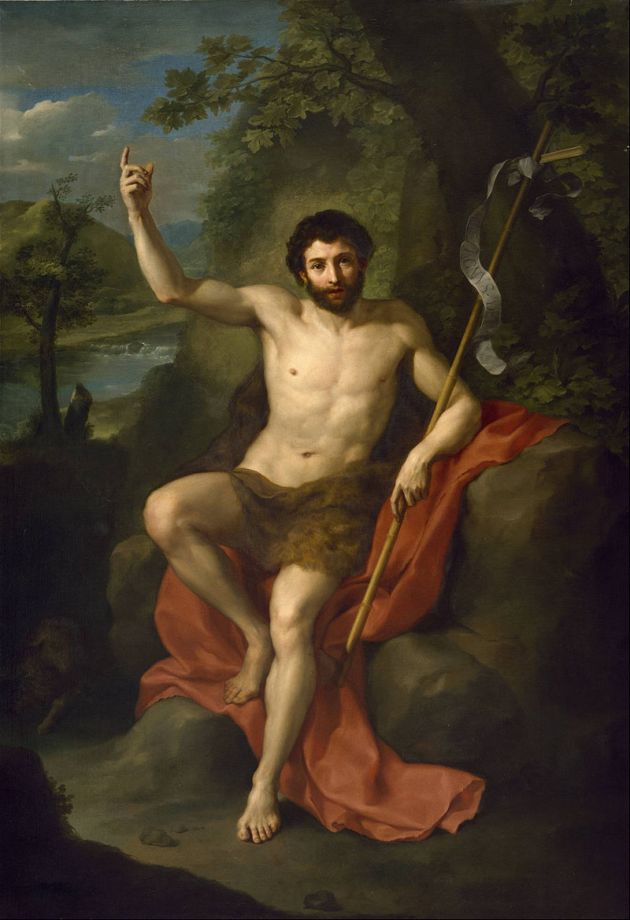
Anton_Raphael_Mengs_-_St._John_the_Baptist_Preaching_in_the_Wilderness_-_Google_Art_Project

“St. John the Baptist Preaching in the Wilderness” by Anton Raphael Mengs

I was reading a book recently by a popular Christian leader, and he had this to say about John the Baptizer:

Several things about John stand out right away. He was an unusual dresser with strange eating habits. Just in case you’re uncertain, wearing clothes made of camel’s hair was not the height of fashion, even during the time of Jesus. We are told he ate locusts and wild honey. I suppose the wild honey was to help get the locusts down. (Erwin McManus, The Barbarian Way)

Overall, I get what the point he was trying to make: John (as well as Jesus) was a provocative character. However, I think McManus overlooked a crucial point. First, this is what the New Testament actually says about John’s dressing habits:

In those days, John the Baptist came, preaching in the wilderness of Judea…. John’s clothes were made of camel’s hair, and he had a leather belt around his waist. His food was locusts and wild honey. (Matthew 3:1, 4-6)

Second, Jesus has this to say about John:

For all the Prophets and the law prophesied until John. And if you are willing to accept it, he is the Elijah who is to come. (Matthew 11:14)

Lastly, notice this description of Elijah—a prophet—from the Hebrew Bible (our Old Testament):

‘He (Elijah) had a garment of hair and had a leather belt around his waist.’ (2 Kings 1:8)

When you consider the thread between those three passages, you begin to notice that something else may be going on which is  a bit beyond the outsider, “barbarian” nature of faith (which I happen to believe in, by the way). If John was conscious dressing like Elijah—and I believe he was—the Baptizer wasn’t merely trying to shock people; he was trying to signal something to them, namely, here comes a prophet. 

Prophets were a unique breed in Jewish culture; they showed up to put the people (and, more specifically, the religous and political leaders) on notice that they had strayed from the Instruction (Torah), and (most often) that they were neglecting the poor and the outsider. Moreover, prophets tended to embody their message, meaning that they didnt’ just speak or write it; oftentimes they acted it out, in sometimes disturbing (and thoroughly gross) ways: nakedness, human feces, and broken pottery were involved.

When you understand the message that John was bringing to the people around Jerusalem, it’s pretty easy to see that he (and later his cousin, Jesus) saw himself as carrying on that tradition.

So when the people of Jerusalem came down to the Jordan river, their reaction actually wasn’t, “Wow this guy is weird.” Rather it was more like, “Wow, there’s a prophet!”

John made perfect sense in his context.

However, as I thought more about this passage and what it said, I actually became troubled on a different level. I started to wonder what this approach to people in the Bible (“Wow these people were weird! They were like from another planet! You wouldn’t even know what to do with them!”) actually says about God and His mission in the world.

You see, the more that we turn people in the Bible into something resembling spiritual space aliens, the easier it is to convince ourselves that there is something unique and special about “those people,” something that we ourselves could never measure up to.

Nothing could be further from the truth.

One of the names that Jesus embodies for believers is “Emmanuel”, or “God-With-Us,” and that phrase means everything, because it is the essence of the Gospel: God enters into humanity, takes on our limitations, embraces our junk and dirt, walks through the muck and the mire of life on earth and ultimately says, “You are okay.”

As Church father Athanasius put it, “God came down to humanity in order to raise humanity up to God.”

Let me spell it out clearly: The Incarnation (“God-With-Us”), along with the Biblical record, means that Jesus (and John the Baptist) made perfect sense in his context. It means that God is somehow perfectly at home within humanity. Now, it doesn’t mean that Jesus wasn’t provocative, or that he didn’t stretch people’s perceptions or understandings.

But he certainly wasn’t a space alien.

Furthermore, the message here is that in a way we are in the same boat as John the Baptist, or even Jesus: John wasn’t a space alien; Jesus wasn’t a space alien… neither am I, and (presumably) neither are you.

God uses normal human cultural context, and “normal” human beings, to bring about amazing, unforeseen changes. Even as a prophet, John made perfect sense in 1st century Judaism.

You make perfect sense in the 21st century.

What does God want to do through you?


++++++++++++++

Words, Pt 2: “Repent”

The second word I want to take a look at is laden with all sorts of negative connotations. I don’t know about you, but my university came with its own street preacher (remarkably free-of-charge). His favorite place was on the median of University Avenue in Fort Worth, where he was free to ply his trade:

“WHORES!”

“FORNICATORS!”

“SODOMITES!”

How pleasant. A great way to wake up on your way to your afternoon geology class.

“Repent” is a word that seems to be usually associated with fundamentalist street preachers: they scream at people to repent so that they won’t be burned up in the fires of hell. The way they use it, it’s a challenging and divisive word that puts people decisively on the defensive. Ears are closed, boundaries go up, and dialogue is unthinkable.

In this paradigm, when Jesus shows up in Mark 1 and says—before anything else—“Repent for the kingdom of God is at hand,” the subtext or paraphrase is something like this: “Everyone better believe in my death and resurrection (which, um, hasn’t happened yet) or I’m gonna burn you all of you suckas up with … fiyahhhhhh!”

In this view, Jesus’ main agenda is to find people to condemn.

Except that doesn’t really seem to be the way Jesus operates. By contrast, the common people seem to really like Jesus, and for his part he seems to be quite gentle with people who, by all accounts, are complete moral failures. Rather, Jesus reserves his “condemnation” for folks who are actually the religious elite who have it all together and have all the answers.

Ironically, they would probably rather resemble my street preacher friend.

So what does Jesus mean by “repent”? The Apostle Paul says it too; what does he mean? (Surely Paul will back the fundamentals: everyone knows that Paul wanted to throw people into hell for not believing in Jesus’ atoning death.)

The word repent is actually a really rich and powerful word. The Greek word is metanoia. Perhaps the most literal translation is change your mind, but a better way to translate it might be, “reconsider your life” or “think differently about reality.”

In the context of Jesus’ statement in Mark 1 (or similarly in Matthew 4), you could paraphrase his statement like this:

Hey the Kingdom of God is here and available to EVERYONE—even the spiritual losers (check the Beatitudes)—so think about your reality differently. You can live your life now completely differently, with transcendent and life-giving spiritual power. You don’t have to live the way you’ve been living; You don’t have to be trapped by the things that have trapped you. It’s available now. 

Now, this doesn’t mean that “repentance” doesn’t come with a cost. To really change one’s mind about reality, one needs to jettison the programs that we have grown up with; our knee-jerk (and often unhealthy) reactions to others’ efforts to control or dominate us. This is certainly difficult, and costly.

But then again, culture’s patterns of addiction and unhealthy obsession would seem to indicate that not repenting has its costs as well. In fact, one could make an argument that living with our compulsive spending, eating, and medicating is a form of death.

So indeed, repent or die: just not in the way you think.

Hey! You can also read “Words: Good News”