40 Words #1: “Ash”

1024px-Crossofashes

It’s Lent 2015.

Forty days of reflection and contemplation, surrender and sacrifice.

Or something like that.

I wanted to do something for Lent that would stretch me (don’t worry: I have my own practices of surrender and sacrifice, but I’m going to keep those between my family and me).

So each day during Lent, I’m going to publish a short blog/devotion wrapped around one word.

So, “40 Words.”

Each of these words represents some aspect of Lent to me. Some of them will be obvious, like today’s. Others may be more… “tangential”.

(Great word, “tangential”.)

I’ve chosen them, they are written down, and each day I’ll publish something in the morning: feel free to use it as a devotion or just a quick read at lunch.

I’m not promising anything profound; I’m just promising a presence.

So here we go.

ASH

Lent kicks off with “Ash Wednesday”. For many denominations and churches all over the world, people file into buildings of various style and size and hear readings about confession and remembrance. Songs are sung, and at some point people file up to the front of a room where they stand in front of a pastor or priest—someone “set aside” in the community to guide people, to administer sacraments, to represent them to God—who then dips his or her finger into a bowl of ashes (the burnt palm fronds from the previous years’ Palm Sunday) which are sometimes mixed with oil. The pastor/leader then will make the sign of the cross on the person’s forehead, usually saying something like, “Remember it’s from dust you have come, and to dust you will return; repent, and believe the Gospel” (or some combination thereof).

Up until a few years ago my particular faith tribe didn’t really remember Ash Wednesday or Lent, but after a few of us began engaging in the season (in particular Holy Week), the church decided to officially “making the journey.”

Ash, along with the saying, reminds me, well, of death. 

Death is something we don’t like to think about in our culture, but it’s the one thing that awaits us all. Our time on this earth is finite.

To me, ash reminds me that the life I have costs something. My affluence costs others. The food I eat costs either a life, or at the very least the time and efforts of someone, somewhere.

Ash reminds me that I’m nothing special; and yet I’m someone infinitely important.

I am loved by God. Loved on a visceral, guttural level.

A love that cost Jesus. 

And yet, I’m human. “Covered in earth and dirt.”

I stumble and fall. Limited and incapable of even living half of a day (if that) without falling victim to my pride, arrogance, narcissism, and self-centeredness.

Ash says that, somehow, I’m simultaneously both loved and flawed. 

And that’s okay.

Maybe today is about not covering up our flaws, but at the same time that God meets us right in the middle of them, not matter how serious they seem to be. 

+e
Lent is Coming (Don’t Look Busy)

Ash Wednesday is this week, which means that the season of Lent is upon us.

Lent is the season of the church that leads up to Easter. It is a time of preparation, meant to prepare us both to remember Jesus’ crucifixion as well as his resurrection. Historically, lent was a season where people who had left the church for one reason or another were re-integrated. The bottom line is that traditionally God’s people have used this season to reflect on areas of their lives that might need some “cleaning up”, and also to slow down in order to shed light on any new areas that might need addressing.

Part of lent is slowing down and strategically making space in your life to hear God’s voice. Usually this means “fasting” in some form or fashion.

But actually fasting—and lent—should be a little more than that. For many Christians, fasting is only half of the equation: the other half is engaging in or giving back resources, in the form of “time, talents, and treasures” that have been freed up by the fast.

So you might consider:

  • giving up lunch once a week, but then giving the money you saved to your local church or a local ministry
  • giving up Facebook or Netflix, but then giving the time you freed up to Bible study or a local mission or charity that needs help
  • giving up an hour of sleep in the morning, but then giving the time to prayer and meditation
  • giving up a snack and instead buying food that you can keep in your car to give to the hungry and homeless that you might encounter as you drive around

These are just a few examples, but I think you see the point. Lent isn’t just about giving up Chipotle or chocolate or ice cream; it’s really about carving up space to see God move in different ways. It’s about bringing some of our physical appetites under control so that we can give to needy folks. It’s about becoming aware of where we are still held captive by those same desires, and where we continually need God’s Spirit to help us, to refine us, to grow us into the people that He wants and needs us to be in His world.

I would encourage and even challenge you to be thoughtful and intentional over the next 40 days. Pick something that will open up space in your life for God to speak and move.

Personally, I am giving up a few things, one of which is Facebook (not a huge sacrifice for me, which is why there are multiple activities for me this year). But, I am also engaging in some activities that, God willing, will allow me to draw closer to God as well as to others.

(By the way, I will continue to write and publish over Lent, so feel free to subscribe here and get my blogs delivered straight to your inbox.)

If you’d like to share your ideas for Lent here, go right ahead. We’re listening. Otherwise (as Gandalf would say), “Keep it safe, keep it secret.”

May your Lenten journey be rich, and full of peace where you need it and challenge you where you need it as well.
+e


 Soul Music

I was 9 or 10 when my maternal grandfather died. We made the trip from Texas to North Carolina to celebrate his life and to lay him to rest. I knew him as a kind, soft-spoken southern gentleman (my mother has different memories, as usual).

I’m not sure how a 10 year old interprets “death”. Though I had visited him and spent a little time with him, we grew up in Pennsylvania before Texas, and so I didn’t have the connection I had with my dad’s parents, who grew up two houses down the road (my uncle lived in between us). My mom was pretty devastated, and it hurt to see her so torn up, but we did our best to keep it together and to mourn in a healthy way. Meals were brought; hugs were given and received; stories were through moist eyes and shaking voices.

There was a viewing; I’d never been to one before (my maternal grandmother died when I was probably 4 or 5, and I don’t remember anything about that except hearing my mother receive the phone call and knowing instantly as I heard her cry, “What?!?!?!” that something was seriously wrong. (Is there a word for that tone of voice? The tone where the unthinkable has happened? It’s not “sad”; it’s not just “shocked”; it’s something from beyond. Beyond the pale of normal, “safe” human interaction.)

Anyway, the viewing. To say it disturbed me is to understate things. The casket was open, but I was, well, horrified, as I realized what I was supposed to do: walk up and look and “pay my respects”. Shamefully, my parents had to virtually drag me up to the casket; I’m sure my mom was so embarassed, but something irrational had captured me, and I couldn’t get past it.

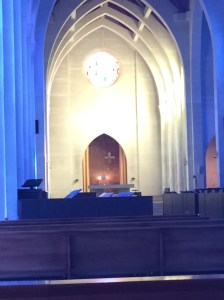
Somehow we got through that night. The next day was the funeral proper. I remember a typical rural southern church: white wooden walls, vaulted ceilings, pews with cushions, everything very clean and arranged. I sat down next to my mother and the service began. Everything was fine until…

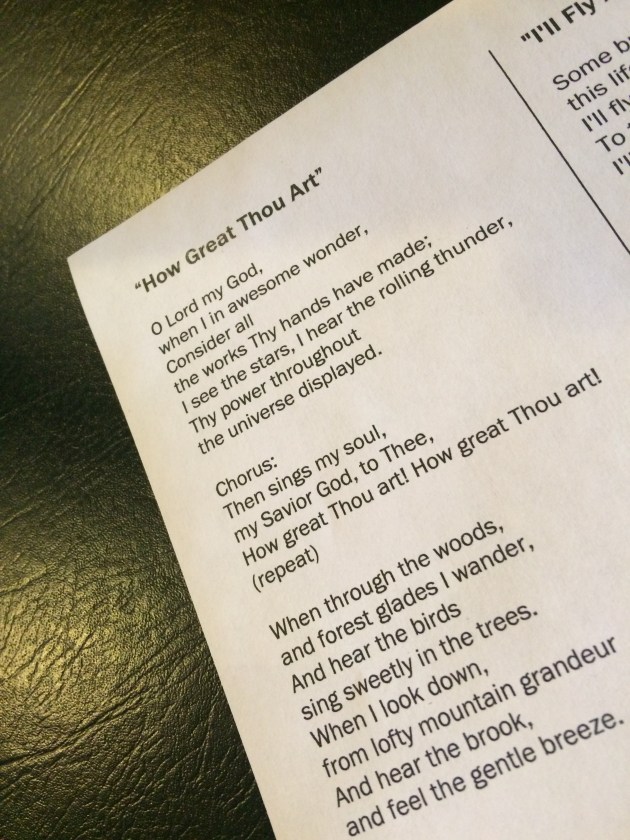
… They started playing, “How Great Thou Art,” an old hymn. I don’t know if it was one of my grandfather’s favorite hymns; I don’t know if it was an afterthought: “Hey everyone knows this one!” All I know is that as the music began and people started singing, I lost it.

I mean, lost it. 

I mean, not like you get the, “Fa-fa-fas” or the tears stream silently down your face. I mean irrational, super ugly, uncontrollable wailing. 

Even to this day my mom says, “We didn’t know what was happening! It was just beyond the normal level of human weeping; you were unconsolable!”

I couldn’t tell you what had happened, except that in that moment, I realized the power of music. I was experiencing something that was communicating to me beyond words, beyond speech, beyond even a human embrace. There was something in the combination of melody, rhythm and words that drilled its way so far beyond my defenses that I was devastated before I even knew what was happening.

It was like being attacted by emotional/spiritual ninjas.

That, my friends, is “soul music.”

Believe it or not, I think in that moment I was captured by music: its power and its ability to break down walls and defenses; to speak the unspeakable and express the unexpressable.

Once you touch a moment like that (theologians might call it numinous or transcendent) you really can’t go back. It changes you; lets you know what’s truly possible, beyond this world that we can see and touch. There was something beyond all of that, and I wanted it. Not only did I want to experience it again, I wanted to be a part of creating it for others.

It’s been a long road since then, but a few days ago I stood up in a small chapel—only 45 people or so—where family and a few friends had gathered to remember “Grandma Alice.” Alice passed away at 94, the grandmother of some friends of mine from my community. Amazingly, I was also Grandma Alice’s worship pastor. Somehow, this woman in her 80s (at the time) worshiped under the leaership of a rock and rolling, guitar playing, melancholic and introspective pastor (that’s me). She was great at giving hugs and giving encouraging words, and I was honored to be a part of remembering her.

The family chose two songs for the service. I don’t know if she had a part of picking them or not. The last song in the service was “I’ll Fly Away.”

Any guess as to what the first one was? IMG_4153

+e

Monastery Reflections: Molehills Out of Mountains

IMG_4108

Two-and-a-half days in a monastery. No media. No work. Silence. About as simple and stripped-down of a life as you could get. That’s what I went to embrace. I went to hear the voice of God, my Father, and to just rest. On the one hand, I had no expectations: just to go and “be.” On the other hand, let’s be honest: silence? solitude? hours of prayer? MONKS, for crying out loud?

Surely, this is the place where God is going to speak, to say something profound.

Either way, I was ready.IMG_4094

When I came back home, a few people were prompting me about the experience. By and large, however, my experience was pretty subtle. God surely spoke, and I wrote some things down; things that will have (hopefully) long-term positive effects in my soul and my life…

But this was no “mountaintop.”

This was stretching, but it wasn’t a shock to my system. These days were an extension of practices I’ve already tried to put in place in my “every day” life.

So there was no great upheaval.

… And I loved it.

I think that somehow we’re predisposed to seek the mountaintop. We expect to soar high and then drift back to earth.

But that makes for a pretty up-and-down, almost schizophrenic spirituality. We binge and purge, so to speak, rather than dine regularly on healthy spiritual disciplines.

IMG_4113For the past few years, I have tried to cultivate an attitude of peace in my daily life. I build practices in order to help me maintain that peace, clarity and centeredness. On a retreat, those practices are enhanced and extended (hopefully), but not necessarily, introduced.

Alan Watts says that the only zen you find on a mountaintop is the zen you carry up with you.

For those who may be uncomfortable with that language, you could just as easily say it this way: “They only spiritual peace you find on a mountaintop (or in a monastery) is the spiritual peace you carry up (in) with you.”

love retreats: I’m planning on going back in a few months for an even longer stay.

But I’m planning on carrying in a lot of peace with me then as well, if for no other reason than I can’t stay in a monastery forever.

My life is not lived on the mountain. It’s lived in the swamp (almost literally?). It involves cranky kids and bad jokes; taking out the trash and washing the dishes; waking up early and sometimes staying up too late.

All of that can be just as beautiful as a mountaintop (or just as hellish, depending on how I’m doing on a given day).

My hope is that more of us stop running after mountains, and start cultivating that interior, detached peace that is offered to all of us, regardless of our geography.

+e

Room With a View

IMG_4095

Some of you know that, for my graduation, I was given a retreat to a monastery by some friends and family. I went up to the Monastery of the Holy Spirit outside of Atlanta, Georgia. I’ve been there once before, but only stayed one night; this trip would be two days and two nights of silence and solitude (for me, this is a good thing).

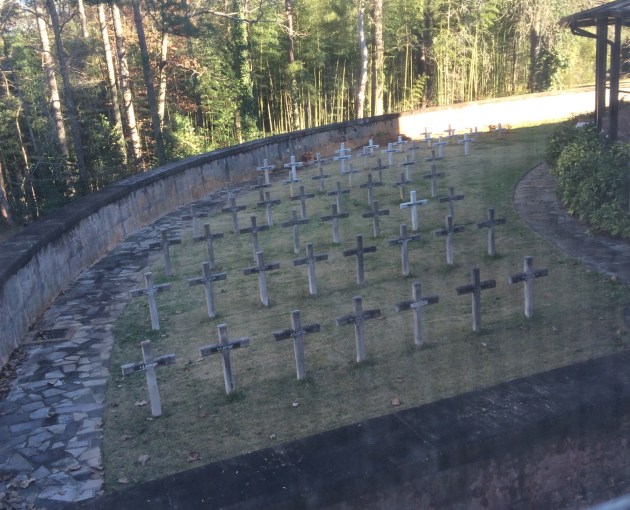
When I checked into my modest room, I quickly went to the window and looked out. This IMG_4093was the scene that greeted me: the graves of the monks who have died in the monastery since its founding in the 1940s.

A room with a view, indeed.

I don’t know how this strikes you. Morbid? Disturbing?

For me, it was amazingly clarifying.

In Adam’s Return, Richard Rohr suggests that one of the key facts that a man must come to terms with is the fact that he (I) will die.

Two days of looking out a window at gravestones helps with this perspective.

Rohr does not suggest this to threaten us with judgment, or to insinuate that we all “get busy.” Rather, it’s meant to plant the seed that everything has the same end, and that part of my journey as a man (or human?) is to learn to release: my stuff, my agenda, my dreams, my family, my control, my ego.

I do believe in the resurrection, but I also know that the mortality rate is still right about 100%, and that, as best I can tell, you still can’t take it with you. It seems to me that we try as hard as we can to convince ourselves otherwise, but I wonder what it costs us. We think that we can maintain control and accumulate more and more and more and that we will never need to release.

And yet those gravestones point to a different reality.

In fact, so much of our spirituality has evolved to keep death as separate from us as possible. Last Christmas I was visiting my parent’s (psuedo) country church up in Virginia, and I was struck by the fact that there was a graveyard beside it.

Graveyards are no longer in the design plans of our safe suburban churches.

But what have we lost?

Have churches bought into the cultural message that promises eternal life, if not youth, and encourage us to attach, attach, attach to everything around us?

I am coming to believe that at some point much of life needs to be about surrender. Knowing that someday I will need to make the ultimate surrender helps just a little bit with that.

I’ll take the room with graveyard view, please.


+e

Into the Silence

HNCK0599

In just a few days, due to the amazing generosity of people in my life, I am driving up to the Monastery of the Holy Spirit, outside of Atlanta, Georgia, for a few days of solitude and silence.

This particularly monastery is a Trappist (or Cistercian) monastery. Now, there are different monastic orders: Franciscans, Benedictines, etc. From what little I’ve learned, the different orders have different emphases: study, poverty, service, etc. Broadly speaking, the Cistercians are focused on prayer and silence. They are not the “most silent” monastic order—my understanding is that the Carthusian monks get that distinction—but silence is a major theme of their life. When you are at the monastery, visitors are generally expected to eat in silence and to talk very quietly, and then only when necessary.

In other words, this is not a place that  is interested in reinforcing my life “as it is.”

If you know me at all, you’d think that my introverted self would be chomping at the bit for this: silence and solitude! No people! Woo hoo!

Well, you’d be wrong.

In a way, I am absolutely eager and ready to go. I am hungry for this, and have been trying to get something like this to happen for months now.

But in other ways, more than ever I know that (a) wherever you go, you bring yourself (or your SELF), and (b) when you really get alone and quiet, you can easily encounter some of the uglier parts of your soul.

As I’ve written before, the “solitary chair”” can be terrifying, because most of us subtly surround ourselves with enough noise to keep us distracted from the real issues in our lives: our brokenness, our deep emotional/spiritual struggles. There are simply things we do not want to see, confront, or deal with.

Silence exposes those things.

On one hand, going away to someplace like a monastery or a campsite or wherever seems like an easy exercise in getting away from the noise of life. But for me, I need to be honest with myself and admit that I can easily carry other “noise” with me: books, music, and my “monkey mind.”

Noise doesn’t always look like Netflix and McDonald’s.

So next week, I am traveling with the absolute bare minimum: no computer, a journal (handwritten!), only the Bible and 1 other text.

My choice is to let God speak and to not distract myself. To try and go deeper, to the next level of foundation in my spiritual life. I want to see more clearly: both God, Christ, other people, as well as my own brokenness and shortcomings.

This is not necessarily something to look forward to.

But I do know that I need it.

(You do too.)

I’m hoping for a deeper revelation of love; a deeper experience of healing and peace; and more centeredness, loving detachment, and clarity in my life.

But I also realize that what I carry into the monastery (including expectations) is not what might be waiting for me. So I hold all of those things loosely, and say (as Mary did), “LET IT BE DONE TO ME.”

If you’ve never gotten quiet and taken the time to really let God speak to you, I’d say (1) I understand; it’s probably pretty scary, and (2) what are you waiting for? 

As C.S. Lewis said of Christ, “No, he’s not tame: he’s dangerous… but he’s good.” 


+e


9 BOOKS I’M EXCITED ABOUT READING in the first part of 2016


FullSizeRender

I’m almost embarrassed about the numbers of unread books I have in my house. I have a pretty voracious curiosity, and sometimes before I consume a book totally (I’m not the fastest reader), my attention moves on to something else.

So here is a short list of books that I currently already own, but haven’t read yet. Maybe you might want to read one or two as well…

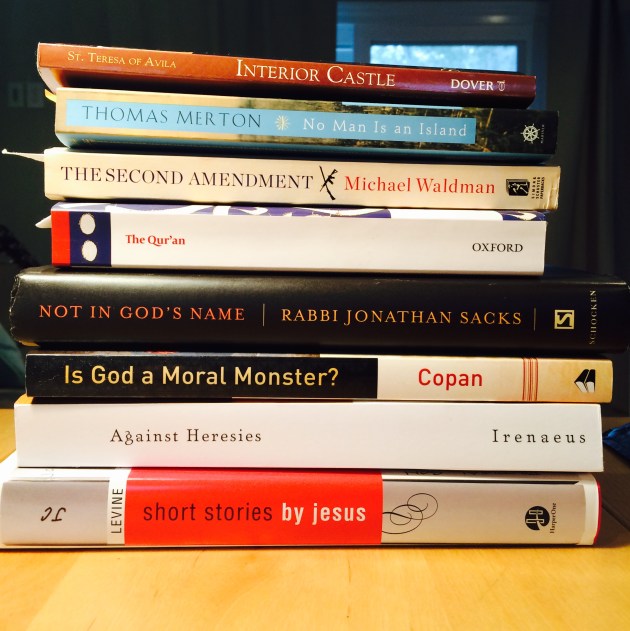
  1. Not in God’s Name: Confronting Religious ViolenceI love what Rabbi Sacks is highlighting with this book, namely (and I am greatly paraphrasing here) that the solution to religious violence (whether perpetrated by Jews, Muslims, or Christians in particular) can only be found in religion as it is properly understood. He shows how the “Abrahamic Faiths” (Muslims, Jews, and Christians) all share a story of a God who is radically inclusive and accepting. So far, this is inspiring and engaging.
  2. The 2nd Amendment: A Biography. As a self-avowed pacifist and (at least) “non-gun-owner”, the 2nd amendment—and specifically how it has been co-opted by the NRA to fight any type of gun control legislation—is pretty interesting to me. Waldman shows how the original amendment was written to balance “standing armies” and “well-regulated militias,” as well as how the 2nd Amendment took a significant turn (in regards to gun ownership) relatively recently.
  3. Against Heresies. St. Iranaeus was a bishop and church father from the 3rd century. His theology has had a significant impact on me personally, and I’m reading this in order to get things straight from the source, so to speak. The gist of his theology is a bit too deep to get into here, but suffice it to say that Irenaeus emphasizes spiritual growth and transformation in such a way that I think will be significant for the 21st century.
  4. Is God a Moral Monster? Copan tackles one of the more difficult subjects in the Bible: namely the apparent sanction of war and even genocide in the books of Joshua and Judges. Haven’t read too much of this yet, so I don’t have much to say, except that Copan appears to show that those “sanctions” or endorsements aren’t quite as clear-cut as we’d like to think.
  5. The Qur’an. Ever since the rise of ISIS in 2014, I’ve been trying to better understand Islam. (A super helpful book, by the way, is called The Great Theft: Rescuing Islam from the Extremists by Khaled Abou El Fadl.) One of my theology professors told me that he reads the Qur’an every year in order to have profitable conversations with Muslims, and he offered a reading plan that would help me navigate the text.
  6. Interior Castle. St. Theresa of Avila wrote this masterwork of Christian mysticism and prayer. I started this in November as part of my morning prayer time.
  7. No Man Is An IslandThomas Merton (along with Brennan Manning and Henri Nouwen) is one of my “g0-to” writers for meditation and contemplation. God continues to use him to challenge me to let go and become better at detachment. I read him constantly through the year.
  8. Short Stories by JesusAmy-Jill Levine is a professor at Vanderbilt Divinity School. She is the “next-level” in understanding Jesus in terms of Jewishness (Levine is Jewish). She brings a thoroughly fresh (and often very challenging) perspective to the parables and stories of Jesus. Really great stuff.
  9. The Ninth Book I’m excited about is the one I’m going to write this year. I have a few things “in process”, and this year is going to be about overcoming “The Resistance” and pushing through the end of this. It’s time to produce. To Make Stuff.

So this is how I’m starting my year; I invite you to engage with any of these with me, and let me know what you think!

What I’ve been up to (or “A Requiem for 2015 and Words for 2016”) 

Well folks, it’s THAT day. January 1. First day of the year. The “threshold day”, where you can look back at what was and look ahead to what might be.

In between. Liminal. (One of my favorite words, btw.)

It’s as good a day as any to set some words down and send them out into the inter-worlds.

What have I been up to? Where have I been? What will I be up to?

These are the questions I’m thinking about today, and the first few days of 2016.

What have I been up to?

Healing, mostly. Doing a lot of “soul work.” Mining in the darkest places (my heart and yours, folks) for the stuff that has been driving and haunting me for most of my life. I find them down there in the caverns and tunnels and nooks and crannies of my memory and consciousness, and then I haul them (with a fair amount of sweat and tears) up to the surface where they can lay in the sun, where the most amazing thing happens…

Because there they get changed. It’s funny how when the sun strikes something it changes it. If you hold it up to the light, it changes to light.

Things are healed and transformed. Wounds become scars which become stories which become the means by which we offer the world around us hope and healing and strength to go on for another day.

Trouble is, most of us don’t like to go to the mines… Mines are, by nature, dark, scary, and places of sweat, toil, and really hard work.

But that’s where the coal is. (And the diamonds.)

I’ve also been finishing Seminary. I shut down almost all creative output (“making”) around June/July in order to focus on the essentials: teaching and music on Sundays, being a husband/father, and cranking through the last few hours of my masters degree.

I ran a little bit more in 2015 than I ever have before. I ran two races: the first was a 10k in March that was difficult (actually, it kicked my butt), but I managed to finish without too much difficulty.

However, I had also committed to running a half-marathon in 2015, so on October 31 we drove up to Boston, Georgia, and I started running. Two and a half hours (and 13.1 miles) later, I staggered across the finish line, exclaiming, “This is the stupidest thing I’ve ever done.”

In a few ways, it was, but in many ways it was actually one of the more profound experiences of my life. I learned that the limits that we impose on ourselves are often more illusory than we believe. We can push back on the boundaries (some of which we impose on ourselves, some of which are imposed by others), and accomplish much, much more than we otherwise think.

I also learned that the only race you can run is your own. You can’t worry about other people. I was passed by grandmothers, and I passed teenagers. I learned that I had no control over what other people did: I could only put one foot in front of the other.

Lastly, I learned that, well, sometimes you can’t be “cool.” When I was pushing through the last 3 miles of that race, I had gone well beyond what I thought I was capable of, and I started breaking down, both physically and emotionally. I was in a fair amount of pain, had nothing left in the tank, and couldn’t see the finish line (at least in part because I run without my glasses), and I was on the verge of tears.

But I kept going, and the more I ran, the less I was capable of thinking about what other folks thought of me. For a person who admittedly makes “image” a part of their life (due to a calling that puts me on stages and in pulpits in front of people), this was really significant to me. I had no control over my image. I was a mess.

And I was okay.

I survived, and stumbled across the finish line, and lived to tell the tale.

So that’s a little bit of my 2015.

Looking forward, I have some thoughts about going into 2016. I’m not going to share all of my personal goals (at least yet), but here are some things that I’m passionate about, and that I’m challenging myself (and maybe you as well) to this year.

CHALLENGES for 2016

  • Seek beauty. Start with Hymn to the Cherubim (those Orthodox!)
  • Seek wholeness. Go to the mines yourself. The world desperately needs people who are on the journey towards healing, wholeness, transcendence, enlightenment. They don’t just need a holy club that’s going to heaven. They need (as Jesus would put it), people who are producing “fruit” (and fruit, on the whole tastes good). So go see a counselor. Get quiet. Become aware of the “thoughts” you’re having that aren’t really thoughts so much as they are reactive video tapes.
  • Elevate your thinking. Don’t be satisfied with what the media tells you (whether you are partial to FoxNews, MSNBC, Huffington Post or the Drudge Report). Look beyond the headlines, and evaluate what you hear and read. Have a conversation that makes you think, and that helps you consider something from another point of view.
  • Make something. The only way we are going to impact the culture is to make more of it. I’m paraphrasing author Andy Crouch, and I fully believe in it. The world is not going to change and evolve on its own; and spiritual people are called to help this world grow in love, compassion, and connection. So, write a blog; make some music; make some peace; make some crafts and give them away. Bless the world. 
  • Read something spiritual. Every day. My choice is the Bible, among other things, but you get the point: embrace Spiritual thinking and a Spiritual mode of being in the world.
  • Walk a little. Get physically healthy. We are unified beings: our physical health affects our spiritual health which effects our emotional health which effects our physical health and so on and so on.

So here we go, 2016! Let’s do this people!

Five Books That (Re) Shaped My Spirituality

I don’t know if you’re looking for something to read (I know I always am), but I thought I’d share some reads that have been pretty foundational in my life.

These five books really were responsible for some “left turns” in my life. They marked pretty large “sea changes” in my spirituality and belief. If you’re looking for something to challenge (and maybe even change) you, maybe pick them up and give them a read. Let me know what you think.

  1. Signature of Jesus. This book really changed the whole game for me. I’ve written about this before, but I just can’t begin to describe how much this book impacted me when I first read it. It called me deeper, beyond merely nodding “yes” (or shaking my head “no”) on a Sunday to a life of pursuing the rabbi from Nazareth. (Note: I’m still stumbling along.)
  2. Adam’s Return. I actually just read this a couple years back, but this was one of my initial exposures to Richard Rohr. More significantly, however, this was a powerful description of mature, Biblical masculinity. Though I read a lot of the popular evangelical attempts at this (Wild at Heart being the most popular), there was something in them that didn’t ring true to me. I could understand the barbarian/warrior metaphors but I also felt like they had a tendency to be destructive in my life. Rohr takes masculinity to the place where it most needs to go: to the cross and into the baptismal waters with Christ, and shows how our masculinity needs to be transformed—particularly in the vein of ego surrender and death to self—so that we can grow (old?) gracefully.
  3. The Illumined Heart. This little book was my introduction to the Eastern Orthodoxy. It was also a pretty significant step forward in my quest for a practical spirituality, an approach to faith that can be lived out in every day life.
  4. Surprised by Hope. Though I’d read a couple NT Wright books before, this was really the first one that catalyzed my understanding of his theology and started to re-shape my own. To be brief, Wright refutes the “practical gnosticism” in the church today that states that our ultimate destination is some kind of disembodied heaven. Wright reminds us that the Biblical view is that of resurrection. Our bodies matter; this world matters. When you understand that the point is not for us to be burned up, or that God’s just not going to throw the earth onto a trash heap, you realize that what you do now—whether it’s justice or art, discipleship, or service—has implications into eternity.
  5. The Divine Conspiracy. This book is a bit deep, and not always the easiest read, but this book planted inside me the revolutionary truth that Jesus wants to live his life through me. Spirituality is not “out there”, and Christianity is not something that is only lived through “special people” or “holy lives.” Rather, my life, right now, is where God wishes to take up residence.

So there they are. If you’re looking to open yourself up to some new ideas and/or new approaches to God and spirituality, I challenge you to dig into one (or more) of these.

Let me know how that works out for you…

Beck Spills Some Musical Truth

“It’s never for the glory, it’s for the satisfaction of blowing up a gig. a lot of people are satisfied with a video. Those who aren’t satisfied with a video will buy the album, and then there’s a few who get the album who will go to the show. That’s where it’s human beings, and that’s what we live for. That’s where it gets sick. If it’s all on video or all on record everything is proper and everyone is minding their manners. We like to get in there and cause a commotion. That’s music; that’s the way it’s meant to be.” Beck.

I love this quote. It actually came off of a show called Sessions at West 54th that used to air back in the 90s. It featured really great bands and musicians  playing absolutely live and in the round. It was an intimate venue that allowed great artists to put killer abilities on display.

At some level I will always be a live musician. I used to be intimidated by the studio, but got over that fear (thanks to a lot of work with a metronome, amongst other things), but it still always comes down to the live event, the exchange of sweat and blood and volume and energy that happens when you’re just pouring it out on a stage, and people are soaking it up and nodding their heads up and down and moving with energy. It’s always great to just let the moment take you, to throw aside perfection in favor of the power of a moment.

That’s still where it’s at.