You Have to Know Your Story

Last week I was in Dallas to lead worship with some friends of mine. My in-laws also live in the area, so I spent the night with them, and ended up driving around Arlington, marveling at how the area had grown (and shaking my fist at Texas Stadium, but that’s another story). Driving through the warm Texas fall, I noticed something that I found utterly fascinating.

Arlington has mostly always been a place of strip malls and—to my eyes anyway—awful urban planning. It has been marked by the worst of our public space and architecture, of a lack of awareness of history and human scale. In some ways, this trip merely confirmed all of that: ugly buildings that were merely twenty years old had been destroyed to make way for new ugly buildings. Chain businesses that had been thriving years ago had been rebranded and become new chain businesses that were now (for the moment) thriving.

But then I noticed something else.

Astonishingly, in the midst of this urban/suburban renewal and sprawl, I found two unlikely establishments that had somehow weathered the storm, and were still open,—twenty-plus years later—and were still going strong.

photo-4Out to breakfast with my father-in-law, we were driving down Division street when I asked him to slow down. There, set back from the street about 50 yards, was  “The Gold Nugget”. This place was really special to me and my wife, since it was the place where we really began dating. Back in the day it had a stage, and a volleyball court out back, but here’s the deal: in 1992 this place was a bit dingy, and a throwback. How in the world is it still in business? 

As I left Arlington and drove to Garland, I drove up Collins Street, past Cowboys stadium. Almost immediately across from that monstrosity was a tiny restaurant called “The Pitt Grill”.

That’s right: that’s the name.

Image via rollbamaroll.com

Image via rollbamaroll.com

I don’t know how long the Pitt has been in business. I know that I used to go there and get greasy eggs and bacon (mmmmm bacon) twenty years ago, and as best I can tell, greasy eggs and bacon are still on the menu today.

The Pitt has no website; neither does the Gold Nugget. Yet these two businesses somehow have weathered the storm of development that has utterly remade (and erased) most of Arlington.

There is no sleek, modern design in their dining rooms…

They don’t serve sushi…

They don’t serve any form of fusion…

I’m pretty sure their bartenders don’t have ironic handlebar mustaches…

While I have no doubt that their bills are manageable (seriously, they’re really not the nicest of places), I think what struck me about The Gold Nugget and The Pitt is that ultimately they knew who they were. I’m sure that over the years they grew a little, and got really good at what they did, essentially these businesses are doing the same thing that they did 10 years ago, 20 years ago, 30 years ago. They’ve seen probably fifty businesses come and go around them, and they still plug on.

The Gold Nugget and The Pitt remind me that you have to know who you are.

The Pitt and the Gold Nugget know what they do, and I have no doubt that they do it consistently.

I have no doubt that they have great stories to tell.

I think of churches that I’ve talked to that have essentially a beautiful traditional service that suddenly feel called to create an awkward and sparsely attended rock and roll service, merely because “that’s what you’re supposed to do.”

I think of leaders who are trying to be something that they obviously are not, struggling with authenticity (by the way, the people you lead can see it) without questioning why they are trying embrace this.

Meanwhile, all that many people “out there” in the world are asking for is for churches, organizations, and leaders that

  • quietly and confidently live out who they are (sometimes in the face of a radically changed world)
  • tell stories about what they’ve seen and what they’ve done

How well do you know yourself? How well does your church or organization? Are you living out your story? Or someone else’s? 

*e

=========================================

Give It, Plus Coming Up…

Hey everyone…

Not really a post today, so much as a “Thank You” and an encouragement for you all to do the same.

  • Thanks for all the encouragement and contributions you all are making here; it’s encouraging to me, and I hope we can continue to learn and explore together…
  • Take a couple minutes (at least) this week and consider gratitude, and where you can be thankful; I know I’ll be doing that this week with family and some friends…

In the next few weeks, I’m going to be starting a new series, called something like “When Good News is Really Good”. I want to take a look at the Four Gospels, and consider some of the interactions and teachings of Jesus in a way that (hopefully) will be new and enlightening for us all.

Until then… have a great Thanksgiving.

under the mercy

eric

++++++++++++++++++++++++++++++++++++++

Resting, Hearing

This Sunday, we announced to my church that I’m going to be taking some time away.

No, I’m not in trouble.

For probably 4 years now, I’ve been trying to discern what God may be calling to for the next season of my ministry and life. I’ve been in ministry for 15 years, and almost of all of it exclusively focused around music on Sunday. Recently, however I’ve started to wonder if my role may be evolving a bit to more purposefully include teaching and leadership. After a few conversations with my pastor, we decided that I should take a few months (!) and go into “listening” mode to try and more clearly hear what God is saying and how He may specifically be leading me and my family.

This is called a “Sabbatical”, and is directly related to “Sabbath.” The Sabbath—and also Sabbaticals—was established by God in Genesis 1, and then reaffirmed a few times in the bible, especially in Exodus. We’re told in Genesis 2v1-3, “So the creation of the heavens and earth and everything in them was completed. On the seventh day God had finished his work of creation, so he rested from all his work. And God blessed the seventh day and declared it holy, because it was the day when he rested from all his work of creation.”

You know what strikes me about this passage?

God wasn’t really “done.” 

Surely God knew that even though he’d brought the universe into being, creation—and the act of creating—wasn’t “done.” Creation is alive, growing, changing. Adam and Eve exist after all, now, and who knows what manner of variables they’ll bring into the picture! (Note see Genesis 3.)

Surely God wasn’t saying, “Whew, that’s done; guess I’ll just sit back and watch it all take shape now.”

I believe that God really knew that actually after you’ve created something—say, the Universe—the real work begins… Conflict, love, hate, war, sacrifice, salvation. All of these things begin to enter the picture after you’ve created something.

It strikes me that even though God is aware that creation is anything but “done”, he is choosing to rest. 

Your work is rarely (if ever) going to be “done” enough for Sabbath to make complete sense.

You will have to choose.

You will have to say, “For today, this is done. I am resting now.” 

I am NOT a “Book Guy”

Contrary to popular perception, I’m not a book guy.

Honestly.

<glancing nervously>

No, really I’m not…

… I don’t have a problem.

Okay, let me defend myself. I’m not a book guy; I’m an idea guy.

I’d actually like to think that I’m a growth guy.

I’m hungry for growth—maybe desperately hungry—and to my mind there are two ways to grow.

The first way is organic and incremental. “Slow and steady wins the race.” You get up and do the same things repeatedly, in order to feed yourself and feel yourself (though actually you don’t always perceive it) steadily growing and changing.

(I am lousy at this.)

Don’t get me wrong: I try. I have disciplines in my life, and I do my best to establish healthy rhythms and practices of grace and growth. But it is a consistent struggle.

The second way to grow is punctuated, evolutionary. It can occur when something—an idea or thought—enters a system that forces that system to change.

  • a thought
  • a concept
  • a belief
  • an action

Sometimes, we can look for experiences to introduce variables: concerts, art galleries & installations, conferences, etc.

But sometimes funds and time prohibit these experiences. In this case, we can turn to shorter-term, less demanding “variables”, like movies (documentaries, please), television shows…

… and books.

Books are not the point. Growth is.

If I recommend—or give—a book to you, I don’t want you to read it. 

I want you to grow.

What about you? How do you introduce new “variables” into the system of your life? When is the last time you allowed yourself to experience something new in order to grow?

Weapons of Mass Production, Pt 1

Something different today…

As a pastor, I have to balance my life between efficiency and love.

This is not easy, because these two concepts are nearly mutually exclusive.

But that’s my reality.

I have to cultivate efficiency because I’m a part of an organization, I lead a team of busy people, and we try to accomplish various things.

I have to “get things done.”

I have to cultivate love because as a pastor I’m charged ultimately with trying to help people cultivate the Spirit of God in their lives.

Most of the time it involves long conversations, sometimes sitting in silence with people as they cry.

This is seldom “efficient.”

Looking at the efficiency side of things first, I thought I’d list some of my most helpful tools. I’m not naturally organized and linear; I’m actually rather distracted, and can be more than a little spacey. I need tools and techniques in my life to help me “ship” and to be present—physically, emotionally, spiritually—when I need to be present.

I need efficiency in order to love.

So here are a few:

  • Getting Things Done. This book forms the backbone of how I organize my life. In a very concise nutshell, everything that you have to do in your life—pick up groceries, finish the TPS report, learn songs for band practice, etc.—is taking up mental energy that you need for the most important/creative work that you have to do. So you get it out; you write everything down in a brain dump, and then you organize it and begin to tackle it. If you’re just getting started in productivity, or looking for a new way to organize your life, take a look at it.
  • OmniFocus. This app is my primary day-to-day task manager, and integrates well with Getting Things Done (GTD). They make it an iPad and iPhone version, as well as a desktop version as well. It syncs—fairly seamlessly—in the cloud and so my tasks are always with me. Very, very powerful, but very helpful (and also pretty beautiful, especially on the iPad and iPhone). The Omni Group make very, very good software. Everything I have to do goes in here, from writing exercises, to meetings, to events, to weekly worship planning.
  • Evernote. Evernote is critical to grabbing ideas, storing pdfs, sermon ideas, meeting agendas, even songwriting ideas. I use Evernote for anything that I want to have readily available. It’s powerful and simple. A great, great tool; make sure you get the mobile version(s).
  • Merlin Mann’s “Inbox Zero” Talk at Google. Merlin is passionate about productivity; he is also irreverently funny and brilliant. This talk (it’s almost an hour long, btw, so set aside enough time) has the capacity to radically change your approach to email. I’m still struggling to get to “Inbox Zero” myself, but it definitely woke me up to some of the pitfalls of email, and how I’d been using.
  • Moleskine notebooks. Part of the GTD system is capturing all the ideas that have the potential to drain your creative energy and distract your and writing them down so you don’t have to think about them. In order to do that, keeping various notebooks on hand is important. My primary notebook is 8×5 1/2 (alternating between squared and blank pages), but I also use 8×5 1/2 cahiers for various bible studies and class notes, a reporters notebook for my car, and finally an extra large notebook that I use as a sketchbook for larger-scale creative brainstorming.
  • Moleskine year calendar. Though I use iCal for my day-to-day calendar, when things get really crazy I reach for a paper calendar. I find that my relationship between me and my calendar changes when I actually have to write things down: I remember more things, but I also get more critical about what I’m doing. I’m somehow more emotionally present to a paper calendar, and that forces me to examine what I’m doing, and why I’m doing it. The large calendar also allows me to see my week at a glance and to easily identify blocks of time that are either being used or are “unseized.”

There are so many tools out there, but these are the ones I keep in my box. These are my efficiency tools.

Do you have any that you share?

Random Thoughts on Prodigals…

“Why did he let me leave in the first place?”

I wonder if the son who fled—we know him as the Prodigal—ever thought that?

Though I know this story from Luke 15 is (a) a parable, and (b) more about the radical behavior of the Father than it is about the son, nevertheless I found myself thinking about the son this morning.

Maybe it’s because I’m such a good prodigal.

Maybe the best there ever was…

Regardless, two things struck me this morning.

Question #1: Why did the Father let the son leave in the first place? 

Surely He knew better; the Father knew the son’s character better than anyone else. He knew what was going to happen. Do you think the gambling, the women, the lavish spending (probably on the ancient near east’s equivalent of Beats headphones and bad car lease agreements) just happened over night?

The Father knew what was up with His son.

And yet He let him go. Why?

Why not protect everybody from the pain—the hell—that was just around the corner. It would’ve spared so many people so much pain.

I think the Father let him go because He loved him; I think He let him go because He knew that maturity largely comes from making choices and experiencing consequences, as painful as that can be. 

And that, ultimately, only mature, free-choosing people can love. 

Love hurts (yes, Gram/Emmylou/Nazareth/Norah/Keith).

But in order to produce, loving mature human beings, a parent has to risk disobedience. That’s what the Father does, even though it costs everyone something.

But could the son ever learn to love without growth?

Question #2: What About Shame? 

If you remember the story, you know the basics: a son asks his father for his inheritance “early” (“Dad, can you go ahead and die? Yeah that would be great…”), and then takes off spending pretty much everything on those things—the same things that most of us would spend free money on if we were eighteen. He winds up broke, alone, and far away from home, eventually ending up working as a servant, feeding pigs and hungry for their food.

Assume, for just a moment, that in an ancient culture like this one, “honor” and “reputation” are paramount concepts…

“Our Father who lives in the heavens, may Your name be kept holy…”

Assume, for just a moment, that this honor and reputation were visibly represented by a family’s father; it’s his job to guard that honor and defend it…

“Our Father who lives in the heavens, may Your name be kept holy…”

Assume, for just a moment, that this son has succeeded in bringing down shame and dishonor to his family, in particular his father. 

“Our Father who lives in the heavens, may Your name be kept holy…”

Assume, for just a moment, that—rather than keeping his father’s name “special” (“holy”, anyone?)—he has actually succeeded in associating that name with the worst of what humanity can offer…

… cheap, humanity destroying sex

… conspicuous and wasteful consumption

… immoral (or worse yet?) amoral living

… narcissism that doesn’t give a crap about anyone

What does the son do when he hasn’t kept his father’s name holy?

What does he do with that shame? 

But there’s something about the father…

I think shame is cyclical: we shame others out of the shame we feel.

We cast guilt onto others because of the hidden guilt we carry around in us.

But what if you feel no shame? 

Or rather, what if you’ve decided to break the cycle of shame inside you forever by experiencing the most shameful thing you can imagine?

How about a public death?

… an execution?

… as an innocent?

… as a terrorist?

When you know the worst of what shame and guilt can do, and you embrace it, it has lost its power. 

And you’ve broken the cycle.

This Father knows suffering; He will know shame; He will know rejection and death…

… and He’s not afraid to embrace it.

Thus, He destroys its power.

It’s no longer part of the equation.

Ultimately, He is not ashamed of the son, because His name cannot be shamed by the son. The son can freely forgive without shame or condemnation because he has broken that perpetual cycle. It’s over, and all that’s left are tears of welcome, hugs, and a big celebration.

That is all…

Well, almost all…

Like it or not, this was the first version that I heard of that song… ah the summer of 76

(p.s. how does that guy sing so high? maybe a combination of the leather pants and facial hair)

Walls.

First, this: I don’t believe in “creative walls.”

You either do the work or you don’t.

But there are other walls, I guess, and I think I just hit them.

About 6 months ago I decided to post twice a week, no matter what. And up to last week, I managed—though sometimes just barely—to do it.

But last week, I couldn’t/didn’t push through. School started for my kids; summer semester wound down for me; work, life and ministry (or maybe it’s better described, “worklifeministry” pushed on.

But I’ve managed through this before. So why did I stop? 

I think it’s because it began to feel successful…

I originally committed to posting so frequently because I sincerely wanted:

  • to develop my writing/teaching voice
  • to stretch myself with a goal
  • to try and speak to people about this God I know, and this life that I’m trying to lead

I’ve received a ton of encouragement from everyone here; and I believe that I’m being called to keep writing, and keep speaking, and keep teaching.

…But what I have to confront is the idea that those things quickly become meaningless.

I’m constantly tempted to find fulfillment in everything around me, the things I can see, touch, taste. I feel like this is truly “Spirituality 101), but even at my age, I still do fall victim to it.

So when the statistics—site hits, twitter followers, “likes”, comments, etc.—start to go up, I keep expecting to feel better.

But I don’t.

Because I’m not supposed to.

Don’t get me wrong: these things are blessings. I want to keep writing. I want to speak to more people—go ahead, tell them!—and to help people wake up to the reality of God in their lives.

But those things don’t bring peace, don’t bring shalom at the end of the day.

That peace is only found in abiding deeply in the peace and love of God.

In sabbath and “family rest”.

In rich and satisfying worship.

In meals together with friends.

In slowness.

Ultimately, I’m so grateful for everyone’s encouragement; as I said, I’m going to keep writing and wrestling with stuff.

But moreso, I’m glad for a God that reminds me that there are more important things than this.

‘Everything is meaningless,’ says the Teacher, ‘completely meaningless.’

Keep this in mind: The Teacher was considered wise, and he taught the people everything he knew. He listened carefully to many proverbs, studying them and classifying them. The Teacher sought to find just the right words to express truths clearly.

The words of the wise are like cattle prods—painful but helpful. Their collected sayings are like nail-studded stick with which a shepherd drives the sheep.

But, my child, let me give you some further advice: Be careful, for writing books is endless, and much study wears you out.

That’s the whole story. Here now is my final conclusion: Fear God, and obey his commands, for this is everyone’s duty. God will judge us for everything we do, including every secret thing, whether good or bad.  -Ecclesiastes 12:8-14

FEEL FREE TO COMMENT. I’m ready.

=================================================

Know Your Core

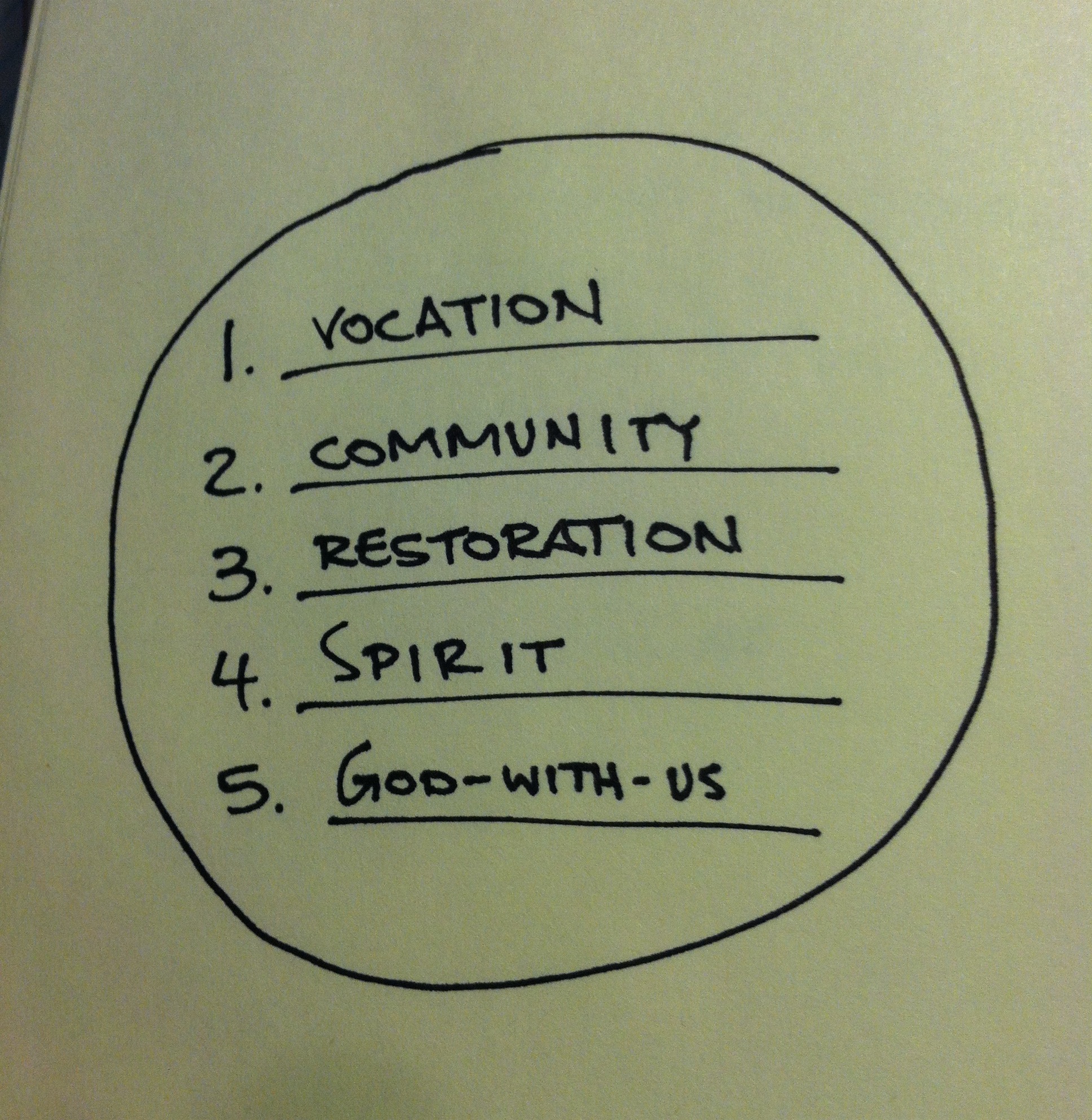
At Willow Creek’s 2011 Global Leadership Summit (hollah), Bill Hybel’s challenged us to be aware of how we would summarize the central message of Christianity:

“What five words would you use to describe the gospel?”

He had everyone draw a circle, and then write the five central messages inside the circle. Everything inside that circle should be driving your mission; those words should be connected vitally with your mission, either as an organization or an individual. 

My core

Question 1: What are your five words?

Question 2: Are you living them out?

===========================================
Four Ways Gigging Made Me a Better Worship Leader / Church Musician

One of my favorite quotes is in the movie Rocknrolla: 

There ain’t no school like the old school and I’m the #@$%@#$% headmaster.

When I started playing guitar, playing in church was not an option. Our church was a piano/organ place, and we only did acoustic guitar on a very, very rare occasion.

In fact, as crazy as this may seem, I never heard real electric guitar—not the heavily compressed, chorused, thin sound—in church until I was probably 30 years old.

So, musically, all my formative years weren’t spent in a youth band; they were spent in clubs.

This is what I think I learned:

  1. Be excellent, quickly.My first gigs were in a cover band. Two hundred dollars for a night (for the whole band). Two 60-90 minute sets. You were paid to be the entertainment. If you couldn’t grab the crowd’s attention, than you (a) were going to have a boring night and (b) weren’t going to be invited back. You had to get their attention, and then hold it. Probably the most extreme situations were when we’d play for a group of bikers; the pressure to entertain and “be cool” was definitely heightened. You had to be on your game.By contrast, church is mostly a captive audience. They’ll tolerate mistakes and give you second chances. However, just because the congregation lets you get away with a bad note doesn’t mean you should let yourself get away with it.
  2. Have your gear together. Even in the era of Guitar Center, you still couldn’t find a place to buy a cable at ten o’clock at night (maybe you still can’t). I remember driving 3 hours to a gig where the drummer forgot his hi hat stand. Outcome: gig with no hi hat. You had to double-check your stuff, and be prepared. Churches today come stocked with complete drum kits, miles of cabling, and usually a tuner (or 4) lying around. It’s nice to have a backup plan, but it’s also unprofessional to show up without a guitar strap. It assumes that someone will take care of you.
  3. Expect the worst. I remember playing a gig in this big wooden room that was essentially tuned to Ab. Every time we hit that note (which we did a lot, because we tuned 1/2 step down), the whole place would erupt with Ab feedback. It made for an interesting set. I also never knew that multiple monitor mixes were even possible until I was probably 25; my first 10 years of playing were spent learning to hear my voice—and the other instrumentalists—in one mix (that was usually too quiet).These days—if I can sound a bit crusty—a church is considered a bit lacking if the Aviom mix isn’t in stereo. Listening—and thus true interactive musicianship—isn’t based on the quality of your monitor mix; it’s based on the discipline of working to hear everyone on the stage, and to be aware of what they’re playing and how it impacts what you’re playing.
  4. God is everywhere. Though I wasn’t always firmly rooted spiritually, I learned that beautiful music can be made in the dirtiest places. On my final (probably) jaunt around the country, I was playing a gig in Lawrence, Kansas. The band I was in “gave in” to the crowd and played a (somewhat ironic) version of “Freebird.” As I played that ridiculous slide part, I practically heard God speak to me, “Do not think for one minute that I’m not hear in this bar. Do not think that you cannot send these notes to Me as worship—as thanks—right here in this moment and in this place. I am here.” 

    Though the church as a body is sacred and essential, God is also everywhere. When you only play music on Sunday morning, or only for your youth group, it’s easy to fall prey to the idea that God is only in the church, or that He is only “listening” to corporate worship music (that is often too safe). Playing music in so many environments helped me understand that God is out there, always moving, sometimes even moreso than what we see on Sunday.

Anyway, that’s it. I’m old school, but I think we do well to make sure our church musicians are seasoned and prepared, and have as wide a view as possible of God’s activity in the world.

Sermon Thoughts from This Morning

For any interested, here are the lyrics to “Trapped” by Jimmy Cliff (via Bruce Springsteen), that I referenced this morning.

Well it seems like I’m caught up in your trap again

And it seems like I’ll be wearing the same old chains

Good will conquer evil, and the truth will set you free

And I know someday I’ll find a key

Yeah I know somewhere I’ll find a key

Well it seems like I’ve been playing your game way too long

And it seems the game I’ve played has made you strong

But when the game is over, I walk out  a loser

And I know someday I’ll walk out of here again

Someway I’ll walk out of here again

But now I’m trapped…

Well it seems like I’ve been sleeping in your bed too long

And it seems like you’ve been meaning to do me harm

But I’ll teach my eyes to see beyond these walls in front of me

And someday I’ll walk out of here again

Someday I’ll walk out of here again

But now I’m trapped…

<take it away, Clarence “Big Man” Clemmons>

Well it seems like I’ve been playing your game way too long

And it seems the game I’ve played has made you strong

Cuz now I’m trapped…