I am NOT a “Book Guy”

Contrary to popular perception, I’m not a book guy.

Honestly.

<glancing nervously>

No, really I’m not…

… I don’t have a problem.

Okay, let me defend myself. I’m not a book guy; I’m an idea guy.

I’d actually like to think that I’m a growth guy.

I’m hungry for growth—maybe desperately hungry—and to my mind there are two ways to grow.

The first way is organic and incremental. “Slow and steady wins the race.” You get up and do the same things repeatedly, in order to feed yourself and feel yourself (though actually you don’t always perceive it) steadily growing and changing.

(I am lousy at this.)

Don’t get me wrong: I try. I have disciplines in my life, and I do my best to establish healthy rhythms and practices of grace and growth. But it is a consistent struggle.

The second way to grow is punctuated, evolutionary. It can occur when something—an idea or thought—enters a system that forces that system to change.

  • a thought
  • a concept
  • a belief
  • an action

Sometimes, we can look for experiences to introduce variables: concerts, art galleries & installations, conferences, etc.

But sometimes funds and time prohibit these experiences. In this case, we can turn to shorter-term, less demanding “variables”, like movies (documentaries, please), television shows…

… and books.

Books are not the point. Growth is.

If I recommend—or give—a book to you, I don’t want you to read it. 

I want you to grow.

What about you? How do you introduce new “variables” into the system of your life? When is the last time you allowed yourself to experience something new in order to grow?

Weapons of Mass Production, Pt 1

Something different today…

As a pastor, I have to balance my life between efficiency and love.

This is not easy, because these two concepts are nearly mutually exclusive.

But that’s my reality.

I have to cultivate efficiency because I’m a part of an organization, I lead a team of busy people, and we try to accomplish various things.

I have to “get things done.”

I have to cultivate love because as a pastor I’m charged ultimately with trying to help people cultivate the Spirit of God in their lives.

Most of the time it involves long conversations, sometimes sitting in silence with people as they cry.

This is seldom “efficient.”

Looking at the efficiency side of things first, I thought I’d list some of my most helpful tools. I’m not naturally organized and linear; I’m actually rather distracted, and can be more than a little spacey. I need tools and techniques in my life to help me “ship” and to be present—physically, emotionally, spiritually—when I need to be present.

I need efficiency in order to love.

So here are a few:

  • Getting Things Done. This book forms the backbone of how I organize my life. In a very concise nutshell, everything that you have to do in your life—pick up groceries, finish the TPS report, learn songs for band practice, etc.—is taking up mental energy that you need for the most important/creative work that you have to do. So you get it out; you write everything down in a brain dump, and then you organize it and begin to tackle it. If you’re just getting started in productivity, or looking for a new way to organize your life, take a look at it.
  • OmniFocus. This app is my primary day-to-day task manager, and integrates well with Getting Things Done (GTD). They make it an iPad and iPhone version, as well as a desktop version as well. It syncs—fairly seamlessly—in the cloud and so my tasks are always with me. Very, very powerful, but very helpful (and also pretty beautiful, especially on the iPad and iPhone). The Omni Group make very, very good software. Everything I have to do goes in here, from writing exercises, to meetings, to events, to weekly worship planning.
  • Evernote. Evernote is critical to grabbing ideas, storing pdfs, sermon ideas, meeting agendas, even songwriting ideas. I use Evernote for anything that I want to have readily available. It’s powerful and simple. A great, great tool; make sure you get the mobile version(s).
  • Merlin Mann’s “Inbox Zero” Talk at Google. Merlin is passionate about productivity; he is also irreverently funny and brilliant. This talk (it’s almost an hour long, btw, so set aside enough time) has the capacity to radically change your approach to email. I’m still struggling to get to “Inbox Zero” myself, but it definitely woke me up to some of the pitfalls of email, and how I’d been using.
  • Moleskine notebooks. Part of the GTD system is capturing all the ideas that have the potential to drain your creative energy and distract your and writing them down so you don’t have to think about them. In order to do that, keeping various notebooks on hand is important. My primary notebook is 8×5 1/2 (alternating between squared and blank pages), but I also use 8×5 1/2 cahiers for various bible studies and class notes, a reporters notebook for my car, and finally an extra large notebook that I use as a sketchbook for larger-scale creative brainstorming.
  • Moleskine year calendar. Though I use iCal for my day-to-day calendar, when things get really crazy I reach for a paper calendar. I find that my relationship between me and my calendar changes when I actually have to write things down: I remember more things, but I also get more critical about what I’m doing. I’m somehow more emotionally present to a paper calendar, and that forces me to examine what I’m doing, and why I’m doing it. The large calendar also allows me to see my week at a glance and to easily identify blocks of time that are either being used or are “unseized.”

There are so many tools out there, but these are the ones I keep in my box. These are my efficiency tools.

Do you have any that you share?

Know Your Core

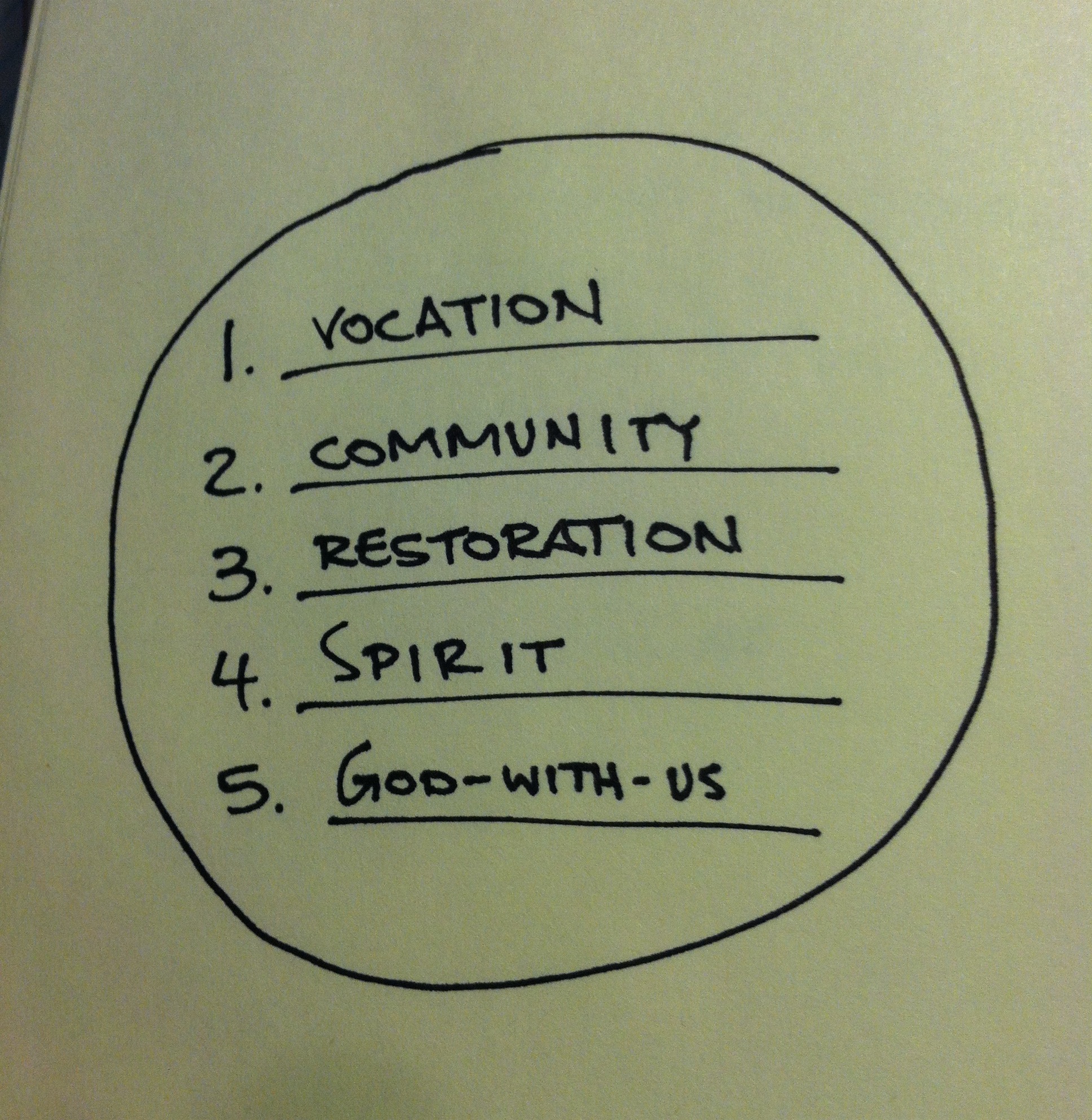
At Willow Creek’s 2011 Global Leadership Summit (hollah), Bill Hybel’s challenged us to be aware of how we would summarize the central message of Christianity:

“What five words would you use to describe the gospel?”

He had everyone draw a circle, and then write the five central messages inside the circle. Everything inside that circle should be driving your mission; those words should be connected vitally with your mission, either as an organization or an individual. 

My core

Question 1: What are your five words?

Question 2: Are you living them out?

===========================================

Worship “Satisfaction”

I read this post last week…

At first—because I’m slightly neurotic—I was really convicted by it, if for no other reason than I, um, often play guitar solos during worship songs.

Forgive me.

But the more I read it, I actually got a little tweaked (full disclosure: if it’s not obvious already, I’m a worship pastor, so as my southern friends would say, I have at least a few “dogs in this hunt”).

As usual, I think of reality more in terms of a tension to be lived in, between the truth of what Bill says and another perspective.

Here are some thoughts from another perspective. Warning: possible frumpiness to follow.

  • I love me some hymns. Love ’em. Believe in them. But the church I serve in is not a hymn-heavy church. We do 3 or 4 a month. There are hymn-heavy churches in town, however, and there are also churches who worship through liturgy, through silence, through choirs.The point is practically all of our churches exist in the flow of a tradition, and this is a good thing. My non-denominational, evangelical church is not going to become high church Anglican. We will not become full gospel AME. While we do our best to learn from other traditions and to give people a wide(r) glimpse of the church, I think that when we constantly question our own tradition we cultivate a sort of eccesiological multiple personality disorder.

    I think there’s a certain amount of wisdom to looking at your church tradition and culture and acknowledging the truth of where it’s been and what it is. Now culture isn’t frozen; we are meant to grow and change, but God created culture. It is a gift, at least a partial recognition that humanity is so diverse. There’s no point in freezing or elevating one form of worship culture and saying, this is what we need to do. 

  • Sometimes, worship participation is simply a matter of discipleship, of the heart.There I said it.

    Now, I realize that I may need to cut my guitar solos short. I accept that chastisement. But I think responsibility needs to be spread evenly. If an individual isn’t willing to sing, “Holy is the Lord,” then I really can’t make them. Ultimately, I am not the worship leader, the Holy Spirit is, and if a person is unwilling to follow the Spirit to God, then so be it. It’s a reality of my call, but I accept it.

    A word about “seekers” (whoever they are): I once heard Erwin McManus say, “if your church doesn’t have problems of heresy and immorality, than you’re probably not missional enough.”

    If we are engaging the world, there will be a certain percentage of people who simply “aren’t there yet.” As I just mentioned, I acknowledge that’s a reality of my job. There will be people in our gathering space who actually don’t have a clue who Jesus is, much less what worship is, and I need to respect their journey.

    But for those of us who are “in the know,” I think there comes a time when we have to simply say, “I’m here to meet with God; I will open my mouth and worship—not only to remind myself of who He is and what He has done, but so that I can be an example to other folks who are at a different part of their journey.” My church is primarily young people: young(ish) families and some post-college and college kids. But we have some older folks as well. One day, an older gentleman (in his 70s) said to me, “You know, I really don’t like the music at all. But God is at work here, so I’m just happy to be here and be a part of something.”

  • Which leads me to my last point…It’s not about you.

    I once led worship in a multi-cultural, multi-ethnic church; our Sunday set lists included modern gospel, songs in spanish, rock stuff (and an occasional hymn lol). Our pastor once said, “Hey guess what you guys: no one here is going to be completely satisfied with worship. THAT’S NOT THE POINT. We don’t come here to just get. We come here to give.” Because that church was clearly diverse, it was easy to grasp the idea that we all need to give up something to worship cross-culturally, but I think the principal holds true for us in mono-cultural worship settings as well:

    worship is first for God, then for us. Worship often overflows into love back from Him to us, but that’s not the point.

    We worship first because of who He is and what He has done for us, not because of what we may get out of it right now.

When I have the rare opportunity to sit under someone else’s leadership, I have the same feelings:

  • “Man, I don’t like this song…”
  • “She’s repeating that chorus too many times…”
  • “The mix is HORRIBLE…”
  • “He’s going to kick that water bottle over…”

In other words, I’m not immune. But I remind myself in those times that this moment is what I’ve been given, and it’s up to me to direct my heart, soul, mind, and strength towards my Creator and Savior.

It’s my choice.

In closing, I’d say this: you don’t sing at my church because you don’t want to sing at my church. It’s really that simple. In a sense that’s okay. And also, I hear the corrections—I don’t want to be a rock star worship leader—and I realize that we need to create an environment that facilitates people meeting with God and tells the story of our faith.

But it’s never gonna be perfect.

Take it away, Mick…

Four Suggestions for Navigating Vocational Change

What do you do when you feel like you’re being called to embrace a new identity, a new call on your life? How do you embrace a new role?

I was talking to a friend of mine this week who believes she is going through a change in her calling. She is leaving behind the familiar rhythms and demands of what she’s known for a while, and choosing to embrace the mystery of this new thing that God is doing in her life.

She asked me the other day for some practical ways to embrace this new thing in her life.

  1. Adjust your schedule. When my call was wrapped up solely in music and songwriting, a portion of my week—usually on Wednesday—was dedicated to songwriting. In 2009/2010, my call began to change to teaching; in response a portion of my week became dedicated to study. When your call begins to change, you need to dedicate time to reflect this new call.
  2. Adjust your information. While I am the pastor of musical worship at my church, it’s my responsibility to seek out new music and new sounds. I need to challenge myself with new sounds and new approaches. However, because I take my call to teach seriously, I’ve begun making sure that I’m consuming information and ideas that push me forward as a thinker and communicator. If you are moving into a new area of vocation and/or ministry, you need to first label that new area (“teaching”, “leading”, “writing”, “leading worship”, etc.), and then go seek information (one of the most valuable resources for me with this is Amazon’s “Customers Who Bought This Item Also Bought” feature).
  3. Adjust your conversations. As you are able to identify and name/label your new identity and call, seek people who (you think) are already in that role to have lunch or coffee. These meetings do not always need to involve direct, “Tell me how to live this out” questions. Often, they can begin with simply, “Tell me your story.”
  4. Be open to a disruptive experience. Don’t discount the fact that your new call may need to be reinforced or confirmed by an experience that is disruptive or different. Spiritually and emotionally, place yourself in a position of openness, and watch and listen. Often, we receive confirmation and earth-shaking revelations through conferences, prayers, or even concerts and films. Allocate resources (time, money, etc.) to put yourself in a position to have a disruptive experience that might just be a game changer for you.
  • Have you ever had to navigate a major vocational or identity change? What helped you move into this new area of calling?

Between Two Visions

apologize ahead of time for the length of this, but this has been on my mind for a while now, and I wanted to share it. Hopefully it all makes sense. 

I’ve worked for churches now for 14 years.

I know I’m supposed to say something higher, and more important sounding, like, “I received a call into full-time ministry at 29, and have been in vocational ministry ever since.”

I know that’s what I’m supposed to say, but I’m not sure that I can, at least with any honesty. At the very least, I’m not sure that I wasn’t doing ministry when I wasn’t working for a church, and I’m not sure that all the things I’ve done in a given week working at a church were actually ministry.

Does that make sense?

So I’m hesitant to call it more than what I think it is. I’ve worked at churches—on and off, full-time and part-time—for 14 years. During that time, I’ve planted churches, done music, taught, shared sorrows and joys with folks, and had a few hard conversations. I’m sure ministry “happened,” but I’ve always been challenged with my role and activities in the context of a church, specifically….

Am I a pastor? 

Most of the time I think I am. I try to be the best shepherd I can be, and try to counsel, encourage, and challenge people as the Spirit leads.

But I know that there’s this other side to me: the side that is gifted with very public talents (we call them “up front” gifts): singing, playing guitar, teaching.

These two sides of me struggle. One side is bathed in humility; the other is extremely comfortable in a spotlight (did the 1st century church have spotlights? never mind.) 

This is a really important place for me to be—between two visions of my “work”—and I think more than a few of us “in the business” of ministry are there as well. I’ve heard stories lately of a few really gifted church teachers and communicators who have left behind their positions. Some of them have left their church communities entirely, others have merely changed their roles to allow them more time to pursue the creative endeavors that they are amazingly gifted at. They’ve tended to couch their reasoning in language like this, “We want everyone to be free to pursue who God has called them to be; something has been nagging at us for a while, growing inside, and we’ve come to believe that we should be moving into (insert “movie making”, “drawing”, “screen-writing”, “book writing” or whatever here), and we need to follow that call of God on our lives. Since that’s what we believe should be happening with you, we should model that.”

Trust me: I know this language. Deeply. I know that God gifted me to communicate through music, and I’m grateful for the chance to have pursued it. Relatedly, there are things around my church that just “need doing”, and I have to, well do them. I wish I didn’t have to. They have little to do with my “calling”, in terms of talent. If I could get rid of them, I would, in a hot minute.

But there’s this other voice inside of me that rails against this whole paradigm. The “other guy” in my life—the one that believes that sitting across a table in a coffee shop and weeping with someone is one of the highest privileges in life—calls, “foul.” That guy’s conception of his job leans heavily on duty, obedience, faithfulness, and humility: things learned at the feet of people like Brennan Manning, Eugene Peterson, and folks that just “followed the call”—and in some cases faced down their demons—long before the book deals came (in some cases, they never came). That guy believes that self-actualization and “pursuing who God has created me” can veer dangerously close to an individualized, westernized version of the Gospel.

Does God call us to self-actualization? I’m not so sure.

To be blunt, I wish their announcements would’ve gone something like this:

“Hey everyone. I’ve really valued the time I’ve had to be a part of this community, to lead you, to teach you, to shepherd you. But there’s been something that’s been brewing in my heart, and in my family’s minds, and it’s come to this: I no longer want to be a pastor. I want to go into movie-making/music-making/design, because I feel that there’s vital, important work to do there—even God-breathed, evangelistic work. I’ve valued being your pastor/leader/shepherd. I will never forget it, and you will always be a part of my life, as we will be a part of you. But this season of pastoring is over. We are no longer responding to that call.”

Again, If I’m being harsh, it’s only because I live in this same spot. I know what it means to want to be free to do more of what you naturally want to do.

I’m just not totally sure that’s the gig. 

Eugene Peterson says that a pastor is someone in a community who has been set aside to pay attention. I love that. I try to do that. For me, that’s not really sexy, in fact, it’s not really about me. Contrary to guitar playing, I don’t think I’m very good at “paying attention”. What’s certain though, is that I’m not paying attention to me; I’m paying attention (or truthfully, trying to pay attention) to the Holy Spirit in the community here.

I’m trying to stay faithful.

I’m not sure if God will release me from the call to “pay attention”. Right now he hasn’t, so…

… for now, my eyes are open.

p.s. The following (LONG) excerpt from Eugene Peterson’s Working The Angles: The Shape of Pastoral Ministry has impacted me more than probably any other group of words in terms of what I believe a pastor is called to. It’s long, but there’s true weight in these words (they are couched in a fictional letter from a congregation to a pastor).

If you’re a pastor, read them and see if they resonate with you; if you part of a body of believers, consider what you’re asking your pastors to do.

——————————————-

We want you to be responsible for saying and acting among us what we believe about God and kingdom and gospel. We believe that the Holy Spirit is among us and within us. We believe that God’s Spirit continues to hover over the chaos of the world’s evil and our sin, shaping a new creation and new creatures. We believe that God is not a spectator in turn amused and alarmed at the wreckage of world history but a participant in it. We believe that everything, especially everything that looks like wreckage is material that God is using to make a praising life. We believe all this, but we don’t see it. We see, like Ezekiel, dismembered skeletons whitened under a pitiless Babylonian sun. We see a lot of bones that once were laughing and dancing children, of adults who once made love and plans, of believers who once brought their doubts and sang their praises in church — and sinned. We see the dancers or the lovers or the singers — at best we see only fleeting glimpses of them. What we see are bones. Dry bones. We see sin and judgment on the sin. That is what it looks like. It looked that way to Ezekiel; it looks that way to anyone with eyes to see and a brain to think; and it looks that way to us.

But we believe something else. We believe in the coming together of these bones into connected sinewed, muscled human beings who speak and sing and laugh and work and believe and bless their God. We believe that it happened the way Ezekiel preached it and we believe that it still happens. We believe it happened in Israel and that it happens in the church. We believe that we are part of the happening as we sing our praises, listen believingly to God’s word, receive the new life of Christ in the sacraments. We believe that the most significant thing that happens or can happen is that we are no longer dismembered but are remembered into the resurrection body of Christ.

We need help in keeping our beliefs sharp and accurate and intact. We don’t trust ourselves — our emotions seduce us into infidelities. We know that we are launched on a difficult and dangerous act of faith, and that there are strong influences intent on diluting or destroying it. We want you to help us: be our pastor, a minister of word and sacrament, in the middle of this world’s life. Minister with word and sacrament to us in all the different parts and stages of our lives — in our work and play, with out children and our parents, at birth and death, in our celebrations and sorrows, on those days when morning breaks over us in a wash of sunshine, and those other days that are all drizzle. This isn’t the only task in the life of faith, but it is your task. We will find someone else to do the other important and essential tasks. This is yours: word and sacrament.

“One more thing: we are going to ordain you to this ministry and we want your vow that you will stick to it. This is not a temporary job assignment but a way of life that we need lived out in our community. We know that you are launched on the same difficult belief venture in the same dangerous world as we are. We know that your emotions are as fickle as ours, and that your mind can play the same tricks on you as ours. That is why we are going to ordain you and why we are going to exact a vow from you. We know that are going to be days and months, maybe even years, when we won’t feel like we are believing anything and won’t want to hear it from you. And we know that there will be days and weeks and maybe even years when you won’t feel like saying it. It doesn’t matter. Do it. You are ordained to this ministry, vowed to it. There may be times when we come to you as a committee or delegation and demand that you tell us something else than what we are telling you now. Promise right now that you won’t give in to what we demand of you. You are not the minister of our changing desires, or our time-conditioned understanding of our needs, or our secularized hopes for something better. With these vow of ordination we are lashing you fast to the mast of word and sacrament so that you will be unable to respond to the siren voices. There are a lot of other things to be done in this wrecked world and we are going to be doing at least some of them, but if we don’t know the basic terms with which we are working, the foundational realities with which we are dealing — God, kingdom, gospel — we are going to end up living futile, fantasy lives. Your task is to keep telling the basic story, representing the presence of the Spirit, insisting on the priority of God, speaking the biblical words of command and promise and invitation

“I Got 21 Problems…”

Each week, as I climb the three stairs to our stage, I have potentially a whole host of problems going through my head; here are just twenty-one:

  1. Who is on the team this week?
  2. What’s the pastor speaking on?
  3. Who’s running sound?
  4. Who is running lights?
  5. What will the graphics look like?
  6. Did I remember to put the “Chorus” graphic in twice?
  7. What arrangement of (that song) did we decide on?
  8. Should that be an “Fmaj7” or just an “F”?
  9. Will the sound guy know when the guitar solo is?
  10. Will the coffee be brewed?
  11. Will the announcement person pray?
  12. Will there be any spelling errors or typos in slides?
  13. Did I meet that person last week?
  14. Who’s counting off the first song?
  15. Who’s counting off the second song?
  16. Where’s my bible?
  17. Does that child’s parents know that they’re in here?
  18. Where’s that buzz coming from?
  19. Did I eat breakfast?
  20. Is that “clever transition” going to work?
  21. AM I MAKING A DIFFERENCE????

Obviously, I can not answer most of these questions; however, I believe one of the essential elements for doing ministry is peace of mind. By the time I walk to the center of the stage, I need to be centered spiritually, intellectually and emotionally, and every question I have to deal with has the potential to pull me off my game. Luckily, I have to make choices with most of them. I can:

  1. Control them by answering them between Monday and Friday
  2. Control them by answering them Sunday with a conversation or a phone call
  3. Trust that they are answered, and just wait and see
  4. Know that they are not answered, but just release them (and make a note to address them later)

The trick to doing nearly anything is knowing when to press/control and when to release. There are simply certain things that I will trade in order to preserve my peace of mind. It may mean that I have to deal with a “curve ball” or two, but I also know where my “shoulders are big“, so I know which areas/categories are easier for me to release.

What about you? Do you know what questions confront you when you are “shipping”? Do you know what to release, control, or trust?

Five Ways to Develop A Leader

Not leaders

Leader.

I’ve been “thinking small” lately about “leadership development”: how can I invest more in smaller numbers of people?

At staff meeting today, we were talking about leadership development. It prompted my thinking about some ways that I’ve engaged with to develop some emerging leaders in our community.

  1. Slow Down. I used to try and “microwave” leaders. Find someone with potential and charisma, and then throw them into things as quickly as possible. Lately, I’ve been convinced that leaders are indeed made, but made over time. Not just popped like microwave popcorn.
  2. Pray. Like a lot of us, I’ve often tapped people on the shoulder for leadership roles. I’ve had conversations over coffee, I’ve encouraged, I’ve cast vision, and I’ve moved those people into positions of trust. Lately however, I’ve taken a slightly different approach, instead bringing people that I’m thinking about for leadership roles to God, and asking Him to break through to them, to light a fire in their hearts. Though it’s still a bit early to render a complete verdict, the method of bringing someone before God before I bring an opportunity before them feels more holistic, and (I daresay) successful. Ironically, the more I ask God to move in someone’s life, I often receive more insight to make that “tap” on his or her shoulder.
  3. Look for catalytic/transformational events. Though the culture of “conferencing” in evangelical churches (whereby staff members repeatedly attend roughly the same conferences with roughly the same speakers where they sing roughly the same worship songs in a highly charged, over stimulated environment) is a bit troubling, I can’t deny that they can be absolutely transformational for an emerging leader (at the very least, they haven’t sung the songs, heard the speakers, seen the laser beams or any other manner of silliness before). So seek ways to pull these folks into some kind of event where their world can be rocked a little bit, and God can speak into their lives in powerful ways. (By the way, it doesn’t always have to a be bigger/flashier/louder event; it could be a smaller/more peaceful/quieter event.)
  4. Don’t just seek to “be with”; try to “do with”. This is probably the thing that I’ve been experimenting with the most. I used to just talk to people about leadership. Lately, however, I’ve been actually pulling people with me on one-on-one meetings, where they can actually see (and participate in) what I do. The “up front” stuff is visible enough, but that’s the tip of the iceberg of my ministry; I remain convinced that the most valuable stuff I do often takes place Monday-Saturday, over coffee, lunch, or breakfast. I’m trying to find ways to take emerging leaders with me to see what that looks like.
  5. Finally, give constant evaluation and feedback. Most people I work with no that after any major undertaking, someone is going to get an email asking three questions: What went well? What needs improving? and What did we learn? Questions like these constantly evaluate events and projects, while still encouraging dialogue. (By the way: make sure whenever possible that positive evaluation isn’t overlooked or forgotten; “improvements” and “learnings” can easily overtake the successes, and cause some discouragement).

Obviously, this list isn’t exhaustive; there are countless ways to develop leaders. These just represent some of my current thinking on how to effectively invest in emerging leaders.

Enjoy!

Improv Leadership

I’ve been enjoying Jonah Lehrer’s book on creativity, and something jumped out at me. In the chapter called, “Letting Go,” Lehrer describes the approach to improvisation at Second City, the premier comedy/improv school in America (with alumni that includes John Belushi, Bill Murray, Dan Aykroyd, Chris Farley, Steve Carrell, Stephen Colbert, Tina Fey, and many others):

Lehrer writes that the students “begin practicing a technique called ‘Yes, and . . .’ The basic premise is simple: When performing together, improvisers can never question what came before. They need to instantly agree—that’s the ‘yes’ part—and then start setting up the next joke.”

Often leadership can devolve into a monologue: the point leader knows “the script”, and they simply dictate their vision and directives to the audience (the staff or team), who then respond accordingly. Needless to say, there is not much creative or collaborative about this environment, and even the most talented leader is missing out on the creative input of the audience/team.

But true collaboration—and all the benefits that come with it—involves embracing the “Yes, and …” philosophy of improvisation. Basically, this means a leader must…

  • confess that he or she does not have the “end of the story” written already; the other participants (team/staff members) are full contributors to the reality of the plot
  • choose to stimulate the improvisational creativity in a meeting or rehearsal by “never questioning what came before”; this means that suggestions and ideas must be accepted and built upon and only very rarely squashed
  • realize that even ideas that seem too far outside of the box can still be agreed to, understanding that improvisation is a process, and even though you may say, “Yes” to that idea, the “and” part means that it is open to change (a reality that the idea contributor needs to own as well)
  • acknowledge the fact that—even though they still have the option to say, “No,”—if they do so they risk squashing the creative process (there will be times this is okay, but discernment is necessary)

Though this culture can be uncomfortable for some contributors (after all, not everyone is comfortable playing improvisational jazz), it can be an amazing creative tool. If you are seeking to increase the level of collaboration and creativity on your staff or team, try embracing this “Yes, and…” philosophy to your meetings. Let the ideas flow and morph and change, and watch the energy level grow and rise from your staff.

Big Shoulders

Sears (Willis) Tower was designed to resemble Chicago's "Big Shoulders" // Image via Wikipedia.org

Two weeks ago, I wrote chord sheets out for about 20 songs in one night. It wasn’t easy, but it wasn’t all that difficult either. I’ve been making music in one form or another since I was 18 years old (8 or 9 if you count piano lessons and choir).

This is just something I do. 

It wasn’t necessarily the most fun I’ve ever had, but the fact that I could write them out so quickly meant that I could be free to focus my attention on other aspects of my life and work. In other words, I know my musical shoulders are big—I can carry a lot, and I can do so with efficiency and relatively little stress. It certainly takes time, but relatively speaking I can handle a lot of musical work and still be able to get other things done in my work. Musical “wins” come quickly for me, which leaves me time to work through more challenging aspects of life.

We all have them, and one of the tensions of leadership/creativity/work is to know where your “shoulders” are “big”—the things you can do, because of your experience, giftedness, and passion, that come easily—so that you can get to the things that may take more time and energy from you.

  • Do you know where your shoulders are big?
  • What can you take on easily while staying free to accomplish other tasks?
  • What “quick wins” can you look for in your work?