Worship Leading Throughout the Room

For awhile I’ve been telling the folks on the worship team at my church to remember that they are always leading worship.

In fact, I prefer the negative form:

You are never not leading worship. 

You see, once you embrace your role as a leader, you no longer always get to choose when and how people respond to you.

In fact, I think it’s just best to assume that—on Sundays especially—people are always observing you, and therefore you always have the chance to “lead worship”, whether you’re on stage or not. You are always leading, so here’s a few ways to lead worship from “around the room”:

  • In the Parking Lot or Lobby: How do you conduct yourself before people know your gifts? Do you make an effort to get to know people? If “Leadership” is a part of “Worship Leading”, than we have to keep in mind that leadership is inherently relational. Saying “hi” to people far away from the stage increases people’s relational connection to you, which leads to trust, which increases your ability to help facilitate their experience with God.
  • In the Back of the Room: Or the side. Or in the front pew. How do you worship when you are not on stage? Is your experience of God as dynamic and vital off the stage as it is on the stage? Because people may be watching you. It’s about authenticity; it’s about saying, “This time—this response to God—is really this important whether I’m on stage or not.”

    (p.s. This means that you’re actually in the room, and not hiding in the green room or sleeping in…)

  • Backstage: What attitudes are you fostering among your band members? Are you bringing to life the same things within your team that you sing about in front of your community? What do rehearsals feel like? Are they relational, gospel-centered?
  • In the Tech Booth: When I visit churches, I carefully watch the tech teams: the audio, lighting, and graphics people. These individuals are usually the best barometer of the spiritual and emotional health of your worship team. How are you leading them? Are you treating them with respect, and seeking to understand their needs and perspective?

Like it or not, once you embrace leadership, you step into a spotlight that seldom dims. People are watching you, and you will influence—lead them—their response to God in every interaction that you have with people.

You are never not leading worship. This is a great opportunity; steward it well.

*e

===============================
Connecting the Core

For those of you who may be leading musical worship in some context…

A while back, I wrote about “Knowing Your Core”: knowing how you would essentially describe the Gospel. (If you haven’t taken the time to write down your core, I’d encourage you to take a few minutes and do this).

It’s not enough to know your core; the real challenge is to make sure that our ministry reflects these beliefs.

For some of us, that means making sure that the songs we sing on Sunday match what we believe is the core. In other words, though we may claim that our Gospel “core” looks like this (this is my core, by the way)

  1. mission/vocation
  2. community
  3. restoration
  4. the Holy Spirit
  5. God-With-Us

However, if we’re not mindful, the lyrics of the songs we choose to sing on Sunday may look like this:

  1. God is really great
  2. We are sinners
  3. Jesus died on the cross
  4. We are still sinners
  5. Good thing Jesus died on the cross

This disconnect isn’t healthy, either for you or for your congregation.

For those of us who are leading music, take a look at the lyrics that you’re singing week-to-week. Are those lyrics consistent with your core? With your church’s core? (Again, first you need to know what your core is.)

For those of us in another form of ministry, we can still examine how our values, actions, and words are connecting with that core.

There is no reason that ministry cannot be an expression of our deepest and “truest” selves, but we do have to do the challenging, reflective work of knowing what that deep and true self looks like.

==================================

The Second Shot ALWAYS Comes

I was listening to the Fresh Air interview with Ben Affleck (it’s really good, IMO), and he was talking about some advice he received as a first-time/inexperienced movie director. Early in his career, he was told, “Know what your second shot will be.”

Affleck explains that a first-time director always knows what his first shot on a movie set will be; in order to avoid looking like a fool, you map it out, you agonize over the details, you go over everything in your head so you can gain the amount of respect and collateral that you will need to complete the film.

However, as Affleck explains, the first shot gets over pretty quick, and it’s at that point that everyone turns to you and says, “Well, what now?”

ffffffft……………..

I believe that this is where a lot of us get hung up. When we are starting something new—a recording project, a teaching series, mentoring someone. We focus tremendous amounts of creative time and energy into the first meeting, the first writing session, the first song, etc., but then something remarkable and troubling happens.

The second meeting/song/Sunday comes rolling around.

And we are shocked, and then sent scrambling to try and write and prepare and execute.

Whenever we start a new project, put some muscle behind what is going to come second as well.

(Incidentally, this is also helpful to remember whenever someone asks you to get involved in a project or movement… There’s always a second shot/meeting/song/gig. Oftentimes, we have the resources—time, energy, ideas, etc.—for the first meeting, but before you become involved you should ask yourself, “WHEN this project continues, will I have the capacity to remain committed? Do I have the resources to help with the ‘second shot’?” 

==================================

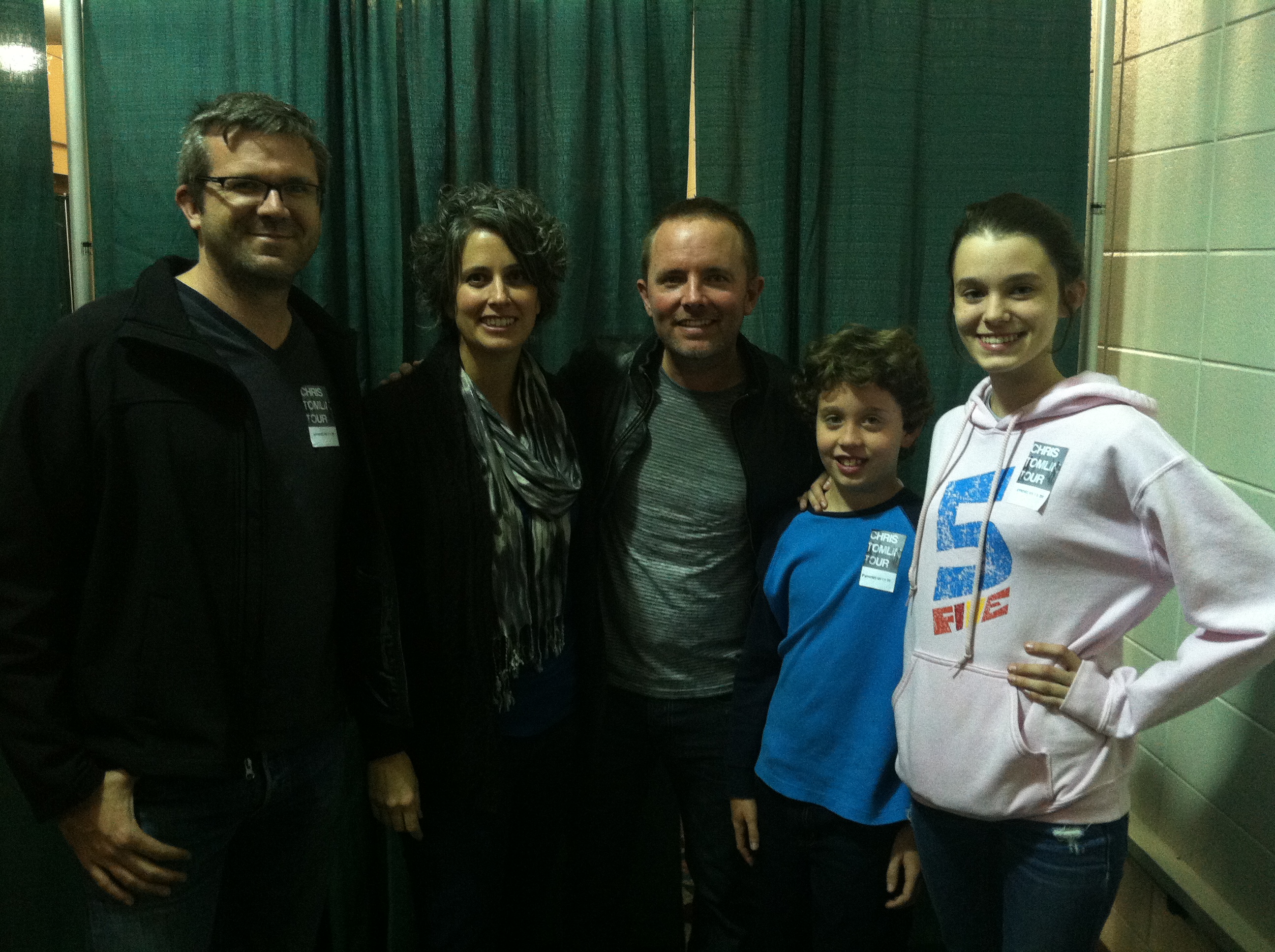
… In Which Eric Embraces Chris Tomlin

Literally!

Literally!

Since I began my sabbatical a few weeks ago, my family and I have been attending a neighborhood church. The experience has been refreshing, most of all because I am getting to experience worship again as, well, a worshiper.

As we prepared to worship, I was trying to grasp onto the culture there: How many songs would there be? Would people raise their hands? 

Most of all, I was wondering, Would I know the songs? 

Refreshingly, they played a couple that I was familiar with. E3 has been doing  “Our God” for around a year, and I’ve sung “Revelation Song” here and there.

As a worshiper, I loved this familiarity: I knew the melodies; I knew the lyrics; I knew the message.

As a church leader, it provoked my thinking in some interesting ways.

As a songwriter and a pastor, I’ve been adamant about original worship music. I have believed—and still do—that the local church should be as diverse, unique, and fresh as our God. The local church should have an infinite amount of expression and variation to it.

Seemingly opposed to this has been the national flattening and “Walmartization” of the Christian music. Just like the broader culture, a few select companies are dominating the national landscape, and consequently drowning out vital local expressions of music and art. Rather than attempting to unleash the creativity that surely lurks somewhere inside their own body, churches seem more content to turn to Chris Tomlin and David Crowder, Hillsong and Lifeway to provide them with the “freedom songs” that we all sing on Sunday. I resonate with Thomas Merton when he writes, “There can be an intense egoism in following everybody else. People are in a hurry to magnify themselves by imitating what is popular—and too lazy to think of anything better.”

However, I’m wondering if there’s not another dynamic to consider…

In my opinion, liturgical worship has many different benefits including the idea that wherever a believer goes in the world, the liturgy is the same. She can engage immediately in worship, no matter whether she is at her home community or halfway round the world.

In the interest of creativity, is it possible for a local church to become too insular, so that its musical worship is only intelligible and accessible to its immediate community?

Should a church maintain an eye towards global expression—the “Big C” Church—when it prepares on Sunday?

And, given that the most evangelical, non-denominational churches don’t employ the liturgy, should we embrace that the “Big Three” (Tomlin, Crowder, Hillsong) are, in fact, as close as we can get to a common worship language? 

I don’t advocate picking songs based on the iTunes worship charts (I actually freelanced at a church that did that—quite distasteful), but as a worshiper who had come from another community, I can tell you that I appreciated the fact that I “understood the language” of this church (they also used the Lord’s Prayer and a couple familiar liturgical elements).

I also don’t think the local church should shy away from fresh songs and creative diversity; however, I think we should maintain a certain eye towards both the transient nature of our culture and the global expression of our faith.

Anyone have any thoughts?

Weapons of Mass Production, cont. :: Leadership Tools

Leadership Tools

Without a watch I can tell you—within about 3 minutes or so—when 1 hour has elapsed.

No really, I can.

I can do this little parlor trick because over the past 15 years of my life I have had to learn how to use 60 minutes of time in the most effective way possible.

I have learned this because, as a Pastor and a leader, one of the most valuable tools I have in my little bag of rusty tools is the one-on-one meeting with volunteers, and this usually happens (in my context at least) over lunch. I don’t have a staff that I can call into a conference room and work things out over a 3 hour meeting. Typically, I have 50-55 minutes to work with.

And I need to know (though God often intervenes and changes my agenda) what I’m doing.

As I was thinking about this, I approach my one-on-one meetings in four distinct ways. Sometimes they bleed into each other and overlap, but by and large these are the “buckets” I place meetings in.

  • The Directive Meeting.  Sometimes I—or my team—needs something done (or I need someone to stop doing something). These meetings are driven by a sense of strategic need and values. A directive meeting demands that you know—as precisely as possible—what it is you’re going to ask. Moreover, you should be able to communicate that somehow within one to three sentences. It’s also helpful to understand the why behind this directive: what is the value or need that is driving this request?
  • The Counseling or Pastoral Meeting. I’m not the best counsellor in the world, but nevertheless I recognize that this is a non-negotiable part of my job, so I try to do my best. The pastoral meeting is sometimes reactive (in other words, a response to a team member’s request to meet) and sometimes proactive or even confrontational (driven by an awareness or observation of a behavior). I tend to take the approach that people in these situations are hurting, even if they’re not aware of it. Therefore, I try to establish a warm, listening environment, and give plenty of space to talk. There may not be a firm “result” to these meetings, but my overall approach and paradigm is driven by something Brennan Manning wrote. “You are going to leave people feeling a little better or a little worse. You’re going to affirm or deprive them, but there’ll be no neutral exchange.” That may be over-simplifiying things just a bit, but for me that works. That quote establishes the playing ground for me.
  • The Coaching Meeting. The coaching meeting is driven by a firm agenda and a specific approach. “Coaching” refers to a method of helping people achieve specific goals within a specific time period. Unlike the directive meeting, most of the time the individual—not me—establishes the goals that I’ll coach them through. In my context, it can be the desire to pray more, or to write more, or to practice more. Also in contrast to the directive meeting, coaching is built on the idea that the answers and solutions lie within the individual, not the coach. It’s my job to establish a framework and to provide some accountability. Lastly, it’s time-bound, meaning a coaching relationship is meant to only last for a specific amount of time and a specific project (if you want to know more about coaching, you can start exploring it here).
  • The “Being” Meeting. Sometimes the greatest gift you can give your team members is the gift of your presence. Without an agenda. Sometimes you need to put away the lists and set aside the values and simply value them as human beings. Not surprisingly, for many of us these meetings are the most difficult ones to schedule and execute, but they can also reap the heaviest benefit. People (including myself) have a need to know that they are valuable far beyond their gifts and talents, and eating a meal together with no agenda is a great way to cultivate that reality in their spirit.

These are my meeting “buckets”; again, sometimes the edges are fuzzy, and sometimes my agenda and plans get disrupted. But I still make an intentional decision on how I approach my time together with my people. It values their time and efforts, and provides a framework and environment within which God works. Maybe it goes without saying, but the last tool to use when it comes to one-on-one meetings is to know what kind of meeting you are going into. 

If you’re in leadership, do you have one-on-one “buckets” or categories that you use? Feel free to share them here.

=====================================

Four Questions for Day 1

Well, it’s here, isn’t it.

Maybe 2012 was the best year of your life; maybe it was a disaster.

Either way, it’s gone.

This morning I enjoyed my ritual of opening my 2013 Moleskine (that’s mole-eh-SKEE-neh to you) and getting ready for the new year.

I love this part of the year, because no matter what happened during the previous 12 months, I get to start again.

Fresh dreams.

Fresh ideas.

As I enter this year (and a 3 month Sabbatical), I’m asking myself four simple questions; maybe they’ll help you too:

  1. How will I rest?
  2. What spiritual foundations do I need to build (or rebuild)?
  3. How can I better listen to God?
  4. What do I want to make?

I’m working on my own answers to these questions; I have some audacious plans that I’m not willing to unveil just yet.

But this isn’t about me; this is about you.

It’s Day 1. Start running. Start listening.

==========================================

You Have to Know Your Story

Last week I was in Dallas to lead worship with some friends of mine. My in-laws also live in the area, so I spent the night with them, and ended up driving around Arlington, marveling at how the area had grown (and shaking my fist at Texas Stadium, but that’s another story). Driving through the warm Texas fall, I noticed something that I found utterly fascinating.

Arlington has mostly always been a place of strip malls and—to my eyes anyway—awful urban planning. It has been marked by the worst of our public space and architecture, of a lack of awareness of history and human scale. In some ways, this trip merely confirmed all of that: ugly buildings that were merely twenty years old had been destroyed to make way for new ugly buildings. Chain businesses that had been thriving years ago had been rebranded and become new chain businesses that were now (for the moment) thriving.

But then I noticed something else.

Astonishingly, in the midst of this urban/suburban renewal and sprawl, I found two unlikely establishments that had somehow weathered the storm, and were still open,—twenty-plus years later—and were still going strong.

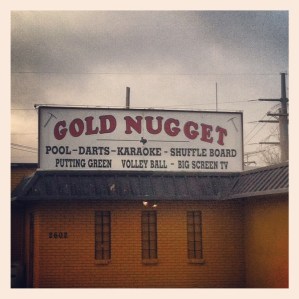
photo-4Out to breakfast with my father-in-law, we were driving down Division street when I asked him to slow down. There, set back from the street about 50 yards, was  “The Gold Nugget”. This place was really special to me and my wife, since it was the place where we really began dating. Back in the day it had a stage, and a volleyball court out back, but here’s the deal: in 1992 this place was a bit dingy, and a throwback. How in the world is it still in business? 

As I left Arlington and drove to Garland, I drove up Collins Street, past Cowboys stadium. Almost immediately across from that monstrosity was a tiny restaurant called “The Pitt Grill”.

That’s right: that’s the name.

Image via rollbamaroll.com

Image via rollbamaroll.com

I don’t know how long the Pitt has been in business. I know that I used to go there and get greasy eggs and bacon (mmmmm bacon) twenty years ago, and as best I can tell, greasy eggs and bacon are still on the menu today.

The Pitt has no website; neither does the Gold Nugget. Yet these two businesses somehow have weathered the storm of development that has utterly remade (and erased) most of Arlington.

There is no sleek, modern design in their dining rooms…

They don’t serve sushi…

They don’t serve any form of fusion…

I’m pretty sure their bartenders don’t have ironic handlebar mustaches…

While I have no doubt that their bills are manageable (seriously, they’re really not the nicest of places), I think what struck me about The Gold Nugget and The Pitt is that ultimately they knew who they were. I’m sure that over the years they grew a little, and got really good at what they did, essentially these businesses are doing the same thing that they did 10 years ago, 20 years ago, 30 years ago. They’ve seen probably fifty businesses come and go around them, and they still plug on.

The Gold Nugget and The Pitt remind me that you have to know who you are.

The Pitt and the Gold Nugget know what they do, and I have no doubt that they do it consistently.

I have no doubt that they have great stories to tell.

I think of churches that I’ve talked to that have essentially a beautiful traditional service that suddenly feel called to create an awkward and sparsely attended rock and roll service, merely because “that’s what you’re supposed to do.”

I think of leaders who are trying to be something that they obviously are not, struggling with authenticity (by the way, the people you lead can see it) without questioning why they are trying embrace this.

Meanwhile, all that many people “out there” in the world are asking for is for churches, organizations, and leaders that

  • quietly and confidently live out who they are (sometimes in the face of a radically changed world)
  • tell stories about what they’ve seen and what they’ve done

How well do you know yourself? How well does your church or organization? Are you living out your story? Or someone else’s? 

*e

=========================================

“I May Not Have Jazz Hands, But I’m Working on Jazz Leadership”

“The real power of jazz is that a group  of people can come together and create improvised art and negotiate their agendas … and that negotiation is the art.” (Wynton Marsalis)

I’ve written before on how leadership (at least collaborative leadership) is like being in a band; today I’d like to zero in on that a bit.

Jazz is considered by many to be the quintessential art form. It is the height and essence of creativity: a group of people that are collectively yet coherently improvising and expressing themselves.

I think—and I’m not the only one—that this is essence of great, creative groups. Relatedly, leadership in a jazz/collaborative sense is not dictating what people play; it’s creating an environment where everyone is simultaneously creating while listening to everyone else in the group. But just because the music contains heavy elements of improvisation, it doesn’t mean that there’s not a leader. Typically, someone is in charge:

  • who chooses the song: “this is the basic structure of what we’ll play”
  • who chooses the key: “this is the basic musical playing field and rules”
  • who chooses the tempo: “this is the speed at which we will move”
  • who determines when it’s not working: “someone is overplaying or not contributing.” 

In other words, a jazz-influenced leader allows everyone to play masterfully and creatively, but still maintains an eye towards the piece being produced for the audience. They also guard the creative process and the group, making sure that all members are negotiating the rules of jazz (such as they are) in a healthy compelling way.

So some quick questions:

If you are a member of a group:

  • have you mastered your “instrument”—the voice that you alone bring to the ensemble?
  • are you contributing? where do you need to push the group in new directions?
  • are you over playing? where might you need to pull back and listen more?

If you are the leader of a group:

  • have you set the ground rules? do you know what “song” you are trying to play?
  • are you allowing the members to play creatively and compellingly?
  • do you need to challenge any members to play more? play less?

Miles… you do the rest….

============================================

Resting, Hearing

This Sunday, we announced to my church that I’m going to be taking some time away.

No, I’m not in trouble.

For probably 4 years now, I’ve been trying to discern what God may be calling to for the next season of my ministry and life. I’ve been in ministry for 15 years, and almost of all of it exclusively focused around music on Sunday. Recently, however I’ve started to wonder if my role may be evolving a bit to more purposefully include teaching and leadership. After a few conversations with my pastor, we decided that I should take a few months (!) and go into “listening” mode to try and more clearly hear what God is saying and how He may specifically be leading me and my family.

This is called a “Sabbatical”, and is directly related to “Sabbath.” The Sabbath—and also Sabbaticals—was established by God in Genesis 1, and then reaffirmed a few times in the bible, especially in Exodus. We’re told in Genesis 2v1-3, “So the creation of the heavens and earth and everything in them was completed. On the seventh day God had finished his work of creation, so he rested from all his work. And God blessed the seventh day and declared it holy, because it was the day when he rested from all his work of creation.”

You know what strikes me about this passage?

God wasn’t really “done.” 

Surely God knew that even though he’d brought the universe into being, creation—and the act of creating—wasn’t “done.” Creation is alive, growing, changing. Adam and Eve exist after all, now, and who knows what manner of variables they’ll bring into the picture! (Note see Genesis 3.)

Surely God wasn’t saying, “Whew, that’s done; guess I’ll just sit back and watch it all take shape now.”

I believe that God really knew that actually after you’ve created something—say, the Universe—the real work begins… Conflict, love, hate, war, sacrifice, salvation. All of these things begin to enter the picture after you’ve created something.

It strikes me that even though God is aware that creation is anything but “done”, he is choosing to rest. 

Your work is rarely (if ever) going to be “done” enough for Sabbath to make complete sense.

You will have to choose.

You will have to say, “For today, this is done. I am resting now.” 

Do All The Work in Your Head

I was watching the finale of Anthony Bourdain’s No Reservations, where they were in Brooklyn, NY.

Anthony ended up at Brooklyn Fare, which looked like one of the most unique restaurant experiences I’ve seen in a long time.

Mostly, because there are only 18 seats.

At one point, Anthony Bourdain looks at his friend Eric Ripert and says, “All the hard work for this took place in the chef’s head.”

Amazing food; 18 seats.

They know how many portions to produce, and when to serve them. Some of the biggest variables in the restaurant business, handled immediately.

In the chef’s head.

Way ahead of time.

Sometimes, when you want to do something amazing, the best way to start is in your head. 

  • What variables can you control?
  • What waste can you eliminate?

If you know ahead of time precisely how you will shape the experience, you can get about the substance of what you want to create: in Brooklyn Fare’s case it’s the food, but it can be anything…

  • the book
  • the worship gathering
  • the melody
  • the life

Control what you can control, so you’re free to delight people.