Getting Back to Our Roots

First Council of Nicea via Wikipedia

In the year 325 a bunch of Christian leaders gathered to decide some really critical theological issues. It was an amazing event, for a few reasons.

First, this had essentially never happened before. These men (let’s be honest) had only perhaps HEARD of each other; they had never met, or looked in each other’s eyes.

Relatedly, this was coming at the end of a season of (albeit sporadic) persecution for the church. Many of these leaders could show, in their bodies, the physical costs of following Jesus.

It must have been mind-blowing.

Someone recorded it:

There were gathered the most distinguished ministers of God, from the many churches in Europe, Libya (Africa) and Asia. A single house of prayer, as if enlarged by God, sheltered Syrians and Cilicians, Phoenicians and Arabs, delegates from Palestine and from Egypt, Thebans and Libyans, together with those from Mesopotamia. There was also a Persian bishop, and a Scythian was not lacking. Pontus, Galatia, Pamphylia, Cappadocia, Asia, and Phrygia sent their most outstanding bishops, jointhly with those from the remotest areas of Thrace, Macadonia, Achaia, and Epirus. Even from Spain, there was a man of great fame…

What an amazing moment in the life of the Church. But something stood out to me; check that list again:

Syrians
Cilicians
Phoenicians
Arabs
Palestine
Egypt
Thebes
Libya
Mesopotamia
Persia
Scythia
Pontus
Galatia
Pamphylia
Cappadocia
Asia
Phrygia
Thrae
Macedonia
Achaia

… Spain

You know what stood out to me?

Though the writer lists ministers from Europe, look at that list of countries.

Not really a western European among them.

Sometimes I think that we are so predisposed to think of Christianity as a western European—actually an AMERICAN—phenomenon that we forget that it’s legacy really isn’t.

As the saying goes, we stand on the shoulders of giants, and in our case those shoulders are black or olive-skinned.

European culture brings great strengths to the table, but we don’t bring everything (and some of what we bring is less than helpful, but that goes for all cultures).

How Euro-centric is your faith? Have you ever attended a worship gathering from a different ethnic background?

Have you ever read something that challenged the cultural perspective of your faith?

For my Caucasian brothers and sisters, I’d lay a gentle challenge at your feet: find a worship gathering to go to where you’d be the minority, where you could see “distinguished ministers” from a different culture.

If you want to read an introduction to the multi-cultural phenomenon of our faith, check out Soon-Chan Rah’s book on how the face of evangelical faith in America is changing.
Four Ways Gigging Made Me a Better Worship Leader / Church Musician

One of my favorite quotes is in the movie Rocknrolla: 

There ain’t no school like the old school and I’m the #@$%@#$% headmaster.

When I started playing guitar, playing in church was not an option. Our church was a piano/organ place, and we only did acoustic guitar on a very, very rare occasion.

In fact, as crazy as this may seem, I never heard real electric guitar—not the heavily compressed, chorused, thin sound—in church until I was probably 30 years old.

So, musically, all my formative years weren’t spent in a youth band; they were spent in clubs.

This is what I think I learned:

  1. Be excellent, quickly.My first gigs were in a cover band. Two hundred dollars for a night (for the whole band). Two 60-90 minute sets. You were paid to be the entertainment. If you couldn’t grab the crowd’s attention, than you (a) were going to have a boring night and (b) weren’t going to be invited back. You had to get their attention, and then hold it. Probably the most extreme situations were when we’d play for a group of bikers; the pressure to entertain and “be cool” was definitely heightened. You had to be on your game.By contrast, church is mostly a captive audience. They’ll tolerate mistakes and give you second chances. However, just because the congregation lets you get away with a bad note doesn’t mean you should let yourself get away with it.
  2. Have your gear together. Even in the era of Guitar Center, you still couldn’t find a place to buy a cable at ten o’clock at night (maybe you still can’t). I remember driving 3 hours to a gig where the drummer forgot his hi hat stand. Outcome: gig with no hi hat. You had to double-check your stuff, and be prepared. Churches today come stocked with complete drum kits, miles of cabling, and usually a tuner (or 4) lying around. It’s nice to have a backup plan, but it’s also unprofessional to show up without a guitar strap. It assumes that someone will take care of you.
  3. Expect the worst. I remember playing a gig in this big wooden room that was essentially tuned to Ab. Every time we hit that note (which we did a lot, because we tuned 1/2 step down), the whole place would erupt with Ab feedback. It made for an interesting set. I also never knew that multiple monitor mixes were even possible until I was probably 25; my first 10 years of playing were spent learning to hear my voice—and the other instrumentalists—in one mix (that was usually too quiet).These days—if I can sound a bit crusty—a church is considered a bit lacking if the Aviom mix isn’t in stereo. Listening—and thus true interactive musicianship—isn’t based on the quality of your monitor mix; it’s based on the discipline of working to hear everyone on the stage, and to be aware of what they’re playing and how it impacts what you’re playing.
  4. God is everywhere. Though I wasn’t always firmly rooted spiritually, I learned that beautiful music can be made in the dirtiest places. On my final (probably) jaunt around the country, I was playing a gig in Lawrence, Kansas. The band I was in “gave in” to the crowd and played a (somewhat ironic) version of “Freebird.” As I played that ridiculous slide part, I practically heard God speak to me, “Do not think for one minute that I’m not hear in this bar. Do not think that you cannot send these notes to Me as worship—as thanks—right here in this moment and in this place. I am here.” 

    Though the church as a body is sacred and essential, God is also everywhere. When you only play music on Sunday morning, or only for your youth group, it’s easy to fall prey to the idea that God is only in the church, or that He is only “listening” to corporate worship music (that is often too safe). Playing music in so many environments helped me understand that God is out there, always moving, sometimes even moreso than what we see on Sunday.

Anyway, that’s it. I’m old school, but I think we do well to make sure our church musicians are seasoned and prepared, and have as wide a view as possible of God’s activity in the world.

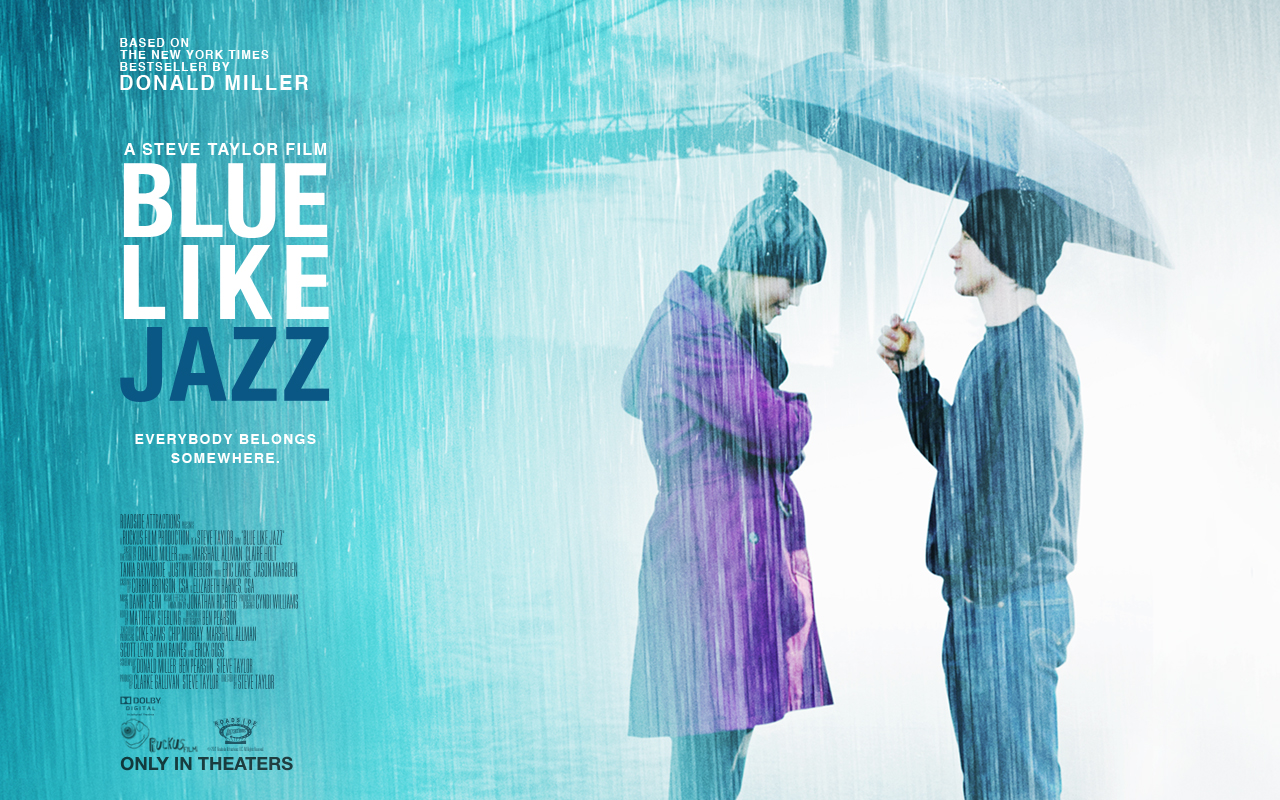
Quick Thoughts on Blue Like Jazz

from bluelikejazzthemovie.com

Tonight, my church sponsored a showing of Blue Like Jazz. Amazon describes the book this way:

In Donald Miller’s early years, he was vaguely familiar with a distant God. But when he came to know Jesus Christ, he pursued the Christian life with great zeal. Within a few years he had a successful ministry that ultimately left him feeling empty, burned out, and, once again, far away from God. In this intimate, soul-searching account, Miller describes his remarkable journey back to a culturally relevant, infinitely loving God.

For anyone wondering if the Christian faith is still relevant in a postmodern culture.

For anyone thirsting for a genuine encounter with a God who is real.

For anyone yearning for a renewed sense of passion in  life.

Blue Like Jazz is a fresh and original perspective on life, love, and redemption.

The movie was really well-done, but to be honest, the book never held the power for me that it had for others (I have my suspicions why, but I’ll keep those to myself for now).

As Miller re-embraces his faith, a few things struck me as important in his (and maybe your) journey:

  • Be wary of overly-neat categories. As Miller enrolls in Reed college, his mother is aware (and obviously terrified) that he is “leaving the tribe.” But the catch is that oftentimes the tribe has become the problem. Though God’s tool on earth is the church, we need to be careful about so identifying the church with God that we come to believe anything outside of the confines of our local faith communities is outside of God’s activity. As Jacob discovered, you can find God in the most unexpected places. Some of the places I’ve see His hand at work include: Elbow (the band), Andrew Goldsworthy, Flannery O’Connor, and my family.
  • Embrace people as, well, people. In the movie, Miller hides his faith from his friends at Reed, and actually comes to almost reject it. Though this caused its share of problems, the gift that it gave him (and can give us) is time, and also the ability to get to know people as human beings (that, incidentally, God created), and not evangelism projects or (even worse), “pagans” who aren’t worth are time, or love. He just comes to accept them as people who are as loving—and as broken—as he is.
  • Lastly, I was struck with how willing the characters are in the movie to simply be themselves. There is a temptation to believe that, as believers, we can only be part of who we are; that God doesn’t love the darker, doubting parts of us. That’s simply not true. God desires fully integrated, holistically loving human beings. The greatest gift we can give God and the world that He loves is a life that is fully owned, fully inhabited, and in the process of being redeemed and healed.

Good movie. Go see it.

Wonder, Craft, and My Secret Love of Electronica

I’ve been really blessed this week to see and hangout with some really gifted artists like DJ Promote and Propaganda, a really great hip hop artist. Tuesday night DJ Promote was doing a set before a big rock band played, and the kids were just going crazy. Propaganda was talking to me and another guy and said, “You know, I’ve been all around the world with this guy (the DJ), and no matter where he goes, within ten minutes the room is just going crazy. He always wins.”

I replied, “I think I know why; it’s because I can feel the joy in his mixing. I can sense the emotion behind what he does.”

Ever met someone who somehow was giving and generous the moment they shook your hand?

I’d met Promote backstage before I even knew what he did, and even then he was gushing with joy and wonder.

Ever felt blessed by just being introduced to someone? You don’t even know how it worked, but you turned away and felt richer and better for just having said “Hello” to them?

That’s the way it was with both Promote and Propaganda. (He did some spoken word stuff that was just so legit, it was amazing.)

Though I have no doubt that they both put in their “10,000 hours”, the thing that set them both apart was the joy and wonder that they put into their art.

Have you ever considered the fact that joy and wonder can be translated by technology? That emotion comes through bits and bytes, electricity and wires? I have not idea how it’s even possible, but I am blown away that repeatedly this is the case. You can hear it. You can feel it.

Great art is, in fact, a gift, but the gift that’s being given in these cases are emotional and spiritual, not merely musical. It transcends craft.

… I would almost venture to say that joy precedes craft.

Keeping in mind that “our art” may involve the crafting of our gospel-shaped lives, or a specific artistic endeavor; remembering that “calling” exists at the intersection of our deepest needs and the world’s deepest joy…

What kind of joy are you putting into your art today? What wonder are you bringing to your calling?

In the meantime… enjoy some great mixing and spoken word.

=================================

Evangelism Training With Marvin

Part of this post appeared in a message I gave at my church in 2010. 

How do you view evangelism? How does your church view reaching out to the surrounding world to proclaim Jesus’ Lordship?

Ever thought of it as a song?

Ever thought of it as The National Anthem?

Here’s my thought process: Most of us live in a culture (USAmerica) where the gospel of Jesus is simultaneously so familiar that it can be ignored, and so unfamiliar that it can be confused and mocked (which is also probably our fault as the church, but that’s another post altogether).

The situation is not too different from the National Anthem: most of us have been hearing it since we were children, at countless sporting, graduations, and civic events. For the majority of us, it has lost its power. As the saying goes, “familiarity breads contempt.”

It’s not the song’s fault. It’s just that we’ve heard it so many times we’ve become almost immune to it, inoculated by uninspired and off-key versions.

Some of us would say the same thing about the gospel; we’ve heard it in so many uninspiring ways, so many bombastic and overblown ways, that we’ve begun to think, “What’s the point?”

I want to suggest three images—three songs, actually—of evangelism, and suggest that we have the ability to choose how we (and our churches) “sing” the gospel, to ourselves and to our friends. 

The Off-Key Gospel

(Note, there were a lot of candidates for this, including an iconic guitarist)

Sometimes we encounter people, churches and organizations that just miss the point entirely. If we look and listen hard enough, we may hear familiar words and notes, but they are so skewed and off that we can’t take the song seriously. Maybe the fruit of their lives—corporately or individually—betrays the message of the song. Maybe their utter lack of preparation says, “We don’t really care about singing to you.” Ultimately, they seem to lack sincerity. They sing because they know they’re supposed to, but their motives are suspect, even mocking what they are purportedly celebrating.

This is not about excellence. It’s about humility. It’s not that Rosanne didn’t have the capacity to sing (maybe she does; maybe she doesn’t; I don’t know); it’s that she didn’t care enough to prepare. The song of God doesn’t have to be sung perfectly, but it should be sung in a way that it’s understandable, and that says something about our willingness to prepare and bring our best.

The Beautiful, Bombastic Gospel

Demi can sing. Obviously. She sings loudly, skillfully, and forcefully. She’s obviously been trained and knows how to knock this out of the park. And let’s face it, she’s cute, a pop icon.

But for me at least, there’s a detachment in this performance. It lacks subtlety and dynamics, and most of all I don’t hear any vulnerability or humanity in it (which is ironic considering Demi’s journey after this).

There are so many churches that “sing this gospel” well—they are adept at phenomenal performances that know how to orchestrate just the right tones. But in the midst of the lights and sound and noise, a little humanity gets lost. The “beautiful gospel” can lose sight of the vulnerability and brokenness—the utter humanity—of Jesus and His work.

Our gospel song should not be addicted to triumphalism; it’s not “Easter All The Time.” The gospel embraces the full range of human emotion: from the struggle at Gethsemane to the mourning at the cross to the joy at the empty tomb.

Gospel “Soul”

Now we’re talking.

A few things stand out to me in Marvin Gaye’s version of the National Anthem.

  • It is familiar. Though there’s an unexpected drum groove underneath, Marvin keeps the melody the same, and it’s easily to recognize.
  • It is decidedly Marvin. He’s decided to approach the song with some originality and creativity. He puts something of himself into the song.
  • It’s soulful, but subtle. Marvin was a master, one of the icons of R&B. But he pretty much gets up there and sings the song. No crazy runs. No extended improvisations. His humanity and his feeling comes through.

To me, this is the way the church needs to approach evangelism—and the gospel—in our culture. Infused with humility and restraint, but individual (and organizational) creativity and inventiveness. Unafraid to be ourselves, but faithful to the message and melody of the gospel of Jesus.

What evangelism song are you—or your church—singing to your community?

The Power of Story

from blogs.amctv.com

The new season of Mad Men started last night (finally).

I love AMC’s tag line: they know that everything revolves around story, and they do a great job of finding shows that tap into the beautiful ambiguity that is our humanity. Every character in Mad Men, it seems is capable of acts of great beauty and great depravity…

A lot like all of us.

I, for one, am drawn into this ambiguity and to the power of these characters’ story: who they are, how they got to be that way, and what they are struggling to become.

We also just got back from Walt Disney World, and it can be argued that no one understands “story” like Disney. I grew up in Texas only a short drive from the original “Six Flags” park. Last night, my wife and I were reflecting on Six Flags versus Disney. It actually seems like Six Flags has more thrills, more rides.

But what they don’t have is story.

I haven’t been to one of those parks in a long time, but my hunch is that there aren’t people walking around with Six Flags t-shirts, wearing Six Flags lanyards, with Six Flags buttons on them that represent the 20 years they’ve been coming to Six Flags parks.

Six Flags is a good for a weekend ride, but Disney has crafted an ability to make their story a part of your story. They’ve created an experience that people have integrated into their lives, telling, retelling, and then re-experiencing the park over and over.

I think the lesson is this: events are only the beginning. To create something special, our churches need to be about creating environments where people can experience an event, tell the story of that event, tell the story of their lives, and then allow their story and the community’s story to merge and intertwine.

Thoughts?

Stacked Decks

I’m highly suspicious of movements to “recover biblical manhood”, mostly because they seem like excuses for grown men (especially pastors) to:

In fact, I think it’s perfectly fine for a Christian man in the 21st century to appreciate cashmere, design, Sigur Ros, and the English Premier League (remember when that guy got his head stapled?!? Talk about a “man’s man”!).

That being said, I saw something this week that was a little alarming. This psychologist makes the case that guys’ brains are being re-wired, largely through the amount of gaming, television, and internet that we consume. I suspect he might be right.

I have a friend that I see once a week; almost every time I see him in his house, he has to put down the XBox controller in order to come to the door to let me in. This wouldn’t be a problem, except for the fact that he’s the father of a 13 year old daughter. I always find myself wondering, “Dude, don’t you have something to do? You’re a dad!” 

Obviously, he’s not the only one. More and more, I see guys in their 20s and 30s who are much more comfortable in front of a screen (“Dude I beat Madden!) than in front of their children, their wives, their bible, or other human beings. I also admit that I’ve been one of those guys myself.

Maybe it makes me officially “old”, but it blows my mind to see dads in their mid-30s acting like 13 year olds.

But this video—and a few other ideas like it—make me think, “No wonder: the deck is stacked against us.”

Think about this:

  • Assuming we are overwhelmingly visual creatures, what do we do with the fact that the visuals we are being exposed to are more lifelike and compelling than ever? Are we capable of even processing the effects on our brain?
  • Assuming that we are also competitive creatures, what do we do with the fact that video games also offer us the illusion of competition combined with compelling visuals?

Is it possible the deck is stacked?

Here’s the deal: I think we need to be aware of this, and in some cases, we need some help. Psychologist Henry Cloud says that expecting success from the same person who can’t control himself in regards to food, alcohol, sex, or video games is futile. The whole point is they have no self discipline. The only way to get help is to get some kind of structure—help—from the outside.

I don’t know what this looks like for you. Maybe it looks like a schedule. Maybe it looks like some kind of rule. Maybe it looks like you put 2 of the 3 game consoles on Craigslist. Maybe it looks like you give the controller to your wife, and let her decide when you play.

But dudes, we have to do something. We are being changed, and we need to realize it.

Do Yourself a Favor (or two)

I came home tonight and Shana was finishing up a movie called Bella.

Amazing story of love (and good food, too!).

Not Hollywood love, real love.

The self-sacrificing kind.

The Jesus kind.

So first, rent it and watch it, and recapture some wonder and innocence in your life.

Why not?

Then, go buy Nina Simone’s “Nearer Blessed Lord” (from the movie).

I’m pretty sure you won’t regret it.

The Disruptive Gospel

As the 20th century drew to a close, a German scientist named Karlheinz Brandenburg was working on a logarithm that would help reduce the size of certain types of computer files; specifically music files. Eventually, he landed on a formula that helped him shrink the size of a standard music composition by about a factor of 10.

Because the file format was designed for a group of scientists known as the Moving Picture Experts Group, it took on an abbreviated version of their name, “mp3.” Aided by the explosion of Napster and websites like mp3.com, the phenomenon of music-as-digital-files exploded.

Music would never be the same.

“Disruptive technology” is technology that enters a given market and, because of its price and or innovation, not only competes in that market, it actually redefines the market entirely. To be concise, it renders “competition” irrelevant, and redefines consumer behavior – it becomes the new standard, the new paradigm.

Whether you officially consider mp3 file compression disruptive technology or not, it’s difficult to argue that the innovation significantly changed the entire paradigm of music consumption. It changed forever our thinking about music (music should be portable, free, and easily shared), as well as our behavior (we either download our music illegally, or pay .99 for a single through iTunes, rather than buying a physical disc or tape from a store).

Mp3 technology had a major part in rendering irrelevant everything else in the “market” of music – CDs, cassette tapes, etc. – and eventually contributed to the entire dismantling of the record industry as we know it.

Now here’s the deal: The Gospel is disruptive technology.

Allow the Gospel to enter into your life, and it has the potential — if we let it — to  realign and redefine our values, thoughts, and behaviors. It renders our old ways of behaving — of our need to control, dominate, and/or manipulate — irrelevant. Hang around long enough, submit to it, and it becomes the new standard of our life, not just something that is an “add on” or a part.

What Goes On…

When I moved to “the big city”, one of the first things that was so shocking to me was how visible and accessible everyone’s home life was. Walking down practically any city street, you are maybe 10 feet away from someone’s living room, and their style — nouveau frat boy to OCD modernist — was on display for everyone to see. For years, frankly, I envied the clean lines and “just so” placement of people’s living rooms, their oh-so-hip furniture and general tidiness.

Over the years, I began to form stories in my mind about what happened inside those nifty spaces. “Surely,” I reasoned, “those folks are the most hip, gentle, intelligent people on the planet; surely the clean lines of their furniture match the nifty efficiency of their lives.” I could see a married couple on the couch, looking up from their copies of The Atlantic and the New York Times to debate the spiritual ramifications of post-modern literary theory while sipping cappuccinos. I saw children getting up after only 3 gentle beeps of a clever alarm clock (probably designed in Sweden), silently but quickly eating their healthy breakfast before jaunting off to a day of classical education.

Now, I like good design. Nothing major (though I do have a subscription to this, lol), just an appreciation for what goes in my living space. After saving for years, my wife and I have finally been able to put “that” kind of furniture in our house; to have “that” kind of kitchen. Though the furniture is still arriving and being unpacked, it is neat and tidy (and some of it, in fact, I believe is designed in Sweden). In fact, our house is pretty darn comfortable to be in, and I think communicates what we like about space, about art, and about life.

But guess what?

+ Parents still oversleep in this house, and have to rush around getting ready for work;
+ Kids need to be practically shoved out of bed in the morning to get ready for school;
+ Dust accumulates everywhere practically every two minutes!
+ Dinners get overcooked;
+ Homework gets struggled through…

Part of me is a little let down: having a comfortable couch doesn’t re-make your life — but part of me also realizes that all of this probably went on behind those peoples’ doors as well.