Jesus is SO Down With Marvin…

I’m journeying through Mark’s gospel with some friends, and we were talking this week about 2v13-22. Essentially, Jesus goes to this guy named Levi (no relation to my son) who is a despised and outcast member of his culture, and invites Levi to follow him.

Then, as if that’s not enough, Levi throws a part for a bunch of his friends and invites Jesus to it. His friends are, well, colorful. Scripture says they were “tax collectors and sinners.” Again, tax collectors were seen as corrupt and greedy, less than moral. The word “sinners” here is even more interesting. There were two different Hebrew words (and concepts) for our word here. The first word was ‘am ha’ aretz. This essentially meant “people of the land”. They were simple people, people who weren’t interested in the rigorous obedience of the Pharisees or the political change of the Essenes or Zealots, but they weren’t necessarily awful. 

The other possibility, however, is slightly more scandalous. The second word is resaim. This word means the wicked. It means people who aren’t even the slightest bit interested in being good, much less holy.

To be clear, we’re not sure which word is being used here, but one thing is clear:

Jesus is with them, either way.

And what’s more—what is really freaking people out—is what Jesus hasn’t asked of these tax collectors and sinners…

… He hasn’t asked them to get their lives straight first.

… He hasn’t shamed them.

… He hasn’t berated them for their lack of morals or for their “bad behavior.”

… He has a party.

So when people come up to Jesus immediately after this and ask, “Why do John’s disciples and the Pharisees fast, but your disciples do not fast” (2v18), something very interesting is going on. You see, fasting itself was pretty common in Jewish culture; it’s actually common in many religious systems. There’s nothing wrong with fasting at all. But fasting typically has a specific connotation to it:

it’s associated with repentance. 

We’re told that John the Baptizer came “proclaiming a baptism of repentance for the forgiveness of sins” (1v4), and the Pharisees were desperate to see God act on behalf of Israel, so they pursued a pretty vigorous program of fasting and righteous (not so they could be buzzkills, mind you, but so God would come to Israel and set them free and bring His peace and shalom to His people).

But when Jesus shows up, he neglects the repentance part and goes straight to the party (his “repentance” in 1v15 isn’t so much about repenting of your sins as it is about rearranging your mind and your life to see the Kingdom in a new way).

He’s saying, “You don’t have to arrange your life to invite God into it; He will come into it just as you are. I don’t want to leave you unchanged; no one wants to be wicked, after all, but I’m coming to the party and you’re invited.”

So, incidentally, when Jesus talks about “unshrunk cloth” and “new wine” in verses 21-22, this is what he’s talking about: the “old way” is not  a bad way, but it really doesn’t fit reality anymore.

Jesus is here, and he’s having a party.

Are we inviting people to a party?

Or are we beating them up?

Or are we selling them “get-out-of-hell” insurance?

A friend of mine sent me this article this week, and it made me think of this passage of Mark and this blog post of mine.

Go read it, please.

….


Shouldn’t we be singing a better song?


I can’t help but read the words of the Grantland article and think about the way we do evangelism. Just reading the words in light of Jesus desire to throw a compelling party for people makes my heart ache for the way we should living with our friends.

Marvin said, “I asked God that when I sang it, would He let it move men’s souls.” 

Do we ask God to let us move men’s souls when we sing the Gospel song?

Or do we just ask for a sale?

Also note: lots of folks hated it. They were outraged. Marvin was corrupting, destroying the National Anthem.

But there other folks there too.

… and they heard that song, heard it in a new way, in a way that they never even know that they needed. Something welled up inside them. Everything that was old and tired about that song now seemed new and refreshing.

They got it.

And they wanted IN.

BLESSINGS.

*e


=======================================
Weekly Wonder, 8 Feb Edition

Never once in my life did I ask God for success or wisdom or power or fame. I asked for wonder, and he gave it to me. -Rabbi Abraham Joshua Heschel

The short list of the thoughts, images, and words that opened my eyes a littler wider this week…

  1. Personal retreats of solitude.
  2.  Henri Nouwen’s book Life of the Beloved. On a whim, I took this with me on my retreat, and I ended up just living with these words for most of the time. His writing is simple, profound, and generous. God wants you to remember that, before, everything else, you are His beloved, His “good gift” to the world. “We were innocent before we started feeling guilty; we were in the light before we entered into darkness; we were at home before we started to search for a home. Deep in the recesses of our minds and hearts there lies hidden the treasure we seek.” Yeahhhhhhhhhh…. anyone else need to be reminded of that?
  3. Charles and Ray Eames (did anyone else not know they weren’t brothers, but a husband and wife?). I watched this documentary on the great American designers of the 20th century. Terrific insight into creativity and to “shipping.”
  4. Little hints that maybe just maybe, you’ve gotten one or two things right as a parent.
  5. Okay…. well, I’m still on my Britpop kick … I love songs that make me feel like just running down the street as fast as I can. “Mr. Brightside” is one of those, but I love, love this song by Stereophonics. (note: I can’t be responsible for any riots that start).  The other thing about this song is that, to my ears, it has 3 different choruses… who does that? 

Enjoy, and may you cultivate some wonder in your lives this week!

Connecting the Core

For those of you who may be leading musical worship in some context…

A while back, I wrote about “Knowing Your Core”: knowing how you would essentially describe the Gospel. (If you haven’t taken the time to write down your core, I’d encourage you to take a few minutes and do this).

It’s not enough to know your core; the real challenge is to make sure that our ministry reflects these beliefs.

For some of us, that means making sure that the songs we sing on Sunday match what we believe is the core. In other words, though we may claim that our Gospel “core” looks like this (this is my core, by the way)

  1. mission/vocation
  2. community
  3. restoration
  4. the Holy Spirit
  5. God-With-Us

However, if we’re not mindful, the lyrics of the songs we choose to sing on Sunday may look like this:

  1. God is really great
  2. We are sinners
  3. Jesus died on the cross
  4. We are still sinners
  5. Good thing Jesus died on the cross

This disconnect isn’t healthy, either for you or for your congregation.

For those of us who are leading music, take a look at the lyrics that you’re singing week-to-week. Are those lyrics consistent with your core? With your church’s core? (Again, first you need to know what your core is.)

For those of us in another form of ministry, we can still examine how our values, actions, and words are connecting with that core.

There is no reason that ministry cannot be an expression of our deepest and “truest” selves, but we do have to do the challenging, reflective work of knowing what that deep and true self looks like.

==================================

The Second Shot ALWAYS Comes

I was listening to the Fresh Air interview with Ben Affleck (it’s really good, IMO), and he was talking about some advice he received as a first-time/inexperienced movie director. Early in his career, he was told, “Know what your second shot will be.”

Affleck explains that a first-time director always knows what his first shot on a movie set will be; in order to avoid looking like a fool, you map it out, you agonize over the details, you go over everything in your head so you can gain the amount of respect and collateral that you will need to complete the film.

However, as Affleck explains, the first shot gets over pretty quick, and it’s at that point that everyone turns to you and says, “Well, what now?”

ffffffft……………..

I believe that this is where a lot of us get hung up. When we are starting something new—a recording project, a teaching series, mentoring someone. We focus tremendous amounts of creative time and energy into the first meeting, the first writing session, the first song, etc., but then something remarkable and troubling happens.

The second meeting/song/Sunday comes rolling around.

And we are shocked, and then sent scrambling to try and write and prepare and execute.

Whenever we start a new project, put some muscle behind what is going to come second as well.

(Incidentally, this is also helpful to remember whenever someone asks you to get involved in a project or movement… There’s always a second shot/meeting/song/gig. Oftentimes, we have the resources—time, energy, ideas, etc.—for the first meeting, but before you become involved you should ask yourself, “WHEN this project continues, will I have the capacity to remain committed? Do I have the resources to help with the ‘second shot’?” 

==================================

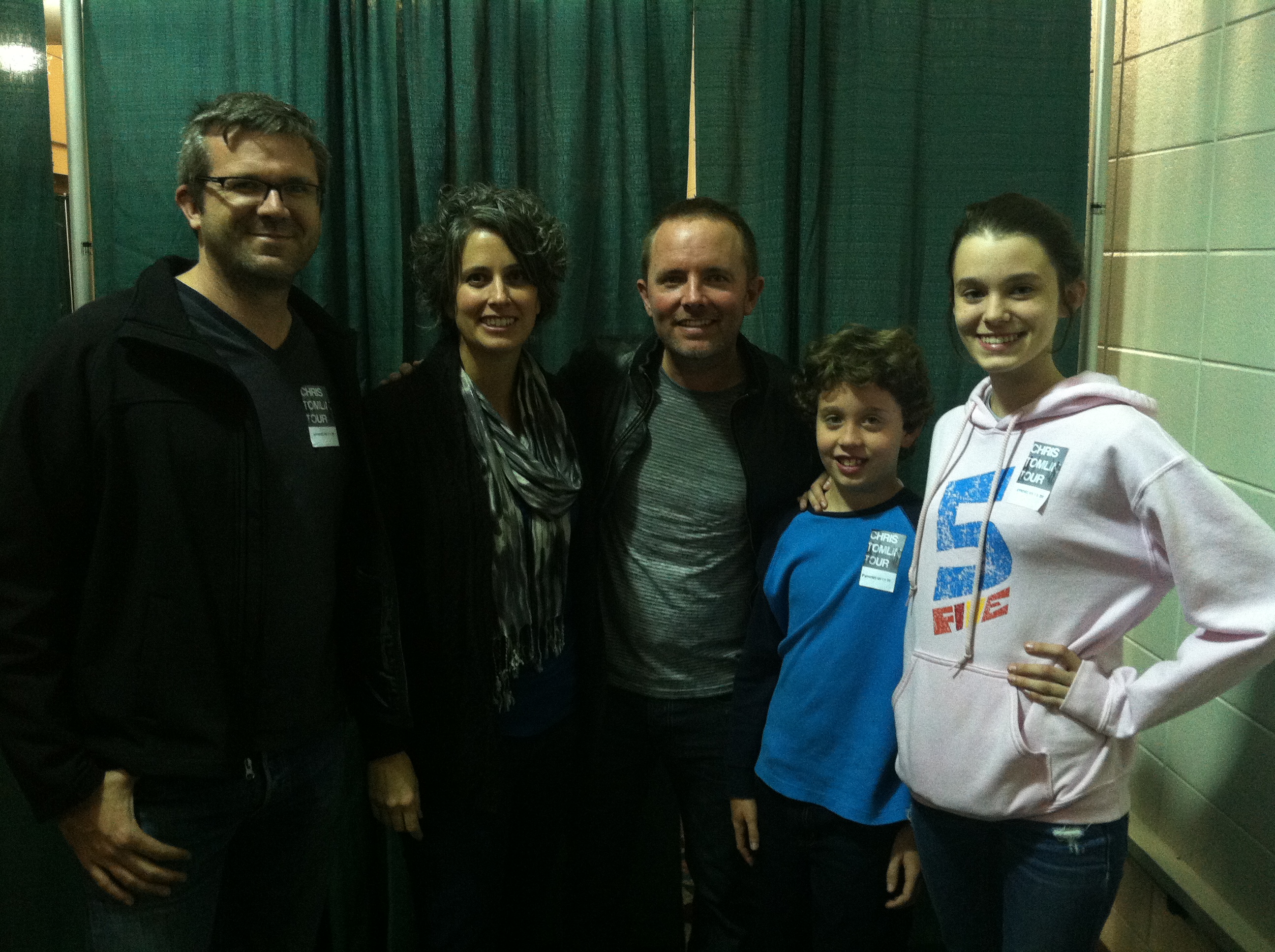
… In Which Eric Embraces Chris Tomlin

Literally!

Literally!

Since I began my sabbatical a few weeks ago, my family and I have been attending a neighborhood church. The experience has been refreshing, most of all because I am getting to experience worship again as, well, a worshiper.

As we prepared to worship, I was trying to grasp onto the culture there: How many songs would there be? Would people raise their hands? 

Most of all, I was wondering, Would I know the songs? 

Refreshingly, they played a couple that I was familiar with. E3 has been doing  “Our God” for around a year, and I’ve sung “Revelation Song” here and there.

As a worshiper, I loved this familiarity: I knew the melodies; I knew the lyrics; I knew the message.

As a church leader, it provoked my thinking in some interesting ways.

As a songwriter and a pastor, I’ve been adamant about original worship music. I have believed—and still do—that the local church should be as diverse, unique, and fresh as our God. The local church should have an infinite amount of expression and variation to it.

Seemingly opposed to this has been the national flattening and “Walmartization” of the Christian music. Just like the broader culture, a few select companies are dominating the national landscape, and consequently drowning out vital local expressions of music and art. Rather than attempting to unleash the creativity that surely lurks somewhere inside their own body, churches seem more content to turn to Chris Tomlin and David Crowder, Hillsong and Lifeway to provide them with the “freedom songs” that we all sing on Sunday. I resonate with Thomas Merton when he writes, “There can be an intense egoism in following everybody else. People are in a hurry to magnify themselves by imitating what is popular—and too lazy to think of anything better.”

However, I’m wondering if there’s not another dynamic to consider…

In my opinion, liturgical worship has many different benefits including the idea that wherever a believer goes in the world, the liturgy is the same. She can engage immediately in worship, no matter whether she is at her home community or halfway round the world.

In the interest of creativity, is it possible for a local church to become too insular, so that its musical worship is only intelligible and accessible to its immediate community?

Should a church maintain an eye towards global expression—the “Big C” Church—when it prepares on Sunday?

And, given that the most evangelical, non-denominational churches don’t employ the liturgy, should we embrace that the “Big Three” (Tomlin, Crowder, Hillsong) are, in fact, as close as we can get to a common worship language? 

I don’t advocate picking songs based on the iTunes worship charts (I actually freelanced at a church that did that—quite distasteful), but as a worshiper who had come from another community, I can tell you that I appreciated the fact that I “understood the language” of this church (they also used the Lord’s Prayer and a couple familiar liturgical elements).

I also don’t think the local church should shy away from fresh songs and creative diversity; however, I think we should maintain a certain eye towards both the transient nature of our culture and the global expression of our faith.

Anyone have any thoughts?

What Beck Can Teach Us About the Bible and the Mission of God

Beck’s latest record, Song Reader, is a phenomenal example of innovation and new thinking in music-making in the 21st century.

You see, Beck released Song Reader not as a CD, or a download, or even vinyl, but as sheet music.

That’s so Gutenberg!

Let me be clear: Beck released Song Reader with the intention that the actual performance of the songs would be carried out by people who bought the music. They would determine the character of the songs, based on his suggestions and music (folks could then submit their performances).

It’s a lesson about so much: not only about how we used to consume music (sheet music used to be enormously popular in the early 20th century) but about what art actually is and where it “resides.”

But I’d like to suggest that Beck’s idea can teach us something compelling about the Bible.

N.T. Wright uses this great analogy about how the Bible for us is sort of like a script to a great play without a written ending. We’re stuck, right now, in the gap between what’s written and the ultimate fulfillment of our story (in Revelation 21).

And, as Wright puts it, it’s up to us to improvise. 

Now, we don’t improvise in a way that is inconsistent with what’s written before; but we also don’t simply repeat the earlier acts. We symbolically “write” our own stories into the play, knowing that eventually the whole thing is going to be resolved by Jesus.

In this same way, Song Reader reminds us that we have the opportunity to take the “song” that’s been given to us—the command to love God and love others—and perform it in new and compelling ways.

Our song may not sound like everyone else’s; it’s really not supposed to.

It’s supposed to be our “performance” of what’s been given to us.

Are you singing? Are you playing?

“I May Not Have Jazz Hands, But I’m Working on Jazz Leadership”

“The real power of jazz is that a group  of people can come together and create improvised art and negotiate their agendas … and that negotiation is the art.” (Wynton Marsalis)

I’ve written before on how leadership (at least collaborative leadership) is like being in a band; today I’d like to zero in on that a bit.

Jazz is considered by many to be the quintessential art form. It is the height and essence of creativity: a group of people that are collectively yet coherently improvising and expressing themselves.

I think—and I’m not the only one—that this is essence of great, creative groups. Relatedly, leadership in a jazz/collaborative sense is not dictating what people play; it’s creating an environment where everyone is simultaneously creating while listening to everyone else in the group. But just because the music contains heavy elements of improvisation, it doesn’t mean that there’s not a leader. Typically, someone is in charge:

  • who chooses the song: “this is the basic structure of what we’ll play”
  • who chooses the key: “this is the basic musical playing field and rules”
  • who chooses the tempo: “this is the speed at which we will move”
  • who determines when it’s not working: “someone is overplaying or not contributing.” 

In other words, a jazz-influenced leader allows everyone to play masterfully and creatively, but still maintains an eye towards the piece being produced for the audience. They also guard the creative process and the group, making sure that all members are negotiating the rules of jazz (such as they are) in a healthy compelling way.

So some quick questions:

If you are a member of a group:

  • have you mastered your “instrument”—the voice that you alone bring to the ensemble?
  • are you contributing? where do you need to push the group in new directions?
  • are you over playing? where might you need to pull back and listen more?

If you are the leader of a group:

  • have you set the ground rules? do you know what “song” you are trying to play?
  • are you allowing the members to play creatively and compellingly?
  • do you need to challenge any members to play more? play less?

Miles… you do the rest….

============================================

Do All The Work in Your Head

I was watching the finale of Anthony Bourdain’s No Reservations, where they were in Brooklyn, NY.

Anthony ended up at Brooklyn Fare, which looked like one of the most unique restaurant experiences I’ve seen in a long time.

Mostly, because there are only 18 seats.

At one point, Anthony Bourdain looks at his friend Eric Ripert and says, “All the hard work for this took place in the chef’s head.”

Amazing food; 18 seats.

They know how many portions to produce, and when to serve them. Some of the biggest variables in the restaurant business, handled immediately.

In the chef’s head.

Way ahead of time.

Sometimes, when you want to do something amazing, the best way to start is in your head. 

  • What variables can you control?
  • What waste can you eliminate?

If you know ahead of time precisely how you will shape the experience, you can get about the substance of what you want to create: in Brooklyn Fare’s case it’s the food, but it can be anything…

  • the book
  • the worship gathering
  • the melody
  • the life

Control what you can control, so you’re free to delight people.

This is your moment of inspiration

Hey everyone… Just a short film from Behance, a network and platform to view and post creative work.

Get on with it, folks!

A Somewhat Random Music Mantra

Over the past few days, I started thinking about the essentials of the way I approach music. It’s probably not complete, and it’s probably not the last time I’ll do something like that, but here ya go…

  • There is no such thing as “simple” music
  • If you think that a genre of music is “easy” you’ve already lost
  • The point is not to get great gear; the point is to make great art
  • There’s a fine line between “ambient” guitar playing and simply not knowing the music
  • Training your ear makes you dangerous
  • Learning music theory makes you lethal
  • A great amp makes an average guitar sound amazing
  • Rhythm guitar is a lost art; go rediscover it

Anything you’d add or take away?