Noticed in November, Pt 8 :: “Don’t Wanna See You”

Though I’m collecting a list of songs I notice in November (hear them on Spotify), I’d like to submit a very special song today.

I’ve released a few singles lately, and this is the newest. It’s called “Don’t Wanna See You.”

You can get it—along with other tracks—on my Bandcamp site. Pay what you like, or just listen.

Another one coming in a few weeks.


Noticed in November, 6 :: “Queen of California”

Here’s the latest; hear the rest here.

For a long time, I had a … “tension” with John Mayer. The guy could play guitar; I mean really play. The guy could write songs; I mean really write songs. 

In a word, I was probably jealous. As someone said once, I felt like Mayer was a version of me, only better.

However, there was something else. Though I had tremendous respect for him as a player and writer, there was something about him that just seemed to rub me the wrong way. He had a certain wry wit about his success, and at times he said all the right things about art and music and humility and respect and all that… but frankly, I just didn’t by it. I opened the door slightly on 2006’s Continuum, largely because I felt like it was slightly more stripped down and more “open and honest” (fuzzy words, I know, but they are the ones who really fit).

Then something happened. First, Mayer fell from grace due to a few really mis-handled interviews (warning: that interview is not very pleasant to read) and very public romantic disasters. These really just seemed to confirm everything I discerned about him.

But then, something else happened. Basically he lost his voice for about two years.

Two years. 

I told everyone I knew that I thought he was done.

But I was wrong.

In 2012, Mayer released Born and Raised, which sounded like some kind of love child between George Harrison, Neil Young’s Harvest, and a whole lot of 70s California rock.

(This is a good thing.)

What’s more, his writing had changed—at least to my ears—a lot. 

He could still turn a phrase without much effort at all, but now there was something else present in his songs…

I call it humility. 

Admittedly, I was going through some pretty tough times during 2012-2013, so I could have just been  hearing what I wanted to, but I heard depths of honesty and humility (again that word: there’s just not a good substitute for it) that, to my ears, weren’t there before. That record—in particular Shadow Days and Born and Raised—became lifelines and inspiration of sorts for me during that time:

I’m a good man, with a good heart
Had a tough time, got a rough start
But I finally learned to let it go
Now I’m here, and I’m right now
And I’m open, knowing somehow
My shadow days are over now, my shadow days are over now…


Then all at once it gets hard to take
It gets hard to fake what I won’t be
Cuz one of these days I’ll be born and raised
And it’s such a waste to grow up lonely…

Those words. Wow. They were my life.

“Queen of California” starts the record off, and it definitely sets the tone for the rest of the release: sonically it’s like a big pleasant pillow of restraint and warmth. Great tones. Lyrically, I hear wonder and gratitude.

I need more of that.

Noticed in November 5 :: Going to the Church

Here’s the latest in my series about music I’m noticing in November.

I have no idea how I discovered the Red Devils. I think I’d read some obscure article about a hard-core blues band in LA that Mick Jagger was watching at some club. At any rate, I bought this CD when it came out, and I’m glad I did because they only made one, a live one that is so raw and joyous. It is certainly one of my top 3-4 blues CDs. It’s sweaty  and smoky.

Here’s what this track tells me:

  1. There’s a difference between going to “church” and going to “church-AH”. I’m not sure what it is, but I know it’s real. In fact, I have been to both, but I’m not always sure how to make the “-AH” happen. Maybe someone should create a conference that teaches churches how to “add the -AH.” Someone get on that. Credit me when it’s done.
  2. You don’t ever need to change chords in a song.
  3. (Guitarists) You don’t ever need effects pedals.
  4. Simple music can be powerful.

I just love this stuff. It’s so stripped and, well, honest. You just don’t hear much music like this anymore. These guys tore it up, and did it about as close to the bone as you could.

There are actually YouTube videos of these guys, but make sure you check out the CD track. They really captured some mojo on that one.


Noticed in November 4 :: “Head On”

The latest song in November is by The Jesus and Mary Chain. Hear it (and the others) on Spotify.

In so many ways, and for better or for words, I “came of musical age” in the 1990s. Even then, my musical tastes were pretty wonderfully diverse: from Pearl Jam to Paul Simon, and lots in between.

Musically, I’m decidedly an anglophile—slap an English accent and sensibility on it, and I’m prone to give it a second listen.

In 1989 or 1990, I picked up Automatic, from The Jesus and Mary Chain, largely on the strength of the music video for “Blues From a Gun”. For some unknown reason, I’ve always been fascinated by music that brings together electronic and decidedly human elements. The Jesus and Mary Chain did just that: they layered loud, distorted guitars over really basic drum machine patterns. From a songwriting perspective, they sounded like they were reinterpreting the Velvet Underground and classic rock and roll melodies and themes through much louder amps.

I was listening to this the other day for the volume and energy of the whole thing, but I also got to thinking about that point of intersection between humanity and electronic elements. It reminds me a lot of my own spirituality, in a way.

“Being human” is always a dance between divine and being, well, “not-so-divine.” That’s an uncomfortable notion for some of us: we’d rather be all of one thing (or the other), but life just isn’t that. We are electronics-meeting-guitars; divinity meeting blood-and-guts. Saints meeting sinners.

(Ironically, my first band didn’t realize that a human drummer doesn’t sound the way a drum machine sounds; we tried to cover a few of the songs on Automatic, and just couldn’t figure out why they didn’t sound right.)

The collision is exhilarating, but sometimes frustrating. I really wish I could just get the whole “saint thing” right and be done with it, or just surrender the “saint thing” and just admit my humanity, giving up on the idea of ever changing.

For some reason I can’t. I have to keep heading back into that tension.

Makes you wanna feel // makes you wanna try
Makes you wanna throw the stars from the sky…


Noticed in November 3 :: Gimme Something Good

My ongoing effort to blog about music I’m listening to in November. You can check out my list on Spotify.

Generally, I don’t like to listen to loud music in the morning. It may seem counter-intuitive, but I actually like to “wake up slow” and start quiet. I don’t usually hit my stride, rock-wise, until about 10:30 or 11:00AM. Early morning drives are usually accompanied by Sigur Ros; maybe The National if I feel like pushing the boundaries.

But the way my week has been—and considering I had to drive an hour to class this week—I decided to bend those rules a bit.

Ryan Adams has long been an inspiration to me. His run of releases—11 between 2000 and 2014—is simply amazing. The man knows how to “to the work.” (In fact, it’s a fairly known fact that he and Stephen King, another guy who knows how to sit down and get to work, are fans of each other.)

I’d venture to say that not one of those records was a flop. Maybe there were some “B-” records, with some C- songs on them, but on the whole the whole catalogue is just solid. 

(BTW, this is no way mean to say that the man cannot turn a phrase; he’s an absolute master at it.)

When I was writing for Maida Vale, Adams was my bar: each year I’d set out to write somewhere between 25 and 30 songs, starting around 5:30 or 6 in the morning and taking advantage of every spare minute. When Maida Vale stopped playing in 2011 (?), I stopped listen to Ryan Adams; the association was too strong.

But I started again when he released his latest, and I haven’t been disappointed. He has a way of making music that I’m convinced I’ve heard before, but really haven’t. Someone once told me that the best music is like that: it simultaneously sounds like classic rock and yet utterly new at the same time. It’s simple, and just solid, and consistent.

I’ve been moved by a couple of his songs—”Dear Chicago” maybe, and “Friends” probably the most—but mostly what Adams does for me is inspire as an artist/creative person to sit down and write. Not care too much about “innovating” or making something radically new. Just get it out the door… 

… And for where I’m at in my life right now, this is healing. Music is still very much my craft, my release, and when I get to make something, to create it, it touches something deep inside me that is still pure and youthful and innocent. It is relatively untouched by all the egoism and self-laden burdens that plague so much of my life.


Noticed in November 2 :: Discipline

Again, inspired by my sister, I ‘m taking a season to write about songs that I am “noticing”. Here’s the Spotify list of the songs (in development).

I think it’s one of the great truths of music and art that the best songs are generally written by folks who are either running firmly towards God or firmly away from God.

(Bono said that, by the way, so you know it has to be true.)

I don’t know really know Trent Reznor, but at the very least he (a) has the reputation of running away from God, and (b) writes some awesome, forceful and violent songs.

Most of them are very much NSFW; police yourselves.

I wrote that I was pretty much in the pit on Nov 3, and on Nov 4 I woke up still fighting a bit of shame and sadness.

But then I got mad.

I’m not proud of my temper; most of the time it expresses itself in hurtful and even embarrassing ways. Nevertheless, it’s there. It’s a part of me.

And on November 4 I decided to get pissed off at the things that drug me into that pit.

Whoever Reznor really is, he writes pretty profoundly about (what I consider to be) spirituality and even health. He kicked a pretty rough heroin addiction back around 2005. Since then he’s created some pretty insightful songs about some of the emotional and psychological demons that haunt some of us.

The chorus of “Discipline” is,

“I need your discipline // I need your help
I need your discipline // I know that once I stop I cannot stop myself…”

Doesn’t get any more real than that.

I cannot and will not vouch for all of Nine Inch Nails’ work, but there are sometimes that I need to hear something that is loud, intelligently aggressive, and also grooving. 

So as I drove around central Florida (still in Orlando for class), I just blasted NIN’s music and allowed some of my anger and frustration to fuel my crawl out of the depths.

Johnny Rotten once sang (well, sort of, Rotten never really “sings”), “Anger is an energy.”

Sometimes our anger can help us fight against the “dark stuff” in our lives.


Noticed in November 1 :: The Healing Day

Every artist is a cannibal / every poet is a thief

All kill their inspiration / and sing about the grief (Bono, “The Fly”)

Like all great artists, I have decided to rip off an idea. My sister, who is better than me at just about everything (especially encouragement) wrote every day in October about music that moved her. I, on the other hand, grew increasingly silent in this space. This is for some highly personal reasons that I am working through, but I also still feel drawn to write. Just this afternoon, while sitting in a class on theology, I decided to do what she did (even though I’m starting way late).

So for the next period of time—not sure yet—I’m going to write about songs that are impacting me. Again, I won’t say much, but this recent season has been a rather intense one in my life, so there’s a lot going on.

Also: get ready, because my tastes certainly run the gamut.

You can hear the songs here.

The first song on the list is “The Healing Day” by Bill Fay.

By nature I am a melancholy person. Most of the time it’s not really that big of a deal (except for the fact that I’m called “Eeyore” at work). However, every so often—maybe once ever 18 months or so—the bottom drops out, and I enter a pretty big skid.

Depression.

I went through a pretty big one—at least 24-30 months—when we first moved to Tallahassee, but I had not really drunk from that bitter cup since then.

Until October.

Maybe it was just seasonal; maybe it was something I did or didn’t do (truth is, it was/is probably a result of a combination), but “The Black”, as I sometimes call it, hit me forcefully in October. There were plenty of days that I limped through (with varying degrees of success), and the struggle was fierce for a lot of it.

(It’s still hovering, by the way.)

Monday, November 3 was a particularly difficult day. I was in Orlando for a class, and for a variety of reasons I was just in a tailspin.

“Despair” is not a word I use lightly, but in this case, well, it fit.

One of my mentors once told me once, “You need to know when to deal gently with yourself.” 

As I drove around northeast Orlando for lunch, this phrase popped into my head, and I found this tune on my phone and pushed play.

Bill Fay is an English singer/songwriter. Though he did most of his work in the 60s and 70s, he released a record—Life is Peoplebillfay2in 2012. I remember hearing the title track and instantly thinking, “Wow, this guy really influenced Jeff Tweedy.” The music is simple and gentle; the word “pastoral” comes easily to mind. I really don’t know a ton about Bill Fay other than these two songs, but they are a good soundtrack when I am trying to “deal gently with myself,” when I am trying to forgive myself and live without shame (which for me is a struggle).

A good friend of mine said recently that he wants to listen to music/art “that will wreck him.”

Sometimes I don’t want music to wreck me; I do a find job of that on my own. Sometimes I want music to help put me back together again, or at the very least just remind me that I’m “okay” even when I am in pieces.

“Healing Day” is not going to be musically revelatory to anyone; it’s pretty simplistic. However, it’s like a great big gentle hug from a good friend or family member when I need it most.

+e


New Song: “She’s Life”

a3969957569_2So in a rather unexpected flurry of creativity a few weeks ago, I wrote and recorded a new tune. It’s called “She’s Life”, and you can find it here (along with some of my earlier stuff).

I know that paying for music is really so, like, 1994, but I’d appreciate whatever you feel you could spare. (It’s only one song, I know).

There’s a lot of worse things you could do with $1, after all.

So I hope you enjoy it, and share it with friends and family.

Here’s the really crazy part: there will probably be another new tune in 3 weeks or so.

Peace, and enjoy.

https://ericcase.bandcamp.com/track/shes-life

Into the Desert: Place of Faith

The Desert-2After a series of plagues, pharaoh finally tells the nation of Israel, “Get up! Get away from my people, both you and the Israelites! Go!” (Exodus 12:31), and so the people do just that, and they take off.

However, Pharaoh quickly realizes that he is saying goodbye to his free labor force and quickly changes his mind (as dictators occasionally do), so he sends a military force after Moses and the children of Israel. Exodus 14 tells the story of Israel being pinned between the “Sea of Reeds” and Pharaoh’s army. (It’s instructive to remember that the Egyptian army represents the pinnacle of military technical superiority at this point; for Moses and a group of escaped slaves, fighting wasn’t really an option.)

The people understandably freak out, and accuse Moses of leading them to this point only so they can die in the desert. They then ask if they could go back to Egypt (more on these points later), but instead Moses responds to them by saying, “‘Don’t be afraid. Stand your ground, and watch the LORD rescue you today. The Egyptians you see today you will never see again. The LORD will fight for you. You just keep still.’” Fighting will do know good in this battle; this is something that only God can do.

Then God’s “messenger” appears, first as a cloud, then as darkness falls as a pillar of fire, and we are told that the cloud/fire moves from in front of the camp to behind them, in between Egypt and Israel (14:19-20). At that point Moses stretches out his hand and the sea in front of the nation parts. Exodus 14:22 says very matter-of-factly, “The Israelites walked into the sea on dry ground. The waters formed a wall for them on their right hand and on their left.” To be honest, I really don’t know what this must have looked like. I believe that something happened, but I don’t know that it really needed to look like Charlton Heston’s (Cecil B. DeMille’s) version.

Besides, that’s not the point: to me, the point is where the fire was, and where Israel was walking. The text says that this all happened at night, and that the pillar of fire is behind the nation, between them and Egypt. So they are told to start walking, by Moses.

Into—as far as they know—the sea.

When light is behind you, what does it do? It casts a shadow, right in front of you. Where you are stepping.

In other words, the people can’t. See. Anything.

This is what faith looks like.

Going into the desert requires a moment when you finally say, “Okay, I cannot see what’s in front of me, but I am ready to take a step.”

What most of us call “faith” in our world isn’t really faith at all, because most of the time we live comfortably, and can see right in front of us. We “know” what God is up to; we feel safe and secure in our faith, or if we do not we can easily identify the problem and “fix” things.

But occasionally God does something different. When we are called into a true desert to address something deeply meaningful and life-changing, we are called to a moment of “sheer faith,” where we may not be able to see anything ahead of us. In this moment, all we have is knowledge and belief that we are being called through the waters to “something else.” This moment of sheer faith is similar—but not necessarily identical—to the concept of “The Dark Night of the Soul,” when God withdraws His presence in order to call His followers into deeper levels of faith and trust.

In the Exodus moment, there may be an awareness of some kind of “protection” so we can make our walk to freedom, but other than that we are walking in darkness into the unknown. Everything inside us wants to see. We may pray for the fire to come around in front of us so we can have our way lit, but in this case we left with a promise and a call forward. The text says that the land was dry, but Israel wouldn’t have known that until they started walking forward.

And this is just the beginning of the desert!

Into the Desert: Intro

 The Desert

Welcome to “The Dry”…

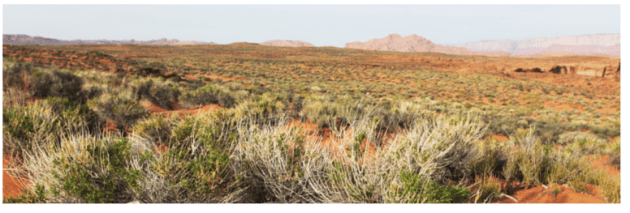
This spring, I dreamed up a teaching series for my church called, “Fierce Landscapes” (inspired by the book by Belden Lane of the same name). It was a journey through “desert spirituality”, which continues to be a really powerful idea in my life. I thought I’d turn it into a blog series, so for the next few weeks I’m going to explore what Israel’s journey through the desert means to us today. Please let me know how you like it. 

The Exodus is, without a doubt, the central event of the Old Testament. If you remove the actual freeing of Israel from Egypt, pretty much the whole story of God’s people will come unhinged. It is the center, the spoke, that holds Israel’s self-identity together. Remove the fact that God—YHWH—tangibly intervened in history at one point, and you the whole operation is in jeopardy. It’s simply that important.

So it’s worth thinking about.

If you’re not familiar with the story, here’s a brief summary. After God calls this one man—Abram—and his subsequent family to become a part of this great rescue operation, God’s great redemptive plan, at one point (namely, at the end of Genesis the first book of the Bible) that family ends up living in Egypt. Most Genesis 37-50 tells the story of how Israel’s sons—first Joseph and then the rest—end up living in Egypt. Joseph rises from a place of imprisonment to a place of power in pharaoh’s household, and at that point, even though the “rescue operation” isn’t necessarily moving forward, the family is safe and secure and waiting for the next unfolding of God’s plan.

Unfortunately, things veer south, and the book of Exodus opens up with this phrase:

“Now a new king came to power in Egypt who didn’t know Joseph… The Egyptians put foremen of foxed work gangs over the Israelites to harass them with hard work” (1:8, 11a).

Basically, Israel, the descendants of Abraham and thus the focal point of God’s work in the world, has been made captive by the Egyptian empire, and things in no way look good for their release any time soon.

One day, Moses, a Hebrew who has been basically raised as an Egyptian, is out tending the flocks of his father-in-law when he has a supernatural encounter with God. Appearing in a bush that is burning but is somehow not consumed, God tells Moses that He has heard the cries of Israel, and that He is about to act to free them. He is going to step into history in a very real and tangible way, and get the rescue operation back on track. (Along the way he gives Moses the first details of how He is going to do this: “Now the Israelites’ cries of injustice have reached me. I’ve seen just how much the Egyptians have oppressed them. So get going, I’m sending you to Pharaoh to bring my people, the Israelites, out of Egypt; 3:9-10).

Through a series of miraculous and devastating plagues, YHWH forces Pharaoh to relent and release Israel. They are free to head towards a land that God will show them: a place of security, of peace. A place where they will be free.

In other words, the place that every slave desperately wants to get to.

However, in between Egypt and this “promised land” is the desert. The wilderness. The unknown.

And Israel has to go through it. Like it or not, there is no detour, no shortcut around the blistering sands and freezing nights of the desert.

It’s also the same for us.

God promises the same things to us that He promised the Israelites: rest, peace, and mission (note that I didn’t say “a Cadillac, a new house, and a great job”). God absolutely wants us to have, as Jesus puts it, “the eternal life now.” He wants to see His Kingdom come in our lives and in our world.

But only if we are willing to go into the desert and allow ourselves to be shaped by it. 

The desert is decidedly “in between”. It is neither-here-nor-there. It is not slavery, but it is not the promised land. It is not bricks, but it is not rest. It is a wilderness, a frontier.

Why?

Why doesn’t God just take the Israelites straight into Canaan, the place He promises them?

Why doesn’t He just instantly change us into peaceful, compassionate people?

Succinctly, because what God wants most of all is for His children to grow and mature. To be ready for the promises (land, freedom, rest, peace, etc.)

The desert is what’s known as “liminal space.” It is frontier space, borderland. It’s the place where the old no longer makes sense, but the new is not yet realized.

Liminal space is the place of change. The governing image is that of a threshold and an open door. As you stand in the frame of the door, you are between two rooms, or between inside and outside. You are (quite literally) neither here nor there.

It’s the space where things happen, where we are the most open to change and growth (if for nothing else than nothing seems to make sense any more).

Later in Israel’s story, God compares His people to His bride, and says this about her and the desert:

“Therefore, I will charm her,
And bring her into the desert,
And speak tenderly to her heart.
“From there I will give her vineyards,
And make the Achor Valley a door of hope.
There she will respond to me
As in the days of her youth,
Like the time when she came out
Of the land of Egypt” (Hosea 2:14-15)

What this scripture is saying essentially is that in the spiritual life the desert is a place of positive change, of growth, of spiritual encounter.

Of course, this doesn’t mean that it’s comfortable, only necessary. 

Do you want to grow? Do you want to be free? Do you want to change? To mature, to grow up? Then the simple invitation rolls out to you: come into the desert. Come into the “space between”, and get ready. Sure, it’s dusty. And dry. And confusing. And anything but comfortable.

But if you were to be honest, the alternative is simply to stay in Egypt, to stay a slave, the “same old way you’ve always been.”

Most of us don’t really want that. We want what Moses and the children of Israel wanted: a life that’s somehow a bit bigger, a bit more peaceful, a bit more engaged, a bit more “on mission” than what we are currently experiencing.

But to do that, we have to be willing to go through the place where we may really not want to go.

Are you willing?


+e