A Blessing for Good Friday…

May you complete this journey fully…

May you face your sin and brokenness completely and unflinchingly…

May you realize what it cost Jesus of Nazareth to heal this broken world…

May you mourn deeply…

May your gratitude be deep and heartfelt …

May you anticipate Sunday… (But not just yet)

May you feel the sadness of the death of an innocent man…

May you shudder in the doubt of the tomb on holy Saturday…

May you walk these final steps with bravery and courage and faith…
May you realize that this death healed the world in a complete and powerful way… That it declares that the darkness will not win…

Amen

Confession

I’m supposed to like record players; I know this.

I’m supposed to like them because I’m a musician, and somehow I’m still slightly cool (at least, my 18-year old daughter still tells me that).

So just those two things alone are supposed to add up to me liking (and collecting) vinyl.

Oh, and then add into the fact that I’m white, and (somehow) middle-class.

This is a slam-dunk, people.

But here’s the deal:

I really don’t.

And it’s not like I haven’t tried: Just like I was supposed to, I retrieved my old records from my parents’ house years ago, in preparation for when I’d get my own turn table and begin to revel once again in that warm analog sound.

I prepared for this!

Then a year or two ago, I even talked my parents (in Virginia) out of their turntable, which was/is a decent Yamaha model from the 80s. When I got it home to Florida, it didn’t work right, but I figured, “Hey, I’ve got time to get this thing repaired, and then I’m gonna be just as cool as all of my hipster friends!”

Then my family got me both a new turntable and a vinyl copy of Funeral by Arcade Fire.

Folks, it doesn’t get any more hip than that.

So I played the Arcade Fire (starting with, what else, “Wake Up”), and then started to cycle through my old records, and in about 5 minutes I remembered something about vinyl that I’d long since forgot:

Vinyl scratches really easily.

I remember being 13 or 14 and sitting down to listen to my favorite “LP” or “45” and being shocked and devastated when a skip or a scratch appeared. I remember delicately handling the records only to have mysterious clicks and skips appear no matter what I did.

My memory wasn’t that rosy.

What’s more, I discovered that I really enjoyed having my entire catalog of music available on my iPhone, my desktop, my laptop, my iPad (as long as there is WIFI, of course), and my AppleTV.

It like the convenience.

And as far as the tone goes, I get that I am losing sound in the compression (as good as it gets), and let’s face it analog warmth does trump (ugh) digital clarity sometimes.

But here’s the thing: 1) To a certain degree, I can EQ for warmth. I roll off some highs, and bring up some some low-midrange, and revel in the color of a nice low end. Also, 2) being a musician, I already hear a lot of what many people miss. I don’t have “Golden Ears”; they’ve never made hit records, but I’m aware of the fact that I’m probably hearing probably 20% more of what the average listener hears, even with the data loss.

Okay. So what’s the point?

The point is, I know all of these things. I love the fact that my family bought me a turntable, but for now in my life, I will focus on digital music, if for no other reason than I don’t need any more stuff in my house. I already have an acquisition problem, and I am practically ashamed of how much I have. Some of this I can justify as “ministry tools” (guitars and books), but other things… like records. I just can’t, at least for now.

But then we went to St. Petersburg for vacation. As we were walking up and down the cool downtown streets, my daughter saw a record store that she wanted to go in, and so we all followed her.

I have to admit: it was very nostalgic to walk around the aisles filled with all of those discs. It felt like 1982 all over again.

My wife casually said to me, “You know, you should buy a record. Don’t you like Wilco? It can be your souvenir.”

She said this to me with all innocence.

But the most amazing thing happened to me when she said it…

Despite the fact that I have no room for vinyl in my house…

… Despite the fact that I know that I prefer to listen to my stuff through iTunes or Spotify…

… Despite the fact that I am crystal clear on the fact that I did not want a record…

… Despite all of that I said, “Yeah… I love Summerteeth; I’ll get it.”

And so I did.

And then I felt awful.

You might say, “What’s the big deal, Eric? It’s just a record?!?!?”

But in my spirit, I was crushed.

Why couldn’t I say no?

How does one’s life get to the point where there is something inside you that drives you to just *acquire* things that you know you neither need nor want?

It was/is a sobering reminder: I am wired up for appetite; for desire; for selfish acquisition.

I desperately need someone or something to heal this sickness inside of me; I don’t want to be a person who mindlessly buys and consumes things simply because I can. Nonetheless, in this minute I utterly failed the test that life gave me.

So this day: this Holy Thursday. The day before Friday of the Cross, I am reminded that the “SELF” inside of me still has an agenda that is opposed to a life of simplicity. My self remains centered on ego and an agenda that would have me consumed with acquisition and consumerism, with control and domination of anything and anyone that gets in my way.

I’m thankful that the Cross not only broke the power of evil in the world, but decisively shows us all the way to exist in a way that transcends the world’s power.

It’s by dying that we truly live.

It’s not easy. I’ll always be drawn to “Glittering Images”, to the “impossible cool” of the world, but fortunately I’ll always have that stronger vision of the Christ on the Cross that reminds me that I don’t have to live like this anymore.

…..


Maybe Jesus Wants Me on the Bench for the “Super Bowl”

(Note: I published a slightly different version of this for my church last week.)

If you hang around churches long enough, chances are you’ll hear Easter referred to as “The Super Bowl.” It’s the time when everyone rolls out the “red carpet” for people who may only come to church once or twice a year. Along with Christmas, it’s a Sunday when you’re as likely to find some kind of livestock in a worship space as a preacher.

People book convention centers, outdoor amphitheaters and all manner of large venues in order to make a big splash and “do it up right” for Jesus’ resurrection.

As best as I can tell, the goal is two-fold:

1. Show visitors that we can put a great celebration, and
2. Celebrate the earth-shaking, cosmic-changing event that is the resurrection.

Best bands. Skinniest jeans. Brightest colors. Most vivid tech. Most flowers. (Cue allergies.)

The superlatives go on and on, and in a way there’s nothing wrong with any of it. We are called to proclaim this message to the world (whether they want to hear it or not), and we are called to celebrate our risen Lord.

But I’d like to challenge you to think about a couple other aspects of this week:

  1. Sometimes, we get so focused on the “Super Bowl” that we undermine our communities’ abilities to be present for it. Instead, we find exhausted volunteers, hyper-focused musicians and technical artists who are playing the heck out of a song but are spiritually worn out from the hours and hours of rehearsals.

    Relatedly, we also find communities that load down Easter with the entire Holy Week journey, so that people are talking about Jesus’ sacrifice on the cross and the atonement as well as the significance of resurrection life all on the same morning. Now, those things are intrinsically related, but they are so cataclysmically huge that the journey becomes to large to take, and most preachers just lean on “the Blood,” which in and of itself isn’t too bad, but it also isn’t really Easter.

    Year ago, I started looking for ways to both slow down during Holy Week as well as lean in to the journey towards the Cross. What I found is that Easter needs the context of Holy Week in order to find its true significance as well as to give volunteers the necessary break during a busy season. Simply put, when you journey into mourning and sorrow, joy and celebration becomes much easier.

  2. Even if your community still chooses to celebrate the “Super Bowl”, it’s up to you to tend to your own soul. Out of all the weeks of the year, this is the week when you should be most connected to God’s presence in your life. So take the time this week to pray, to meditate even in the midst of rehearsals and soundchecks and call times.

    Realize that you actually aren’t playing in the Super Bowl. God did that (and won). You’re just telling people the story of the Super Bowl, and guess what: you’re a part of that story. So don’t zone out during it.

40 Words: Failure.

“Failure” is not a pleasant word; not even close to something like, “Illustrious” (which was my favorite word as a 9th grade English student), or “Sublime” (not so much the band, but the adjective), or “Craftsman” (one of my former bandmates called me that referring to my approach to music, and it remains one of the highest compliments I’ve ever received… or could give).

Nope, “Failure” is a word we like to avoid.

It’s the “DNF” in the race (Did Not Finish).

I’m probably more familiar with failure than I’d like to admit.

It’s easy for me to focus on my “wins” and my achievements, especially over the last 12 months or so:

  • Graduating Seminary (with a 3.8 GPA, even!)
  • Running my first half-marathon
  • Raising two pretty decent kids
  • Becoming a better husband
  • Wrestling with some long-time demons, and achieving some semblance of sanity for the maybe the first time ever
  • Mentoring and teaching a variety of people in my community

Those things are all important, and I’m proud and grateful to have completed them, but I also have to admit that I have a pretty significant history of being someone who struggles to “finish.”

I’m great at starting.

But it’s that middle that tears me up.

I committed to blogging Lent. I did. I can’t take that back. I put it out there for all of the internets to see…

And then I failed.

I lasted what, two or three weeks?

I don’t even know. I don’t want to know, to tell you the truth.

And so the tapes begin:

“You see… you never finish anything

… You quit. You’re a quitter.

… You bail out as soon as things get hard.

… You don’t have enough grit.”

Those are some tapes that play in my head. Lovely, isn’t it? We all seem to have them—little quotes and sayings that invade our headspace whether we want them there or not, and remind us off all the bad things we are and all the good things we are not.

But I also know that’s not the whole story.

It seems to me that there comes a point where you have to make a choice about what it means to be human: are we the sum of our actions and deeds? Are we “sowing a destiny,” so to speak?

OR…

Or are we far more complex than that? Am I more than a failure, even when I fail?

I’d like to think that I am, and I’d like to think that God thinks so too.

So yeah, I failed. I started, and didn’t finish. I had the best of intentions, and they didn’t pay off.

But here I am: Holy Wednesday. I will walk towards that Cross on Friday, and I know that Jesus died for this “failure”, mostly because He knows that being human means not getting it right sometimes (most of the time?), and that we all need a little help.

40 Words: “Mystery” (03.08.2016)

Where has lent been taking you? Where has this journey led you?

I can become pretty fascinated with words and phrases. I find it interesting how we assume that some words mean one thing, when upon closer examination we discover that there is a nuance we are missing. Over time it is been forgotten, or changed by culture.

Eugene Peterson wrote once that in prayer we come to face to face with the possibility of words coming to mean what they really mean, which can be a pretty scary thing. But rather than focus on just that, I was thinking this morning about a phrase and a concept that is easily thrown around in circles of faith, but is seldom really thought about.

A journey inward is a journey into mystery. We discover things about ourselves that we never realized, we come face-to-face with aspects of our personality that we have either forgotten about or never discovered. As I’ve said before, to in this sense Lent is likewise a journey into this same mystery. Through our disciplines and abstinence and fasts, God reveals things about our lives and character that we were unaware of.

One of the phrases that Christians throw about quite easily is “God knows me better than I know myself.” The Bible reinforces this in writings like Psalm 139, when the writer writes that God has knit him together in his mother’s womb.

But the implications of this are fascinating to me: because it means that ultimately at the bottom of who we are we are a mystery, not just to other people, but to ourselves. We tend to assume that a contemplative, inward journey will lead us to a more concrete awareness of who we are, but oftentimes the opposite is true: as we go into ourselves more and more what we come to discover is that there is less and less about ourselves to understand. We realize that we are deeper than our possessions, deeper than our circumstances, deeper even then our emotions. Likewise, we come to see that our motives confuse us; we believe certain things with our minds, but actually behave in ways contrary to those beliefs. Ultimately it’s as if we are unknowable even to ourselves. It’s at this point, we are reminded that we are not called to trust ourselves for life or salvation; we are called to trust something—someone—else. At this point we can literally take ourselves out of the driver seat even have our own lives, and rest a shirt the one who ultimately knows us is guiding us.

Welcome to the mystery that is you.

40 Words: “Desert” (3.7.2016)

If you know me at all, you know I’ve been periodically fascinated by the desert. I built a whole sermon series about it, have written about it here, and have read a myriad of books about “desert spirituality.” I’ve accepted it as a great teacher, and a challenging, but uncomfortable friend.

The idea of “desert spirituality” emerged in the first few hundred years of the church, as men and women fled the increasingly urban context of the faith and entered into the isolation and “fierce landscape” of the desert, usually in Egypt. While these pilgrims were definitely rejecting the culture that they saw around them, they were also seeking to more fully embrace the transformative and holy life that God was calling them to. In order to bring that life into being, they had to be brought face-to-face with the stark realities of who they were at their core, of who they were when the distractions ceased and they were unable to hide behind the countless masks that society so easily provided them with.

So, embracing a life that included vast amounts of time by themselves, as well as time with and serving others, they founded and developed a rigorous spirituality that is ruthlessly honest about what it means to be human (in all of our brokenness) as well as ruthlessly hopeful in a God that is lavishly loving and eternally committed to our growth and development.

The trouble is, most of us don’t live in deserts any more. We live in a comfortable, sustained and sustainable suburban existence.

Now we have to look for the desert, and it’s simply not easy to find.

The good news is that you don’t need to sand to have a true spiritual desert.

You just have be willing to experience discomfort, emptiness, longing, hunger, and some forms of deprivation and yearning.

Those things are discoverable if you really wish.

Lent is a “desert season” in the Christian calendar. The more we embrace the disciplines of abstinence that come with these 40 days, the  more we can taste the desert that brought such powerful revelation to the men and women that have gone before us.

Welcome this time as an opportunity to grow, to learn, to stretch, and to hear God in new (if challenging) ways.

40 Words: “Solitude” (3.5.2016)

There are just too many voices.

Coming from everywhere, and nowadays increasingly without ceasing or pause.

Red Dots—alerts on our phones—demand our attention, dings and whistles, buzzes and vibrations all pull us here and there, giving us the illusion of importance.

It’s a blissful distraction.

Some of us claim an allegiance to deeper waters. Some of us believe in a well of faith that dwells inside us.

But the voices and the dots, fortunately, give us a lovely, anesthesia.

But then, for better or for worse, occasionally we enter a season or a zone where the voices still and the silence grows, whether cultivated or not.

And in that silence, we hear another voice. The well of faith becomes clearer, and we can see a path towards the better, deeper, healthier parts of our souls.

Solitude may not be natural to our modern world, but it is far more necessary than we’d like to think, mostly because solitude carves out a dwelling space for the God that we seek and run after.

I’ve heard it said that God is a very powerful gentleman; he is the creator and mover of the universe, but at the same time he respects our desire for space, even when the space isolates ourselves from him.

Over time, however, some of us discover that it’s actually possible for solitude to become more natural to us than the red dots and the buzzing vibration.

If for no other reason than that’s where we find our Father.

40 Words: “Relinquish” (03.02.2016)

How is your fast going?

As I wrote yesterday, mine is definitely up and down. In many ways, it’s a daily struggle for me, and sometimes I just don’t win.

Every once and while, though, there is a victory. Small and insignificant in the grand scheme of things, but a victory nonetheless.

I’ll take it.

This Lenten journey is an opportunity for me—for us—to participate in Jesus’ own story.

In a way, it’s easy to think of Jesus as a victim: arrested and tortured by a corrupt religious system, and then executed by an uncaring empire.

Ultimately, I don’t think that’s the whole (or even the majority) of the story. Repeatedly in the gospels, Jesus talks about his decision to go to Jerusalem, and ultimately to the cross. In John’s gospel, he clearly says (and Jeff Tweedy sings), “No one takes my life from me; I lay it down.”

I think that all the time Jesus actually knows exactly what he is doing, and his journey is ultimately a journey of relinquishment.

In turn, as we relinquish our rights in Lent—

… our right to be satisfied

… our right to be distracted

… our right to be comfortable

… our right to be satiated—

We walk part of Jesus’ journey with him.

One of the key reasons Jesus undergoes this journey is to show people what God ultimately looks like.

People think that to be God means to have ultimate power and therefore to get what you want, when you want it.

Jesus’ subversive, even counter-intuitive story says that actually to be God means to surrender. It actually means to set aside your rights and, rather than be served (i.e., get what you want), it means to serve. 

40 Words: “Brokenness” (03.01.2016)

487725_10200632903890056_376366753_n

image from longingforhomedesigns.com

“To be alive, is to be broken.” -Brennan Manning

I forget simple things, like that statement, over and over.

As I’ve said repeatedly, Lent is this season for reflection and contemplation, a time to clear space in my life into which God can speak…

… and I can listen.

At my church, we have been going through a sermon series called “SE7EN”, which is a journey through the Seven Deadly Sins and their effect on our lives. I’ve preached two of the sermons, and each time I have counseled people to get honest with someone and admit their failings.

There’s no shame in having cracks and faults. We all have them; that’s what it means to inhabit this body of ours.

(Of course, the earth-shaking, universe-changing idea is that God decided to inhabit a body just like mine and live a 100% God-centered, God-focused life. This means that brokenness is not an inhibitor of God’s work. It means that brokenness and limitation is a place where God is willing to make his home, in some form or fashion. My job is to recognize that fact and live out that reality.)

Well, I want to get honest with you.

I’m lousy at fasting.

Last week, my wife was out of town, so I was being a faithful house husband: fixing dinner, reheating leftovers, supervising homework and in general running the monkey house.

I consistently blew my fast for 5 days in a row.

I don’t know what it was: the change in routine, the stress of being alone, etc., etc.

The reasons go on and on, but the bottom line remains the same: I failed to control my own self, my ego-driven desires and urges.

By the way, this is not beating myself up; this is merely taking responsibility

Never mind that I was writing daily about the importance of fasting.

Never mind that I had just delivered a message on fasting on Sunday.

This was not my vision for the week.

But here I am, at the beginning of another week. Shana is again traveling, and so I will, again, be faced with my own limitations and temptations.

Part of the spiritual life is an exercise in accepting your limitations while at the same time being doggedly determined to change, progress, and evolve over time.

I believe that God wants more from me, because He has more for me.

Much of my reading recently has come from ancient spiritual masters, from both the Eastern and Western traditions of the Church. More than modern authors, they seem to recognize two key things:

1. The offer of transformation, of *theosis* or “divine union”

2. The inherent limitations of being human.

Because of these limitations, they don’t pull punches when it comes to arranging your life for spiritual growth. Essentially, they say that we *must* learn to discipline and control our egotistical, self-driven urges in order to give ourselves more completely to Christ.

I’m buying that. 100%.

To be alive is indeed to be broken. But to be alive is also to participate in the divine mystery of God-With-Us.

Back to the fast.

40 Words: “Fragile” (02.29.2016)

FullSizeRender.jpg

We are not meant to be superhuman.

Last year, I managed to run my first race, EVER. I ran a 10k in March, and then, somehow, trained to run a half-marathon in October.

It was, by far, the most difficult thing I’ve ever done.

I was on a roll: my goal, my plan, my intention was to run the Tallahassee Half Marathon in February. In fact, I bought my registration and tweaked my training appropriately.

I had big plans.

But training over the holidays isn’t easy. I ate too much, skipped days here and there, and before you knew it I was a bit behind.

“No big,” I thought, “I just ran a half-marathon! I can make this up easily.”

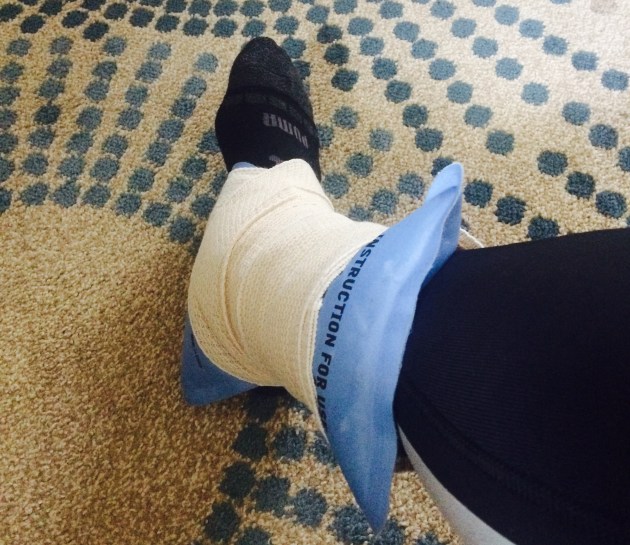
One day in December I had an 8-mile run scheduled, and at about the 6 mile mark I felt a strange twinge in my ankle. It wasn’t enough to stop my run, but it was worth being aware of.

In the next day or two, I’d figured out that I had stumbled into another bout of tendonitis. It wasn’t painful to walk, but I definitely felt it when I tried to run.

(I had tendonitis back in 2013, and it put me in a walking boot for 4 months; I knew this wasn’t to be trifled with.)

In terms of the Tallahassee Half—my goal, and my plan—I was *done*.

I had to face the hard facts, and shut down my training and surrender my goal.

It was sobering.

But life is full of unexpected twists and turns and hardships. It’s just that way.

Kind of like missing 4 days of Blog Posts in a Lenten Series.

I had no intention of skipping those days, but last week just threw some curve balls at me, some anticipated, some not.

But (as Michael Caine said in Batman, and Rob Brydon so eloquently imitated in The Trip,

“Why do we fall, Mr. Wayne?”

The only real option, it seems is to get up and start walking (or crawling) again.

Or writing.

A couple weeks ago, I started running again. In order to be safe, I decided to return to a “couch-to-5k” program that I’d used before, so that I could make sure I didn’t stress my ankle out too much. I pack it in ice, and do stretches, and take Motrin.

(In other words, remind myself that I’m not 25 anymore.)

It’s been working, but make know mistake, it’s a bit embarrassing in light of my ambitions: instead of celebrating my 2nd half, I’m doing 3 minute runs followed by 3 minutes of walking.

Not exactly setting any records.

But this is what life is: a constant exercise in adjustments and tweaks to new circumstances.

I’d planned to write every day in Lent.

That didn’t happen.

But I’m still committed to this project, and though it’s embarrassing to have to admit that I missed 4 days because I couldn’t adequately balance my schedule, I really have no choice, except to sit down in front of my computer again, and *start over.*

It’s no sin to be fragile and imperfect.

Welcome to the human race… again.