Stop Worrying…

Note: My first ever iPad-only post, and I’m still learning… I’ll fix the links when I get back home… 

An atheist organization started this bus campaign in England.  Frankly, I’m not too hung up on arguing or “evangelizing” them (how can you make “good news” good to those who don’t want to hear it?!?)

For those of us who’d claim some faith, however, I’d recast their slogan this way: There is a God, now stop worrying and get on with your life.

Though God’s ways are sometimes strange and difficult to understand, I am coming to believe that God’s love somehow overflows to us, for us.

Consider Moses’ words in Deuteronomy 30:

Now listen! Today I am giving you a choice between life and eath, between prosperity and disaster. For I command you this day to love the LORD your God and to keep his commands, decrees, and regulations by walking in his ways. If you do this, you will live and multiply, and the LORD your God will bless you and the land you are about to enter and occupy.

But if your heart turns away and you refuse to listen, and if you are drawn away to serve and worship other gods, then I warn you now that you will certainly be destroyed. You will not live a long, good life in the land you are crossing the Jordan to occupy.

Today I have given you the choice between life and death, between blessings and curses. Now I call on heaven and earth to witness the choice you make. Oh, that you would choose life, so that you and your descendants might live! You can make this choice by loving the LORD your God, obeying him, and committing yourself firmly to him. This is the key to your life. And if you love and obey the LORD, you will long in the land the LORD swore to give your ancestors Abraham, Isaac, and Jacob.

All Wham! references aside, two things jump out at me:

  1. Moses seems to practically beg Israel to “get it right”… The tone in this passage is such that you get the feeling that God (through Moses) is just cheering on his people to make the right decisions so that they can have a life of fullness and peace. Even when Moses cautions the people, he doesnt’ say, “God will destroy you; he says you will be destroyed.
  2. Relatedly, God doesn’t call Israel to worry about his love; He maintains, “make this decision then get on with life. I am for you, and for your descendants. There’s a good life waiting for you; just get the foundations right and then stop worrying.

What does it mean that God is inclined towards us, cheering us on to obedience and life?

Meet My Friend Lindsay…

Special treat today… My friend, writer, and all around awesome person has agreed to write something on her spiritual growth. She has an amazing story of transformation and change, and I asked her to share a little of it. She normally blogs at Fueled By Diet Coke, but well, I have her today…


“For the past ten years, you’ve been suffering from an eating disorder, and we’ve got to start a treatment regimen to get you healthy again, so—“

The rest of my nutritionist’s words were muffled under the sound of the blood pulsing violently against my ear drums. I had an eating disorder. I’d had one. For a decade. I was physically unhealthy. I was suffering from something seriously life-threatening.

Over the next several months, I cooperated with my treatment and was able to get on the road to a healthy body image. Though I still struggled daily, I was proud to leave my disordered eating days in my past. I was finally ready to proclaim heath.

Fast forward two years.

“Why are you doing this again?”

The words shot out of my mouth like ping pong balls and bounced against the windshield and hit me in the face. Despite the eating disorder treatment under my belt and its offering of some false sense of normalcy, I was still suffering from a disease much more deteriorating. Complete and utter self-hate.

I was sitting in my car, parked about a block from my house and my new husband, with hot tears running down my cheeks.

I’d run away from him again. This time, however, after telling him he would divorce me if he knew what was good for him. Not even a year into our marriage and I had slapped the “d” word across his face and left.

I looked up at my reflection in the rearview mirror and saw my red face, stained with the makings of a sabotaged relationship, with no one to blame but myself.

“Why?” I demanded again through clenched teeth. A rhetorical question I felt the need to answer anyway. “Because this is how you always are. This is what you’ll always be. You’ll never be more than your failures and that’s why you don’t deserve anything good.”

This is how it always went. It was as if someone would insert a DVD into my brain every day and play it loudly – a DVD recap of everything I’ve ever done wrong, everyone I’ve ever hurt… a resounding soundtrack to the cyclical nature of me beating myself (sometimes actually physically) into a bloody pulp.

Just as the DVD began to start over for the tenth time that day, something pressed the STOP button. A small voice. It didn’t say much, just, “Go back inside, Lindsay.”

I didn’t want to. I didn’t want to go back inside to find yet another relationship ruined by my own insecurities and hate. I didn’t want to walk back into the house to face my husband, whom I was certain had decided that this instance was the last straw and he was leaving me for real. I didn’t want to open the door and find our small house empty, now a cavernous reminder that I was, indeed, the worst person in the world.

But that voice wouldn’t stop. So I eventually relented.

I put my key in the lock as quietly as I could and turned the knob. I was shaking, but my breathing had returned to normal. I had the comfort and peace of that small voice with me. I knew that I was doing the right thing, no matter how badly it was going to hurt me. I was fully prepared to accept my fate. My failure. My abandonment.

But what I saw broke me down even more than I could have even imagined. I saw him. I saw my husband, slumped down in a sad heap on the floor of our living room.

His eyes met mine. “You came back,” he said, hopefully.

I collapsed in his arms and apologized probably a hundred times, letting him forgive me just as many.  I didn’t understand it. I was the prodigal son, the adulterous Israel, being taken back with a warm embrace and a promise of unconditional love.

Three years later, I know now that that small voice was Jesus.

Being raised in a Christian home, I’d read the scriptures about God calling us, His followers, a “masterpiece” and “new creations.” I’d heard about Him creating in us a “new heart” and all that. But, up until that day, I’d never allowed him to try it with me. I’d always assumed that I was too far gone, too unlovable, to be anything but trash. But feeling the warm embrace of my husband, a man who truly does love me as Christ does the church, I finally surrendered to God, allowing him to guide my growth and healing.

Through trusting Him, I was able to seek wise counsel from pastors, friends, and family, in order to rebuild the shattered shell of a girl I’d become. I knew that, at this point, it was my choice to give God the space to kill my old self and raise me anew in Christ Jesus.

Since then, I’ve started writing a blog about learning how to love yourself in a world that profits off of your low self-esteem. At first, it was merely an outlet for my growing pains. But at this point, it has turned into a ministry, reaching thousands of readers who have struggled in the same way I have. I wonder, quite perceptively, if this wasn’t God’s plan for me all along.

It hasn’t always been easy. I’ve had a lot of hard conversations, answered a lot of tough questions, and made really difficult promises. There were times when going back to my old ways seemed easier, more comfortable, more feasible, and I had to make the commitment to God to work in me all over again. But I can tell you, without a shadow of a doubt, that every second has been worth it.


 

My (Half) Day as a Monk

image via wikipedia.org

All I knew is that I needed a break.

Last week, I found myself desperately needing to hear from God. I didn’t know quite know what to do, so I drastically rearranged my schedule in order to try and put myself, as best I could, in a position to listen. About halfway through the day, I thought, “Hey, I just spent the day like a monk would!”

Okay let’s be honest: my understanding of a monk’s life is informed mostly by television, movies, and a few books, but this represents my best guess as to what it would be like. 

  • Monks get silence. St. Benedict wrote that Monks should diligently cultivate silence at all times.” After I dropped my daughter off at school, I stopped talking (Full disclosure: In order to keep from being rude, I needed to say, “Thanks,” to a couple people). I turned the radio off, put away the iPod, and just. shut. up.
  • Monks get solitude. Bernard of Clairvaux wrote, “Christ the Lord is a spirit before your face, and he demands solitude of the spirit more than of the body… To follow the advice and example of the bridegroom, shut the door and then pray… He spent nights alone in prayer, not merely hiding from the crowds but even from his disciples and familiar friends.” I hid my phone and turned off my mail app, in order to be fully present and not distracted.
  • Finally, monks get work. Though the purpose of a monastic life was not to work and “produce” stuff, the fathers of the church knew the value of working with your hands and contributing to a community. In the midst of my silence, I went out and mowed the lawn, continuing to direct my thoughts towards God (and also continuing to remain silent).

Silence and solitude don’t come easy or naturally in our society. Even our spirituality can be shot through and through with activity, busy-ness, and distractedness.

Dallas Willard bluntly writes that, “the life in tune with God is actually nurtured by time spent alone… It is is solitude and solitude alone that opens the possibility of a radical relationship to God that can withstand all external events up to and beyond death. (The Spirit of the Disciplines, 101)

Because I believe in the power of a secret, I won’t divulge all of what I heard from God that day, but I will tell you this much:

He spoke, and I heard. 

A lot of you might say, “I could never take the time to do that,” but I wonder…

  • a lot of us take regular trips to the beach or to the pool…
  • a lot of us carve out time to travel hours (because in Tallahassee we have to) to go see a great band…
  • a lot of us take days full of friends, shopping, and voices…

So why not take some time to seek some silence, and quietness. Take some space to get away from the constant voices in your life to sit at the feet of God?

p.s. to read a little more about the rule of St. Benedict, you can go here and here.

The Rule Behind the Freedom Behind the Rule…

I don’t know about you, but there is a constant tension in my life of faith between my efforts to grow, and the call to rest in God’s love, forgiveness, and grace (“unmerited favor”). Most of us would readily say that Jesus came to set us free from “rules” and works-based faith, but the reality is much more subtle than that simple platitude.

In the first place, most Jews of Jesus’ day had no illusions that they (just like the Christians) were children of grace. They knew that their very existence—as a people—was as a result of God’s preemptive action in the Exodus. The law came after God set them free; their obedience came out gratitude for God’s liberating action. They knew that YHWH was a God of lavish mercy and forgiveness, and they rejoiced and celebrated that forgiveness.  So when Paul (or Peter, or the Gospel writers) proclaims that God freely forgives, and that forgiveness is based not based on our works, he is not actually proclaiming anything radically new to a Jew.

But there’s more.

Paul has a troubling habit of talking a lot about “works”—these works from which Paul is (supposedly) telling us we have been freed. Paul never really says, “Don’t do works.” However, he does constantly say, “Don’t trust your works to save you; work, but still trust in Jesus’ saving work on the cross, and God’s faithfulness.”

A great example of this tension is in Paul’s letter to the church at Colossae, particularly in the section between 2:6 and 3:18.

In this section, Paul constantly emphasizes our freedom in Christ. It culminates with verses 20-23:

You have died with Christ, and he has set you free from the spiritual powers of this world. So why do you keep on following the rules of the world, such as, ‘Don’t handle! Don’t taste! Don’t touch!’? Such rules are mere human teachings about things that deteriorate as we use them. These rules may seem wise because they require strong devotion, pious self-denial, and severe bodily discipline. But they provide no help in conquering a person’s evil desires.

Paul certainly wants us to avoid relying only on rules and “discipline” to transform us. But it’s not quite that simple, because shortly after telling us to not rely on “rules”, Paul reminds his readers (and us) that we do need to do a few things, and one thing in particular.

For Paul, it all revolves around 3:10: “Put on your new nature, and be renewed as you learn to know your Creator and become like him.”

In other words, though we should not rely on rules for our salvation, it is our responsibility to:

  • Put on our new nature
  • Learn to know our Creator
  • Become like him

Paul goes further in the verses before and after this one (all from chapter 3):

  • set our sights on—and think about—the realities of heaven (vv2-3)
  • put sinful things to death (v5)
  • get rid of anger, rage, etc. (v8)
  • don’t lie (v9)
  • clothe yourself with tender-hearted mercy, etc. (v12)
  • make allowance for each other’s faults (v13)
  • teach and counsel each other (v16)
  • sing psalms and hymns (v16)

Actually seems like an awful lot to do!

But as I read this passage this morning, it seems it all flows from the three things in 3:10 (put on our new nature, learn to know our Creator, and become like him). That verse struck me as the culmination of the passage; everything—the lists that Paul writes before and after—flows from that.

Still, that’s no small thing.

In summary, I’d say that, even though entry into God’s Kingdom and His people is utterly free, with the only requirement being humility and a belief in Jesus’ work and faithfulness, God (through Paul) actually does expect His people to have a character and presence in the world.

He expects us to be different, specifically by putting on our new nature (identity in Christ), learning to know Him, and becoming like Him.

So, today:

  • are you willing to embrace the notion that God wants to partner with you in your change?
  • are you willing to orient your life around the three things in 3:10 in order to allow Him to change you?

I Am (or A Call to Humility)

As some of you may know, during Jesus’ ministry there was not a single monolithic “Judaism.” Rather, different groups were interpreting and expressing their faith in unique ways. Broadly speaking…

… in an attempt to achieve and maintain purity and distinctiveness from the surrounding corrupt culture, the Essenes had chosen to retreat away from society. They lived in desert communities, and were preparing for a final military battle, where they would be recognized as the “true followers” of YHWH.

… the Sadduccees were largely afluent, and had aligned themselves with the economic and political structure that surrounded the Temple in Jerusalem. Because they were well off, they weren’t interested in any sort of change. They’d “got theirs”, and weren’t interested in any dialogue that might involve a loss on their end. Relatedly, they didn’t believe in the resurrection (because who needs resurrection when you have the good life on this side of death?).

… the Pharisees were the “peoples’ champions,” being popular with the masses. They were concerned with the purity of God’s people: not for purity’s sake, but so God might return to Israel and overthrow the Roman/pagan empire that controlled them. Because, in their view, God’s return depended on Israel’s purity (and quite a few people agreed with them), they sought to “help” the people fulfill the Law in as complete a way as possible.

… The Zealots were absolutely convinced that they were God’s people, and that God needed to rule them. The problem was that, at the time, Rome was ruling Israel. The Zealots desperately wanted to change that, in any way they could. They demanded change now. Which meant military resistance. Which meant weapons. Which even meant political murder. Anything to bring about the “Rule of God” in their nation.

… The Romans, lastly, had little interest in matters of faith. They had their Gods and, for the most part, were tolerant of their subjects’ beliefs. What the Jews believed about YHWH mattered little to them, as long as the peace was kept and commerce was undisturbed. Though the Romans had their pantheon of gods, the Roman “state”, for all intensive purposes, was god and supreme authority. They were supremely pragmatic, and ultimately “might made right”. The Romans got their way because they had the swords and the legions.

For years, it’s been popular for the church to ridicule and lionize Jesus’ rivals. Constant insinuations of, “Wow how could you be so off? How could you miss Jesus?…

“I mean, it’s Jesus for crying out loud!”

Message after message insinuates that somehow we would’ve gotten it right. We would’ve bet on the right horse.  I guess it’s easy to believe that somehow we’re above falling victim to all of these “silly” beliefs…

Actually it’s arrogance. We’re not above any of them.

Whether it’s just my natural tendency towards (sometimes false) humility or not, I wonder if we shouldn’t give a tad more grace to all of these groups. In fact, I’d say it this way…

I’m an Essene whenever I come to believe that God has given up on this world and it’s going over the cliff; whenever I decide to retreat inside the walls of Christian “safety” and wait for Jesus to come back and “fix everything”…

I’m a Sadduccee whenever I deny that Jesus has broken the power of death, and begin acting like this life is all there is; when I forget that this life is not the end of the story; I’m also a Sadduccee when I prefer my security, power and money over what God may be leading me towards…

I’m a Pharisee (a lot, actually) whenever I decide that someone else’s “righteousness” needs to look like mine; when I decide that somehow I know the path for others, and that they are somehow inferior to me…

I’m a Zealot whenever I decide that political power = spiritual righteousness, and whenever I think that a political party (a) has exclusive rights to God or (b) will be the savior of our nation…

Lastly, I’m a Roman whenever I choose to ignore the presence of Jesus and His call to come and die at His cross, whenever I prefer to worship the gods of pragmatism and strength, rather than weakness and service…

I’m all of these things. I don’t know if I would’ve been numbered among Jesus’ followers, or the crowd, or even the Romans who beat him and nailed him to the cross.

Good thing He died for all of those folks.

And me too. But I think it would be great if we can learn that none of us are above mis-reading Jesus, and when we talk about how “silly” these folks were, we are already walking down the road towards an unsettling arrogance and close-mindedness.

THE Prayer Pt 4 :: “May Your Kingdom Come…”

Our Father, who lives in the heavens,
May Your name be kept holy.
May Your Kingdom come,
May Your will be done,
On earth just like it’s done in Your presence.

Give us this day our daily bread
And forgive our sins
As we forgive those who sin against us.
Don’t bring us to the times of trial,
But deliver us from the evil one.
Amen.

There are three critical parts to this section: God’s Kingdom to come, God’s will to come, and His presence (presence is a slightly better translation than “heaven”, since we need to remember that God is not limited to living in heaven).

God has a Kingdom. This is no small thing.

In fact, it’s such a large thing that it’s the first recorded statement of Jesus in Mark’s Gospel:

‘The time promised by God has come at last!’ he announced. ‘The Kingdom of God is near! Repent of your sins and believe the Good News!’

Notice Jesus did not say, “Repent and believe in my  coming death and resurrection so you can go to heaven.” Again breaking it down:

  • God promised this
  • The Kingdom is near
  • You have to change your way of thinking
  • This is Good News 

There is no exact consensus on Jesus’ “Kingdom” teachings: did he intend it to be established while he was alive? Is it visible, or more spiritual? However, what is clear is that it comprised the major thrust of his teaching while on earth. Perhaps we could just say this:

To the extent that a “Kingdom” exists wherever a king’s will is put into place and performed, God wants His presence in your life to make a difference.

In a sense, the King’s Kingdom starts with you, and then spills over to the rest of the world as well.

To pray for God’s Kingdom to come is to pray for that to be true in your life.

Which means we need to take seriously the call to change, to become more like Christ, to in fact, “be perfect, even as your Father in heaven is perfect.” (Matthew 5:48)

We shouldn’t be afraid to pray this line of the prayer, but we should also be willing to go on the journey to relinquish our place in our kingdom, and to let God have His place in it.

Resurrection is About EVERYTHING

Just a brief thought on the resurrection (because it’s a season, after all).

…Not long after his death hi associates started to claim that he was now in charge, for real. And they started to act as if it was true. This isn’t about ‘religion’ in the sense the Western world has imagined for over two hundred years. This is about everything: life, art, the universe, justice, death, money. It’s about politics, philosophy, culture, and being human. It’s about a God who is so much bigger than the ‘God’ of ordinary modern ‘religion’ that it’s hardly possible to think of the two in the same breath. (N.T. Wright, Simply Jesus)

I Don’t Want a Narcissistic Crucifixion

According to iTunes, I have a lot of music. Over 22 days’ worth, to be exact.

I intentionally chose probably 95% of it; the rest were gifts, and songs that I needed to learn for gigs.

I also have probably 100 podcasts—again, ones that I have chosen.

I really don’t have to listen to the radio anymore. I can exist in my own little “Pod World,” and never have to listen to music I don’t like, or ideas I don’t agree with, any more.

That’s the world we live in—a “targeted marketing” paradise where I can tailor my world around me: my tastes and desires, my whims and wishes.

DVR, Netflix, Facebook, all point to a somewhat disturbing phenomenon:

I am the center of my existence. My needs rule.

Turning to the cross, although this may sound sacrilegious, I want to be crystal clear: Jesus’ death on the cross is not simply about the forgiveness of my individual sins. 

As N. T. Wright puts it, for too long we have made this individual forgiveness the “Sun” in our “Good Friday” universe.

But God’s purposes are much, much bigger.

And the truth is, I need it.

I don’t need a salvation that is “all about me” to join up with my universe that is all about me.

I need a God who is bigger than that; who—and pay close attention here—forgives me along the way to a larger and grander purpose in the world. 

The cross isn’t just about individuals; it’s wrapped up with the entire mission of God from Genesis 2, through Abraham, through Israel, through the Prophets, and ultimately into Revelation.

Stay with individual forgiveness only, and you risk developing a narcissistic spirituality; start with mission and you get the over-arching purpose of God, with forgiveness thrown in…

… What a gift!

Holy Week, Friday :: The Praetorium :: the Place of Suffering

Mark 15:1-20. Very early in the morning the leading priests, the elders, and the teachers of religious law—the entire high council—met to discuss their next step. They bound Jesus, led him away, and took him to Pilate, the Roman governor.

Pilate asked Jesus, “Are you the king of the Jews?”

Jesus replied, “You have said it.”

Then the leading priests kept accusing him of many crimes, and Pilate asked him, “Aren’t you going to answer them? What about all these charges they are bringing against you?” But Jesus said nothing, much to Pilate’s surprise.

Now it was the governor’s custom each year during the Passover celebration to release one prisoner—anyone the people requested. One of the prisoners at that time was Barabbas, a revolutionary who had committed murder in an uprising. The crowd went to Pilate and asked him to release a prisoner as usual.

“Would you like me to release to you this ‘King of the Jews’?” Pilate asked.10 (For he realized by now that the leading priests had arrested Jesus out of envy.) 11 But at this point the leading priests stirred up the crowd to demand the release of Barabbas instead of Jesus. 12 Pilate asked them, “Then what should I do with this man you call the king of the Jews?”

13 They shouted back, “Crucify him!”

14 “Why?” Pilate demanded. “What crime has he committed?”

But the mob roared even louder, “Crucify him!”

15 So to pacify the crowd, Pilate released Barabbas to them. He ordered Jesus flogged with a lead-tipped whip, then turned him over to the Roman soldiers to be crucified.

16 The soldiers took Jesus into the courtyard of the governor’s headquarters (called the Praetorium) and called out the entire regiment. 17 They dressed him in a purple robe, and they wove thorn branches into a crown and put it on his head. 18 Then they saluted him and taunted, “Hail! King of the Jews!”19 And they struck him on the head with a reed stick, spit on him, and dropped to their knees in mock worship. 20 When they were finally tired of mocking him, they took off the purple robe and put his own clothes on him again. Then they led him away to be crucified.

After the public betrayal and humiliation of the upper room, Jesus’ physical ordeal begins. He is arrested at night, and then kept up through a sham (and illegal) trial, before being delivered over to the only people with the power to inflict capital punishment in the region—the Romans.

The Romans didn’t particularly dislike Jesus; to them he was simply another Jewish religious fanatic. The punishment they inflicted on him wasn’t particularly malicious or evil.

But it was efficient.

Jesus was beaten, whipped, insulted, and he bled, sweat, and wavered.

Make no mistake, a lot happens at the cross; but a lot happens before the cross as well.

Because Jesus suffers.

Call me crazy, but having a “suffering savior” matters to me.

It’s possible that God, being all-powerful, was completely capable of bringing us back to Himself with a snap of His infinite fingers. But regardless, He chose to come to us in the form of a human being.

Who was beaten, whipped, and crushed.

I think the implications of this are staggering.

If we worshipped a God who was only far-off, who is distant, who is only perfect and clean, than I would be terrified or embarrassed to come to Him (or Her) in my weakness and suffering.

But because God—because somehow YHWH—knows suffering, knows pain, knows humiliation, it means that I can bring my own suffering, pain, and humiliation to Him, and when I do, he says,

“I understand.”

“I have felt this.”

“You don’t have to be ashamed.”

Because God suffered, I can suffer too, and know that He welcomes it, and shares in it. He does not shun me in my weakness, but welcomes me.

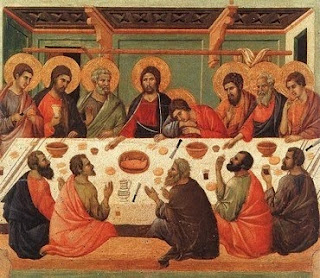
Holy Week, Thursday :: The Upper Room :: the Place of Betrayal

12 On the first day of the Festival of Unleavened Bread, when the Passover lamb is sacrificed, Jesus’ disciples asked him, “Where do you want us to go to prepare the Passover meal for you?”

13 So Jesus sent two of them into Jerusalem with these instructions: “As you go into the city, a man carrying a pitcher of water will meet you. Follow him. 14 At the house he enters, say to the owner, ‘The Teacher asks: Where is the guest room where I can eat the Passover meal with my disciples?’ 15 He will take you upstairs to a large room that is already set up. That is where you should prepare our meal.” 16 So the two disciples went into the city and found everything just as Jesus had said, and they prepared the Passover meal there.

17 In the evening Jesus arrived with the twelve disciples. 18 As they were at the table eating, Jesus said, “I tell you the truth, one of you eating with me here will betray me.”

19 Greatly distressed, each one asked in turn, “Am I the one?”

20 He replied, “It is one of you twelve who is eating from this bowl with me. 21 For the Son of Man[e] must die, as the Scriptures declared long ago. But how terrible it will be for the one who betrays him. It would be far better for that man if he had never been born!”

22 As they were eating, Jesus took some bread and blessed it. Then he broke it in pieces and gave it to the disciples, saying, “Take it, for this is my body.”

23 And he took a cup of wine and gave thanks to God for it. He gave it to them, and they all drank from it. 24 And he said to them, “This is my blood, which confirms the covenant[f]between God and his people. It is poured out as a sacrifice for many. 25 I tell you the truth, I will not drink wine again until the day I drink it new in the Kingdom of God.”

26 Then they sang a hymn and went out to the Mount of Olives.

What do you fear most?

Though most of us have irrational fears of something physical (ask me sometimes about my “relationship” with reptiles), for most of us the fear of emotional damage and threat loom larger.

How much do you fear humiliation?

I think Mark—and the other gospel writers as well—chooses words very carefully. In no way is he an idiot, or some kind of literary or spiritual half-wit. There’s a picture of Jesus that he is trying to paint, and he is using every available tool to work in the  medium of words.

Notice how he includes the phrase, “The Twelve.” First Jesus sends two disciples into the city to find a room where he will celebrate this Passover-ish meal. Then he shows up with The Twelve. Then he talks to The Twelve. Then he says, one of The Twelve will betray him.

What happened to the two?

I agree, along with theologian and New Testament scholar Craig T. Evans, that the reason Mark highlights the phrase “The Twelve” in this passage is that there were other disciples in the room. They secured a “large room” for the meal: more than enough for Jesus and his chosen twelve. But a large room would be necessary to accommodate a larger group of followers.

How many were there? 20? 40?

So when Jesus announces that one of these 12 followers would betray him, it’s not in a private, intimate place. It’s not an aside to a camera.

It’s in public.

There would’ve been some kind of gasp in the room. This was the “inner circle”, the chosen disciples, representing the “new Israel.”

And Jesus just announced that they would fail; not just fail but betray.

It would’ve been, to say the least, an awkward moment.

But Jesus is not surprised, and doesn’t seem let it affect the moment, because he goes on with the meal. 

He inaugurates the Lord’s supper, and proclaims the new covenant.

In spite of their coming failure.

Because ultimately it’s not their mission to complete. They can fail (and fail they do); he will not. 

So today, as we work through “Maunday Thursday“, keep these things in mind:

  • Relatedly (and obviously), we have all betrayed and failed Jesus in some way
  • Jesus’ is not surprised by our struggles to be faithful; he works through them and in spite of them
  • He is also not embarrassed by us; it’s his mission—we are merely called to do what he called those disciples in the upper room to do…
…To remember him.
Tomorrow: The Place of Suffering