Resting, Hearing

This Sunday, we announced to my church that I’m going to be taking some time away.

No, I’m not in trouble.

For probably 4 years now, I’ve been trying to discern what God may be calling to for the next season of my ministry and life. I’ve been in ministry for 15 years, and almost of all of it exclusively focused around music on Sunday. Recently, however I’ve started to wonder if my role may be evolving a bit to more purposefully include teaching and leadership. After a few conversations with my pastor, we decided that I should take a few months (!) and go into “listening” mode to try and more clearly hear what God is saying and how He may specifically be leading me and my family.

This is called a “Sabbatical”, and is directly related to “Sabbath.” The Sabbath—and also Sabbaticals—was established by God in Genesis 1, and then reaffirmed a few times in the bible, especially in Exodus. We’re told in Genesis 2v1-3, “So the creation of the heavens and earth and everything in them was completed. On the seventh day God had finished his work of creation, so he rested from all his work. And God blessed the seventh day and declared it holy, because it was the day when he rested from all his work of creation.”

You know what strikes me about this passage?

God wasn’t really “done.” 

Surely God knew that even though he’d brought the universe into being, creation—and the act of creating—wasn’t “done.” Creation is alive, growing, changing. Adam and Eve exist after all, now, and who knows what manner of variables they’ll bring into the picture! (Note see Genesis 3.)

Surely God wasn’t saying, “Whew, that’s done; guess I’ll just sit back and watch it all take shape now.”

I believe that God really knew that actually after you’ve created something—say, the Universe—the real work begins… Conflict, love, hate, war, sacrifice, salvation. All of these things begin to enter the picture after you’ve created something.

It strikes me that even though God is aware that creation is anything but “done”, he is choosing to rest. 

Your work is rarely (if ever) going to be “done” enough for Sabbath to make complete sense.

You will have to choose.

You will have to say, “For today, this is done. I am resting now.” 

Jesus’ Family Problems

I wrote this for my church’s e-news. Thought I’d include it here. 

During our Tuesday staff meeting, Mark and I were talking about Jesus’ family, and how he experienced not only the blessing of having a father, mother, and siblings, but how he also may have experienced the “blessing” of family loss and sorrow. He encouraged me to write out my thoughts.

You see, Jesus did in fact have an earthly father; his name was Joseph. However, scripture records something interesting about Joseph, namely that he disappears

Saint Joseph with the Infant Jesus by Guido Reni, c 1635 via Wikipedia

relatively early in the story of Jesus’ life. In fact, the last mention of Joseph in the gospels comes in Luke chapter 2, when Jesus is about 12 years old. After that, there’s no mention of Joseph at all in Jesus’ adult ministry. Tradition has held that Joseph died, leaving his wife and children alone.Even understanding that “adulthood” began a lot earlier than it does for us today, that’s pretty huge.

Jesus grew up without an earthy father.

Jesus also had a family, and Mark’s gospel actually lists Jesus’ brothers and sisters (in a way): James, Joseph, Judas, Simon, and sisters (plural, though they remained nameless). Including Jesus, that makes at least seven children.

All without a father to provide and care for them.

What’s more, we are also told in Scripture that those brothers and sisters didn’t think too much of their preaching brother. Mark notes that his family thought he was “out of his mind” (3:21), and John indicates that even at the cross, Jesus had to hand his mother over to the care of the apostle John (John 19:25-27), implying that his brothers and sisters were nowhere to be found.

They wanted no part of Jesus’ life, much less his death. 

(In their defense, Jesus’ brothers eventually came around to recognized him as Messiah; his brother James was the leader of the Jerusalem church and eventually wrote the book of James).

So, though Jesus knew a loving mother, and had an earthly father, as well as brothers and sisters, he also knew…

… the lack of a father

… the possible poverty and marginalization that a widowed family of seven children endures

… rejection and abandonment from his brothers and sisters

What I’m trying to say—and what part of the “Good News” is—is that not only does Jesus come to us in the midst of our family wholeness, he comes to us in our family brokenness. 

He knows it.

Personally.

He knows our sorrows, as well as our joys.

“God-With-Us”—Emmanual—indeed.

The Scandalous God

In Luke 14, Jesus describes a great feast.

15 Hearing this, a man sitting at the table with Jesus exclaimed, “What a blessing it will be to attend a banquet in the Kingdom of God!”

16 Jesus replied with this story: “A man prepared a great feast and sent out many invitations. 17 When the banquet was ready, he sent his servant to tell the guests, ‘Come, the banquet is ready.’ 18 But they all began making excuses. One said, ‘I have just bought a field and must inspect it. Please excuse me.’ 19 Another said, ‘I have just bought five pairs of oxen, and I want to try them out. Please excuse me.’ 20 Another said, ‘I now have a wife, so I can’t come.’

21 “The servant returned and told his master what they had said. His master was furious and said, ‘Go quickly into the streets and alleys of the town and invite the poor, the crippled, the blind, and the lame.’ 22 After the servant had done this, he reported, ‘There is still room for more.’ 23 So his master said, ‘Go out into the country lanes and behind the hedges and urge anyone you find to come, so that the house will be full. 24 For none of those I first invited will get even the smallest taste of my banquet.’”

About 4 years ago, my understanding of Jesus began to be radically rebuilt; I came to realize that most of what I’d been taught Jesus, salvation and faith was not necessarily wrong, but just incomplete. Ever since then I’ve carried a key assumption with me to the text of the bible:

there is probably something going on in the text beyond the obvious. 

It’s easy to carry our 21st century assumptions into the Bible, and that can surely illuminate some of the stories and message, but it’s also easy to miss the original (and often explosive) agenda of Jesus and writers of both Testaments.

So two quick, related observations. First, the parable takes place in the context of a discussion on humility. In fact, the man’s comment in verse 15 is a reaction to this previous exchange:

When Jesus noticed that all who had come to the dinner were trying to sit in the seats of honor near the head of the table, he gave them this advice: “When you are invited to a wedding feast, don’t sit in the seat of honor. What if someone who is more distinguished than you has also been invited? The host will come and say, ‘Give this person your seat.’ Then you will be embarrassed, and you will have to take whatever seat is left at the foot of the table!

10 “Instead, take the lowest place at the foot of the table. Then when your host sees you, he will come and say, ‘Friend, we have a better place for you!’ Then you will be honored in front of all the other guests. 11 For those who exalt themselves will be humbled, and those who humble themselves will be exalted.”

12 Then he turned to his host. “When you put on a luncheon or a banquet,” he said, “don’t invite your friends, brothers, relatives, and rich neighbors. For they will invite you back, and that will be your only reward. 13 Instead, invite the poor, the crippled, the lame, and the blind. 14 Then at the resurrection of the righteous, God will reward you for inviting those who could not repay you.”

Jesus is talking about humility and how critical it is to a “resurrection life.”

In Jesus’ context—1st century Palestine, a conquered Roman territory—this is a scandalous notion, and Jesus’ pushes the point even further with his banquet story.

This other meaning of Jesus’ story here begins to be revealed when we understand two things:

  1. In the first century, honor and reputation were of absolutely paramount importance. People made decisions based on how it might enhance their public honor and/or reputation.
  2. One of the ways that you could enhance your honor and reputation was by hosting a party and inviting the right” people to it. 

To restate this, if people wanted to know how awesome you were, how “honorable” you were, they would look at comes to your table. If “the best folks” came to your house for a party, it made you look good; really good.

And this mattered to you.

A lot.

So Jesus is talking here about God’s reputation, and how it plays into the Kingdom.

God starts out by inviting “the usual suspects”, but they reject his invitation (essentially, by the way, this a comment about the rejection Jesus is experiencing during his ministry). So God, in this culture, does the unthinkable.

He throws the concern for his reputation aside and invites “the riff raff.”

He forsakes his honor, his reputation, and essentially says, “Bring them on.”

What do you do with a God like that?

What do you do with a God who lays aside His honor and status in order to welcome everyone in?

What do you do with this God who …

… sets aside His status?

… embraces humility?

… even embraces death as a criminal? as a rebel?

The truly radical and explosive nature of this parable is that Jesus is saying, “You need to sit at the lowest seat at a wedding banquet; you need to embrace humility, because that’s what God does.

Getting Back to Our Roots

First Council of Nicea via Wikipedia

In the year 325 a bunch of Christian leaders gathered to decide some really critical theological issues. It was an amazing event, for a few reasons.

First, this had essentially never happened before. These men (let’s be honest) had only perhaps HEARD of each other; they had never met, or looked in each other’s eyes.

Relatedly, this was coming at the end of a season of (albeit sporadic) persecution for the church. Many of these leaders could show, in their bodies, the physical costs of following Jesus.

It must have been mind-blowing.

Someone recorded it:

There were gathered the most distinguished ministers of God, from the many churches in Europe, Libya (Africa) and Asia. A single house of prayer, as if enlarged by God, sheltered Syrians and Cilicians, Phoenicians and Arabs, delegates from Palestine and from Egypt, Thebans and Libyans, together with those from Mesopotamia. There was also a Persian bishop, and a Scythian was not lacking. Pontus, Galatia, Pamphylia, Cappadocia, Asia, and Phrygia sent their most outstanding bishops, jointhly with those from the remotest areas of Thrace, Macadonia, Achaia, and Epirus. Even from Spain, there was a man of great fame…

What an amazing moment in the life of the Church. But something stood out to me; check that list again:

Syrians
Cilicians
Phoenicians
Arabs
Palestine
Egypt
Thebes
Libya
Mesopotamia
Persia
Scythia
Pontus
Galatia
Pamphylia
Cappadocia
Asia
Phrygia
Thrae
Macedonia
Achaia

… Spain

You know what stood out to me?

Though the writer lists ministers from Europe, look at that list of countries.

Not really a western European among them.

Sometimes I think that we are so predisposed to think of Christianity as a western European—actually an AMERICAN—phenomenon that we forget that it’s legacy really isn’t.

As the saying goes, we stand on the shoulders of giants, and in our case those shoulders are black or olive-skinned.

European culture brings great strengths to the table, but we don’t bring everything (and some of what we bring is less than helpful, but that goes for all cultures).

How Euro-centric is your faith? Have you ever attended a worship gathering from a different ethnic background?

Have you ever read something that challenged the cultural perspective of your faith?

For my Caucasian brothers and sisters, I’d lay a gentle challenge at your feet: find a worship gathering to go to where you’d be the minority, where you could see “distinguished ministers” from a different culture.

If you want to read an introduction to the multi-cultural phenomenon of our faith, check out Soon-Chan Rah’s book on how the face of evangelical faith in America is changing.

Random Thoughts on Prodigals…

“Why did he let me leave in the first place?”

I wonder if the son who fled—we know him as the Prodigal—ever thought that?

Though I know this story from Luke 15 is (a) a parable, and (b) more about the radical behavior of the Father than it is about the son, nevertheless I found myself thinking about the son this morning.

Maybe it’s because I’m such a good prodigal.

Maybe the best there ever was…

Regardless, two things struck me this morning.

Question #1: Why did the Father let the son leave in the first place? 

Surely He knew better; the Father knew the son’s character better than anyone else. He knew what was going to happen. Do you think the gambling, the women, the lavish spending (probably on the ancient near east’s equivalent of Beats headphones and bad car lease agreements) just happened over night?

The Father knew what was up with His son.

And yet He let him go. Why?

Why not protect everybody from the pain—the hell—that was just around the corner. It would’ve spared so many people so much pain.

I think the Father let him go because He loved him; I think He let him go because He knew that maturity largely comes from making choices and experiencing consequences, as painful as that can be. 

And that, ultimately, only mature, free-choosing people can love. 

Love hurts (yes, Gram/Emmylou/Nazareth/Norah/Keith).

But in order to produce, loving mature human beings, a parent has to risk disobedience. That’s what the Father does, even though it costs everyone something.

But could the son ever learn to love without growth?

Question #2: What About Shame? 

If you remember the story, you know the basics: a son asks his father for his inheritance “early” (“Dad, can you go ahead and die? Yeah that would be great…”), and then takes off spending pretty much everything on those things—the same things that most of us would spend free money on if we were eighteen. He winds up broke, alone, and far away from home, eventually ending up working as a servant, feeding pigs and hungry for their food.

Assume, for just a moment, that in an ancient culture like this one, “honor” and “reputation” are paramount concepts…

“Our Father who lives in the heavens, may Your name be kept holy…”

Assume, for just a moment, that this honor and reputation were visibly represented by a family’s father; it’s his job to guard that honor and defend it…

“Our Father who lives in the heavens, may Your name be kept holy…”

Assume, for just a moment, that this son has succeeded in bringing down shame and dishonor to his family, in particular his father. 

“Our Father who lives in the heavens, may Your name be kept holy…”

Assume, for just a moment, that—rather than keeping his father’s name “special” (“holy”, anyone?)—he has actually succeeded in associating that name with the worst of what humanity can offer…

… cheap, humanity destroying sex

… conspicuous and wasteful consumption

… immoral (or worse yet?) amoral living

… narcissism that doesn’t give a crap about anyone

What does the son do when he hasn’t kept his father’s name holy?

What does he do with that shame? 

But there’s something about the father…

I think shame is cyclical: we shame others out of the shame we feel.

We cast guilt onto others because of the hidden guilt we carry around in us.

But what if you feel no shame? 

Or rather, what if you’ve decided to break the cycle of shame inside you forever by experiencing the most shameful thing you can imagine?

How about a public death?

… an execution?

… as an innocent?

… as a terrorist?

When you know the worst of what shame and guilt can do, and you embrace it, it has lost its power. 

And you’ve broken the cycle.

This Father knows suffering; He will know shame; He will know rejection and death…

… and He’s not afraid to embrace it.

Thus, He destroys its power.

It’s no longer part of the equation.

Ultimately, He is not ashamed of the son, because His name cannot be shamed by the son. The son can freely forgive without shame or condemnation because he has broken that perpetual cycle. It’s over, and all that’s left are tears of welcome, hugs, and a big celebration.

That is all…

Well, almost all…

Like it or not, this was the first version that I heard of that song… ah the summer of 76

(p.s. how does that guy sing so high? maybe a combination of the leather pants and facial hair)

Design Decisions

Design Decisions

Okay so I’m a sucker for design, especially modern design.

I could stare at Dwell for hours.

Frankly, I find great beauty in the clean lines and sharp definition; I feel peace when I see the discipline of editing and minimalism.

(p.s. These things are not always present in my life.)

One of the striking features about excellent design is the forethought that goes into material selection and function. Over and over again, you can see this played out in spaces with features that actually look better now than they did when they were new (in some cases maybe 40 or 50 years ago).

In other words, good designers make choices today with the future in mind. They are asking, “How will this doorknob, this pull, this frame look when it has been used 5,000 times by children’s hands…

…when it has been beaten by the wind…

…when it has been broken and repaired…

The point is this: The best design decisions—and materials—age well. It’s not about price or perfection, it’s about what a building, or a piece of art (or anything with intentional design) will look like when it has aged. When “life has happened” to it.

This is profoundly similar to our lives.

Most of our lives—both in terms of our “stuff” we have and the decisions we make—isn’t designed to age well, if at all. 

We buy for the short term; we organize and decide for the here and now.

Cheaply designed bookshelves break rather than age…

Hasty choices can be the same way. 

But what if we took a step back and asked, “What are the one year implications for the way my life is designed now?”

How will my life’s “design decisions” age over five years? Ten? Twenty?

Because that is the evidence of good design. We’re not supposed to look perfect; but we do have the opportunity to show the scratches and weathering of good use and design with a long view.

“Anyone who listens to my teaching and follows it is wise, like a person who builds on a house on solid rock. Though the rain comes in torrents and the floodwaters rise and the winds beat against that house, it won’t collapse because it is build on bedrock. But anyone who hears my teaching and doesn’t obey it is foolish, like a person who builds his house on sand. When the rains and floods come and the winds beat against that house, it will collapse with a mighty crash.” (Jesus, Matthew’s Gospel, 7:24-27)

peace

===============================================

Faith Not in the Prayer, but in the One Behind It.

The issue of prayer is not prayer. The issue of prayer is God. (Rabbi Abraham J. Heschel)

I read that this morning…

That’s a heavy way to start the day.

How much do the words we speak (or sing, for that matter) reveal our true beliefs about God?

I think more than we realize.

Or how about this: how much do the words we avoid speaking reveal our true beliefs about God?

Same.

My wife and I are constantly debating this, but when I read the Bible—and especially the Old Testament—I see people boldly praying to God, even to the point of arguing and bartering with Him. At the very least, they aren’t afraid to be honest. Some of my favorite “honest” prayers are recorded in the Psalms, like this one:

O God, do not be silent!
Do not be deaf.
Do not be quiet, O God.
Don’t you hear the uproar of your enemies? (Psalm 83:1-2)

This is a gentle one, but Asaph isn’t afraid to basically tell God to wake up and see what’s going on.

At first glance, we tend to think that these words are more pious than they appear to be; that Asaph is calmly reciting words that don’t really mean what we think they mean.

But then we read some of Jesus’ words on prayer:

‘There was a judge in a certain city,’ he said, ‘who neither feared God nor cared about people. A widow of that city came to him repeatedly, saying, “Give me justice in this dispute with my enemy.” The judge ignored her for a while, but finally he said to himself, “I don’t fear God or care about people, but this woman is driving me crazy. I’m going to see that she gets justice, because she is wearing me out with her constant requests!”

Wow.

Jesus said that.

The implication is that we are free to be honest, passionate, and even a little bit brash in our prayers.

Where does this passion come from?

  1. belief in our cause
  2. belief in the character of the judge

Jesus goes on to ask that if this judge—who was lacking in love and justice—could eventually respond to this woman, how much more would God respond to us? 

Returning to Psalm 83, it’s easy to see the tension we live in. Though we might be afraid that God is being silent, or not hearing, or even somehow unaware of our situation, we don’t need to be afraid of His character that invites us to persevere in coming to Him.

The upside-down logic in this is that if I stop asking someone to act on something that is important to me, it’s because

  • I no longer believe that it’s important
  • I no longer believe that the person cares
  • I no longer believe that person is capable of acting on my behalf

Wow.

When you think about it this way, the brash honesty of Asaph, or Abraham, or Jesus is actually a radical statement of faith in the capacity of God to care for His children (not to mention His graciousness to allow them to come in honesty and freedom).

Are there areas in your life where you have “stopped knocking”? 


======================================

THE Prayer, Part 8 :: Deliver Us From Evil

Our Father, who lives in the heavens,
May Your name be kept holy.
May Your Kingdom come,
May Your will be done,
On earth just like it’s done in Your presence.

Give us this day our daily bread
And forgive our sins
As we forgive those who sin against us.
Don’t bring us to the times of trial,
But deliver us from the evil one.
Amen.

It doesn’t take a huge leap of faith to believe in the presence of evil. In fact, it may be easier to believe in the power of evil than it is to believe in God. After all, the headlines are definitely sexier:

  • suicide bombers
  • poverty
  • drug addiction
  • promiscuity that leaves lonely and shattered lives in its wake
  • acts of hatred committed in the name of religion (almost all of the religions)

And that’s just off the top of my head.

The last line of the prayer (at least in Mark’s version) asks us to deliver us from “evil” or “the Evil One”, and sometimes it seems like God has chosen to ignore this request.

Has He?

Ultimately, I have neither the brains or space or typing capacity to wrestle with the question of why evil ultimately exists, but I do have a few thoughts.

  1. Jesus’ ministry, especially as portrayed in Mark’s Gospel, is a running battle with evil: over and over again we are told that Jesus confronts “evil spirits” and though they seem to know exactly who Jesus is (in contrast to most everybody else, including his own closest followers), they don’t stand a chance against him. So Jesus knows what evil looks like, and he doesn’t like it. At all. We like to think of Jesus running around, showing everyone what God’s love looks like, and being a good teacher; I don’t think we often think about Jesus primarily focusing on confronting evil, but that’s pretty much what Mark describes. 
  2. This battle with evil comes to a head, in a way, in the garden of Gethsemane. Jesus leaves his closest followers behind and goes into solitary prayer. By this point, he can easily see where his actions are taking him—to death—and so he prays to God one of the most honest prayers we’ll ever read: “‘Abba, Father,’ he cried out, ‘everything is possible for you. Please take this cup of suffering away from me. Yet I want your will to be done, not mine.’”

    And God said, “No.”

    As N.T. Wright put it, “We have to come to grips with the fact that Jesus gave this prayer to his disciples, but that when he prayed it himself, the answer was ‘No’… He would be the one who was led to the Testing, who was not delivered from Evil… Jesus was called to throw himself on the wheel of world history, so that, even though it crushed him, it might start to turn in the opposite direction.”

  3. As Jesus embraced his call to the cross, I believe that he knew this call was to be a sort of ultimate battle with evil. However, this battle would not be fought on “evil’s terms”. It would be fought on God’s terms; which meant

    … surrender, not slaughter

    … humility, not arrogance

    … sacrifice, not triumphant destruction

    In other words, Jesus’ would fight and win the battle against evil by (ironically) letting evil do its worse to him.

  4. The early followers of Jesus struggled to make sense of the cross. Among other things, they recognized that something cosmic happened there, and it had to do with the power of evil in the world. One of those followers wrote this to a small church in Asia: “He (Jesus) canceled the record of the charges against us and took it away by nailing it to the cross. In this way, he disarmed the spiritual rulers and authorities. He shamed them publicly by his victory over them on the cross.”

So what do we do this this? Is evil defeated? Because sometimes it sure doesn’t look like it… How do we live in light of this?

  • Evil has been defeated, so we no longer have to pay undo attention to it. We are free. Some would call us to retreat from the world so that we won’t be contaminated by its evil, but we can say, “look at the cross; the powers have been defeated there.” We are called to live as free people in a world that God has created, and is redeeming.
  • Evil has been defeated, but that doesn’t mean we ignore it completely. Redemption is a process. History is moving. Jesus ultimately defeated the powers at the cross, and ultimately evil will be completely defeated, but in the meantime, we are called to help in its defeat, but using the method that Jesus used: by exposing the vacuous and empty nature of evil—of violence, of power, of economic supremacy, of consumerism (just to name a few)—through the humility, meekness, and even irony of the cross.

To pray, “deliver us from evil” is to simultaneously claim the power of Jesus’ ultimate victory and to embrace the call to be a part of defeating it, daily, hourly, moment-to-moment in our world and in our lives.

Shalom.

=================================================

Walls.

First, this: I don’t believe in “creative walls.”

You either do the work or you don’t.

But there are other walls, I guess, and I think I just hit them.

About 6 months ago I decided to post twice a week, no matter what. And up to last week, I managed—though sometimes just barely—to do it.

But last week, I couldn’t/didn’t push through. School started for my kids; summer semester wound down for me; work, life and ministry (or maybe it’s better described, “worklifeministry” pushed on.

But I’ve managed through this before. So why did I stop? 

I think it’s because it began to feel successful…

I originally committed to posting so frequently because I sincerely wanted:

  • to develop my writing/teaching voice
  • to stretch myself with a goal
  • to try and speak to people about this God I know, and this life that I’m trying to lead

I’ve received a ton of encouragement from everyone here; and I believe that I’m being called to keep writing, and keep speaking, and keep teaching.

…But what I have to confront is the idea that those things quickly become meaningless.

I’m constantly tempted to find fulfillment in everything around me, the things I can see, touch, taste. I feel like this is truly “Spirituality 101), but even at my age, I still do fall victim to it.

So when the statistics—site hits, twitter followers, “likes”, comments, etc.—start to go up, I keep expecting to feel better.

But I don’t.

Because I’m not supposed to.

Don’t get me wrong: these things are blessings. I want to keep writing. I want to speak to more people—go ahead, tell them!—and to help people wake up to the reality of God in their lives.

But those things don’t bring peace, don’t bring shalom at the end of the day.

That peace is only found in abiding deeply in the peace and love of God.

In sabbath and “family rest”.

In rich and satisfying worship.

In meals together with friends.

In slowness.

Ultimately, I’m so grateful for everyone’s encouragement; as I said, I’m going to keep writing and wrestling with stuff.

But moreso, I’m glad for a God that reminds me that there are more important things than this.

‘Everything is meaningless,’ says the Teacher, ‘completely meaningless.’

Keep this in mind: The Teacher was considered wise, and he taught the people everything he knew. He listened carefully to many proverbs, studying them and classifying them. The Teacher sought to find just the right words to express truths clearly.

The words of the wise are like cattle prods—painful but helpful. Their collected sayings are like nail-studded stick with which a shepherd drives the sheep.

But, my child, let me give you some further advice: Be careful, for writing books is endless, and much study wears you out.

That’s the whole story. Here now is my final conclusion: Fear God, and obey his commands, for this is everyone’s duty. God will judge us for everything we do, including every secret thing, whether good or bad.  -Ecclesiastes 12:8-14

FEEL FREE TO COMMENT. I’m ready.

=================================================

Know Your Core

At Willow Creek’s 2011 Global Leadership Summit (hollah), Bill Hybel’s challenged us to be aware of how we would summarize the central message of Christianity:

“What five words would you use to describe the gospel?”

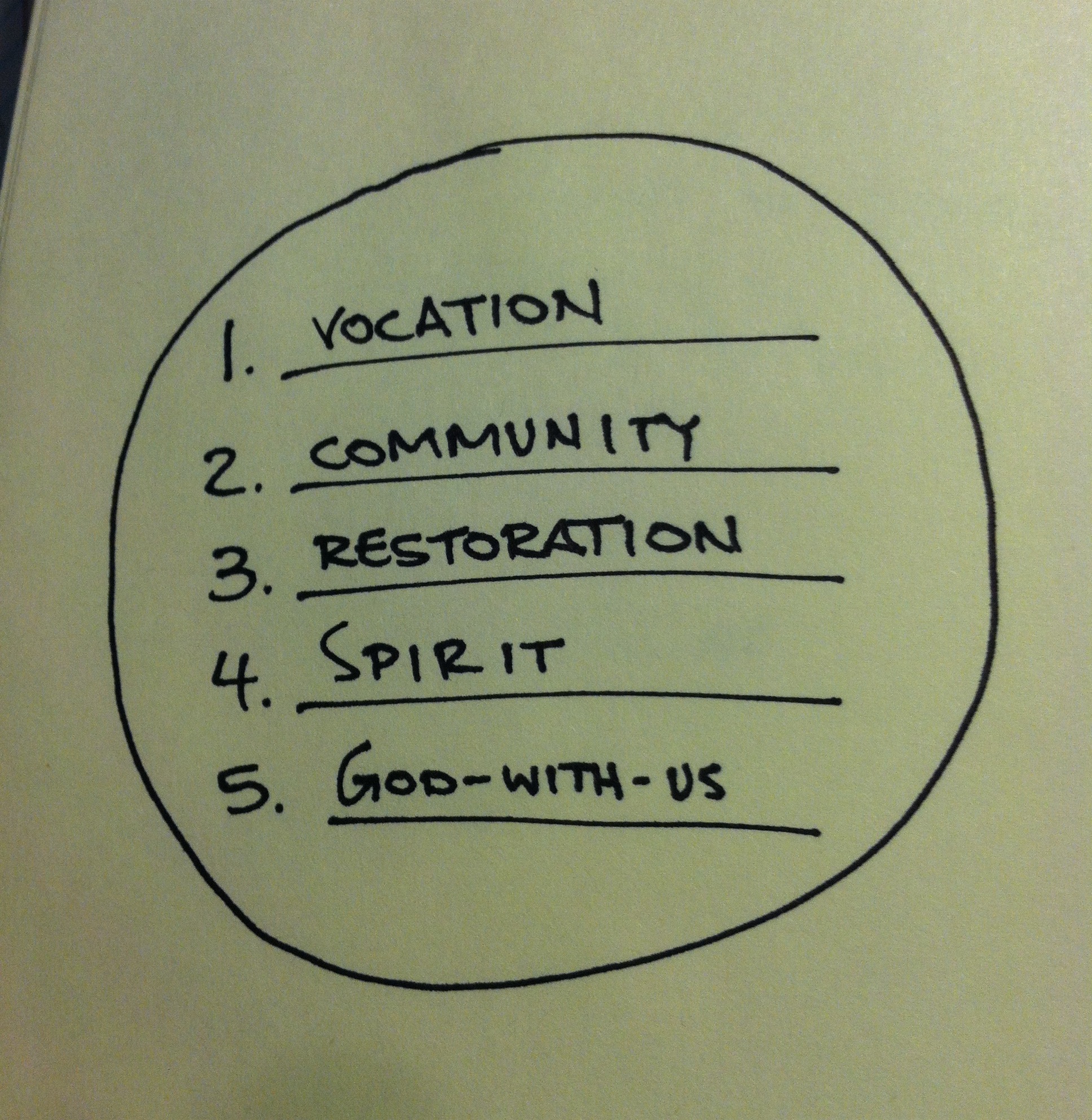
He had everyone draw a circle, and then write the five central messages inside the circle. Everything inside that circle should be driving your mission; those words should be connected vitally with your mission, either as an organization or an individual. 

My core

Question 1: What are your five words?

Question 2: Are you living them out?

===========================================