Just Put It On the Set List …

When you do anything creative, you will encounter forces inside you that strive to get you do something—anything—other than execute, to finish, to “ship”. Stephen Pressfield calls this force “The Resistance”; Seth Godin and Merlin Mann will tell you it comes from your “Lizard Brain.” At any rate they have one goal in mind:

To keep you safe, lazy, and content right where you are:

  • “Don’t write; it’s not worth it…”
  • “No one will like it anyway…”
  • “Didn’t FIFA 2011 come out today…”
  • “I think I’m hungry…”
  • “I wonder if anyone re-tweeted me…”

No matter what the form, the Resistance/Lizard Brain wants you to not create, not to butt heads with bringing something into the world, not “to ship.” Furthermore, we need to understand that “shipping” is a lot more than producing the obvious kinds of art (visual, musical, etc). Creativity is about bringing something to the world that wasn’t there before, and to that extent we are all artists; we are all creating our lives, moment-to-moment, and bringing them to the world.

What can you do?

Last week, I had the idea of writing a song for our weekly gathering. I started an idea (which, we all know, is NO guarantee of finishing said idea), and almost immediately began feeling the Resistance kick in. I was almost instantly rationalizing how to not get the song done.

So I fought back; before the song was 50% done, I put it on the set list, essentially committing myself either to finish it or to face a half dozen conversations about what the song was and “Where were the chords?” and “What are the lyrics?” I knew I either had to finish it, or inconvenience myself with a lot of explanations. By Tuesday afternoon the song was 60% done, with a skeleton format; by Thursday (rehearsal) night it was 90% there and was gaining momentum.

We played it Sunday.

Sometimes the best “hack” for doing creative work is to publicly commit yourself to it:

  • “I’m going to paint something for you; I’ll have it by Friday…”
  • “I’ll write the article this week…”
  • “I’m going to send you a poem to look at this week…”

By making commitments that are somewhat timely and specific, we can trigger our “put-up-or-shut-up” reflex and get around the Resistance. It holds us accountable to something, and we need that because—let’s face it—creative work is really easy to be lazy with. No one expects anything from most of us: if we don’t blog no one is going to send us angry e-mails. If we don’t work on lyrics no one is going to talk about us at the water cooler. It’s too easy to let stuff fall off our plate. But to the degree that being an artist is about doing art, we need to find ways to get ourselves to produce.

What can you commit to this week? What can you ship?

… Just put it on the set list.
“Gospel Artists”, pt 1

We have too many maps.

In general, maps do a great job of (a) telling you where you are, and (b) telling you where you need to go. Some of them even tell you the fastest route to get there. Maps are efficient and effective.

But what maps can not do, almost by definition, is how to discover something unexpected. They cannot tell you how to find that beautiful accident: a scenic highway, the fruit stand with amazing  peaches, the funky old barn right beyond the turn of the road.

It’s the job of maps to be accurate and efficient; that’s their nature.

But sometimes, I think we need to acknowledge that we need something “beyond” (or “short of”) a map.

As human beings, disciples, and ministers in the 21st century, I think we live in a time where “Gospel Maps” abound all around us. Books and conferences, CDs and Podcasts abound, all sharing the best ideas from around the world. We are inundated with information about how to find out what God is doing in the world, and then how to translate that into gospel activities.

But they are all maps. And maps inhibit discovery; they inhibit serendipity; they give us the easy way to get from Point A to Point B.

And I’m not sure that “efficiency”, and even “accuracy” is the point of living the Gospel Life.

What if the point is “creativity”, “innovation”, and “love”.

Maps can’t really tell you how to ultimately do that.

In Linchpins, Seth Godin writes, “The reason that art is valuable is precisely why I can’t tell you how to do it. If there were a map, there’d be no art, because art is the act of navigating without a map.”

From 1997–2001, I was a part of a ministry that was attempting to connect with a new generation of believers that saw the world slightly differently than their parents and grandparents. In the early years of Axis, finding any other “partners” in ministry was difficult. In fact, we only knew of two other ministries in the entire U.S. that seemed to be speaking our language.

In other words, there were no maps.

There were no conferences to go to.

There were no minor ministry celebrities to follow on Twitter.

There were only three widely-released CDs of worship music that sounded like “us”.

Let me say that again: there were only three widely-released worship CDs that resonated with what we were doing. 

No maps.

We had no choice, but to try and innovate. We looked at each other, and called out the best of our creativity and imagination and will. We experimented, we implemented, we corrected, focused and re-focused.

I think that our history as believers is chock full of innovators, people who found themselves in places where there either were no maps, or the maps they thought they had were incorrect:

Brennan Manning…

Henri Nouwen…

Dietrich Bonhoeffer…

Karl Barth…

Thomas á Kempis…

Martin Luther…

Augustine…

Paul of Tarsus…

John The Beloved Disciple…

James the Just…

… and, of course, Jesus Christ.

All of these artists innovated fearlessly and creatively. Their imaginations were fully engaged, and though (save Jesus) they made mistakes (yup, they made mistakes) they kept forging ahead rather than retreat to the map.

Today, maps surround us. You can follow any number of ministry blue prints and worship styles. Hundreds of “new” ideas/maps are thrown at us—daily—through Amazon, Lifeway, Catalyst, Passion, Willow, Hillsong, Twitter, etc. etc.

But is this your best? Is this the best imagination that you can bring to the table?

Understandably, sometimes we need a map. Sometimes we need to get from Chicago to Richmond quickly and efficiently. But if we never got off the major interstates, would we ever discover the farmer’s market outside of Winchester? (The most amazing apple pie, ever, btw.)

I think our Gospel—our Good News—deserves more than a map. It deserves all of our imagination and effort.

Where are you relying too much on Gospel Maps?

Where do you need to learn—or what do you need to throw away—in order to become a Gospel Artist? 

“Low Frequency Living”


There is nothing, absolutely NOTHING, like hearing a master drummer lay down an amazing groove…

When it all comes together, it’s amazing: the drums become a groovy, powerful symphony that is practically irresistible to any listener. The cymbals, snare, toms and kick all blend together across a wide dimension of frequencies to make this happen. Each drum has its own space in the sonic landscape: from the high peaks of cymbal crashes to the thud of the bass drum. In turn, each of these frequencies have certain characteristics and effects on a listener.

High frequencies (high hats and cymbals) capture our attention instantly—like the whistle or chirp of a bird or the cry of a train—but they diminish quickly. The sound waves are small and tight, and do not travel far in the air.

Middle frequencies (snare drums and toms) are the “bread and butter” of the drum set—like our normal every day voices. Their sound waves travel farther distances then the high hats and cymbals.

The bass drum occupies the lowest frequency. Though they don’t always capture our immediate attention, low notes travel the longest in the air—like a fog horn, or the low moan of a tuba.

Each instrument works together to provide a sonic voice, a sonic message…

What if our lives have the same potential? I was thinking: there are things that I do that get great attention in the short run (playing and singing on stage), but ultimately don’t “travel that far”, spiritually speaking.

In the “middle frequencies”, there are things such as “every day conversations”, with friends and family over meals and coffee, that have much more resonance, much more power to linger. They may not grab the attention that singing and playing do, but they have more “legs”, sonically speaking.

Finally, there is “low frequency living”: things that may elude the notice of most people, but have tremendous staying power. They boom through my life, resonating for days, weeks, maybe months. What’s more, the sound usually carries over to the world around me. Things like…

… fasting

… secret giving (is it still secret? uh oh)

… prayer

… solitude

… silence

This is “Low Frequency Living”: doing things that escape the eyes of most people, but that “boom” throughout the moments and days that we live. We need the cymbals, and snare drums, but it’s that resonance, that reverberation, that makes the groove all come together, and makes it irresistible for everyone who is listening to our “song.”

What does low frequency it look like for you?

Fear

fear has 10,000 faces, but all of them are designed to do one thing…

… to make you stop. what. you. are. being. called. to. do.

Fear has so many weapons at its disposal:

+ sex
+ terror
+ insecurity
+ XBox
+ Netflix
+ NFL Network
+ shame
+ over-confidence
+ “under-confidence”
+ shopping

… and on and on. Fear wears masks that don’t look anything like fear, but it’s still fear.

Fear that you may actually be called to teach.

Fear that you may actually be called to lead.

Fear that you may actually be called to help people.

Fear that you may actually be called to be sober.

Fear that change is not only possible, but grace-ful and grace-sent.

Most of my life has been oriented around giving into fear, giving it too much attention, listening to its seductive, whispering voice.

But the good news is that I don’t have to listen. And neither do you. There is something out there waiting for you to do. There is a person waiting for a phone call, a prayer to be prayed, a song to be sung.

Even better news is that fear is ultimately powerless. Pick up the phone, bow the knee, sing the song and fear runs and hides (for another day, but that’s for… well… another day) ….

1. What should you be doing?

2. Who should you “be becoming”?

3. What are you afraid of?

That is all.

“MoFo.”

This is a bit of rant…

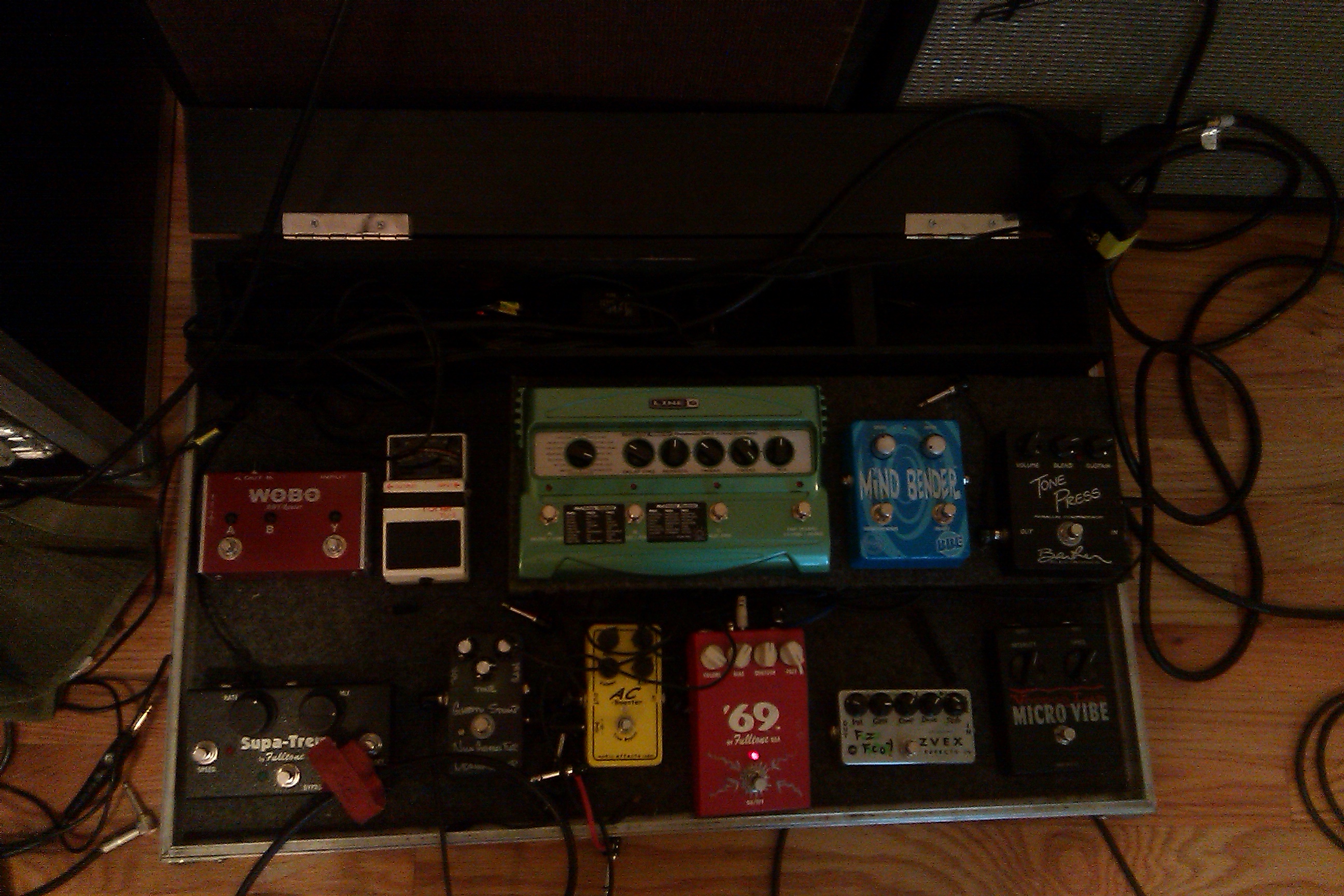
I was on my favorite gear discussion board today, when I noticed a few posts with similar titles: “Post your favorite U2/Praise and Worship Pedalboards”; “Favorite Praise and Worship Overdrive Pedals”; and so on…

<sigh>

Church, what have we become? Where has our creativity, our imagination, our artistry gone?

In 1998, “The dotted 8th” (let the musician understand) was a revelation. It was new, it was majestic and ambient, rhythmic and interesting, and could lay down tremendous beds of comforting sound around a band and worship leader.

That was 13 years ago now, folks. We were absorbed in the sound of U2 because, well, that sound was cresting and peaking. Now, the culture has moved on. U2 is still selling out stadiums, but Arcade Fire, Mumford and Sons and The National are making exciting music now. Why won’t we embrace them as “temple musicians”? Why have we stopped growing?

Yes, U2 is an amazing, even anointed band. Yes, Coldplay is their scrappy sonic younger brother. But we’ve all missed the point, and by missing the point we’ve cheapened U2/Edge’s sonic tapestry as well as the creative element in worship music.

Because what we should really be interested in, musicians, is the way Edge thinks. Not how to rip off his delay tone.

He said once in an interview, “I’m interested in abusing technology.”

Where’s that attitude and approach in our efforts? Have we settled?

We pick and choose the safest parts — we love “Where the Streets Have No Name” (c’mon, I know it makes you cry; I’ll confess: me too!), but we shy away from “Mo Fo” sonically as well as lyrically (even though I’d say that the latter is about an overtly spiritual song as you could find, if you, um, cared to read the lyrics). Feed 3 or 4 fuzz pedals into a Whammy Pedal and hit “Go” … because that type of thinking is where all of this tapestry came from!

But we’d rather figure out how to find the right “Praise and Worship Overdrive Pedal”.

You know what the right “Praise and Worship Overdrive Pedal” is?

The one you can afford. The one you’re stepping on right now.

Because worship music is about incarnation. Which means it’s about God’s intersection with you. With your experiences, your gear, your creativity, with your imagination.

Worship guitarists out there — what are you afraid of? Ry Cooder once said, “Go where it’s dangerous and say, ‘Yes.'”

Go ahead. Step on the pedal; the one that’s “NSFW” (“Not Safe For Worship”). It will be okay (though I didn’t say it would be easy)… Edge would be proud.

And the church, in the long run, will be edified…

Because we still need imagination. Maybe now more than ever.

Yes, yes, yes.

I get this, at a very deep level. This is how I approach music.

“Either you are the music or you’re not. There are a lot of people that want to do what I do, but what I do is about humility and righteousness and understanding, because music is precious. I know it’s just rock and roll, but there are moments in there. There really are and you can’t miss them. It’s got to be soulful, it’s got to speak to you, it’s got to twist your little heart, and you have to be turned on.” – Andy Johns, Producer, in September 2010 Guitar Player (see credits here)

At least we’re big with someone…

This was posted on my Facebook Wall…

“I’m camping with my 3 yr old this weekend and had American Sun playing. He asked me to put it on in his room of the RV as his “sleeping music”. I said “you know what bud? The man singing is daddy’s friend”. His response was “I love daddy’s friend”.

I’m not sure three year olds were your intended audience, but with him…”

Do Yourself a Favor (or two)

I came home tonight and Shana was finishing up a movie called Bella.

Amazing story of love (and good food, too!).

Not Hollywood love, real love.

The self-sacrificing kind.

The Jesus kind.

So first, rent it and watch it, and recapture some wonder and innocence in your life.

Why not?

Then, go buy Nina Simone’s “Nearer Blessed Lord” (from the movie).

I’m pretty sure you won’t regret it.

Gems

Here’s the track list for the next Maida Vale disc (not in order)

  • Jordan!
  • Signs of Life
  • State Street Serenade
  • Is Your Heart Blue?
  • You Look Good
  • Broken on the Wheels of Love
  • Big Events in Loneliness
  • Tick Tock
  • Never Been Good

I’m excited to wrap this thing up and get it mixed. There are a few songs here that have never seen the light of day, so it will be nice to release some fresh music to folks. However, thoughts linger: does anyone still believe in the “disc/album” format? Singles dominate the horizon, and I understand why. It makes sense. But for me and the band, this whole recording was an effort to capture a very specific time in our lives, and also to try and weave that into a cohesive ethos and approach to a body of work. As much as I like singles and the constant flow of music it can produce, I’m just not sure that you can weave a narrative into 7 – 8 songs that are released over 12 months.

The songs become compartmentalized and fragmented, like our lives. I (and I think Maida Vale) believe in something holistic and big… very big and beautiful.

Hope someone out there can believe in it as well. We’ll see in June, maybe.