
I Don’t Want a Narcissistic Crucifixion

According to iTunes, I have a lot of music. Over 22 days’ worth, to be exact.

I intentionally chose probably 95% of it; the rest were gifts, and songs that I needed to learn for gigs.

I also have probably 100 podcasts—again, ones that I have chosen.

I really don’t have to listen to the radio anymore. I can exist in my own little “Pod World,” and never have to listen to music I don’t like, or ideas I don’t agree with, any more.

That’s the world we live in—a “targeted marketing” paradise where I can tailor my world around me: my tastes and desires, my whims and wishes.

DVR, Netflix, Facebook, all point to a somewhat disturbing phenomenon:

I am the center of my existence. My needs rule.

Turning to the cross, although this may sound sacrilegious, I want to be crystal clear: Jesus’ death on the cross is not simply about the forgiveness of my individual sins. 

As N. T. Wright puts it, for too long we have made this individual forgiveness the “Sun” in our “Good Friday” universe.

But God’s purposes are much, much bigger.

And the truth is, I need it.

I don’t need a salvation that is “all about me” to join up with my universe that is all about me.

I need a God who is bigger than that; who—and pay close attention here—forgives me along the way to a larger and grander purpose in the world. 

The cross isn’t just about individuals; it’s wrapped up with the entire mission of God from Genesis 2, through Abraham, through Israel, through the Prophets, and ultimately into Revelation.

Stay with individual forgiveness only, and you risk developing a narcissistic spirituality; start with mission and you get the over-arching purpose of God, with forgiveness thrown in…

… What a gift!

Brennan Manning on the Cross

In 1963 a friend gave me an expensive crucifix. A French artist had carved in wood, carved very delicately, the hands of Jesus on the cross. On Good Friday the Roman artists carved—O God, how they carved!—our brother Jesus with no trouble at all. No art was needed to bang in the nails with hammers, no red lead to make real blood gush from his hands, feet, and side. His mouth was contorted and his lips twisted simply by hoisting him up on the crossbeam. We have so theologized the passion and death of this sacred man that we no longer see the slow unraveling of his tissue, the spread of gangrene, this raging thirst… Jurgen Moltmann writes, ‘We have made the bitterness of the cross, the revelation of God in the cross of Jesus Christ, tolerable to ourselves by learning to understand it as a necessity for the process of salvation.’ (Brennan Manning, The Ragamuffin Gospel)

Holy Week, Friday :: The Praetorium :: the Place of Suffering

Mark 15:1-20. Very early in the morning the leading priests, the elders, and the teachers of religious law—the entire high council—met to discuss their next step. They bound Jesus, led him away, and took him to Pilate, the Roman governor.

Pilate asked Jesus, “Are you the king of the Jews?”

Jesus replied, “You have said it.”

Then the leading priests kept accusing him of many crimes, and Pilate asked him, “Aren’t you going to answer them? What about all these charges they are bringing against you?” But Jesus said nothing, much to Pilate’s surprise.

Now it was the governor’s custom each year during the Passover celebration to release one prisoner—anyone the people requested. One of the prisoners at that time was Barabbas, a revolutionary who had committed murder in an uprising. The crowd went to Pilate and asked him to release a prisoner as usual.

“Would you like me to release to you this ‘King of the Jews’?” Pilate asked.10 (For he realized by now that the leading priests had arrested Jesus out of envy.) 11 But at this point the leading priests stirred up the crowd to demand the release of Barabbas instead of Jesus. 12 Pilate asked them, “Then what should I do with this man you call the king of the Jews?”

13 They shouted back, “Crucify him!”

14 “Why?” Pilate demanded. “What crime has he committed?”

But the mob roared even louder, “Crucify him!”

15 So to pacify the crowd, Pilate released Barabbas to them. He ordered Jesus flogged with a lead-tipped whip, then turned him over to the Roman soldiers to be crucified.

16 The soldiers took Jesus into the courtyard of the governor’s headquarters (called the Praetorium) and called out the entire regiment. 17 They dressed him in a purple robe, and they wove thorn branches into a crown and put it on his head. 18 Then they saluted him and taunted, “Hail! King of the Jews!”19 And they struck him on the head with a reed stick, spit on him, and dropped to their knees in mock worship. 20 When they were finally tired of mocking him, they took off the purple robe and put his own clothes on him again. Then they led him away to be crucified.

After the public betrayal and humiliation of the upper room, Jesus’ physical ordeal begins. He is arrested at night, and then kept up through a sham (and illegal) trial, before being delivered over to the only people with the power to inflict capital punishment in the region—the Romans.

The Romans didn’t particularly dislike Jesus; to them he was simply another Jewish religious fanatic. The punishment they inflicted on him wasn’t particularly malicious or evil.

But it was efficient.

Jesus was beaten, whipped, insulted, and he bled, sweat, and wavered.

Make no mistake, a lot happens at the cross; but a lot happens before the cross as well.

Because Jesus suffers.

Call me crazy, but having a “suffering savior” matters to me.

It’s possible that God, being all-powerful, was completely capable of bringing us back to Himself with a snap of His infinite fingers. But regardless, He chose to come to us in the form of a human being.

Who was beaten, whipped, and crushed.

I think the implications of this are staggering.

If we worshipped a God who was only far-off, who is distant, who is only perfect and clean, than I would be terrified or embarrassed to come to Him (or Her) in my weakness and suffering.

But because God—because somehow YHWH—knows suffering, knows pain, knows humiliation, it means that I can bring my own suffering, pain, and humiliation to Him, and when I do, he says,

“I understand.”

“I have felt this.”

“You don’t have to be ashamed.”

Because God suffered, I can suffer too, and know that He welcomes it, and shares in it. He does not shun me in my weakness, but welcomes me.

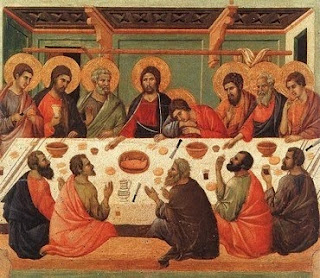
Holy Week, Thursday :: The Upper Room :: the Place of Betrayal

12 On the first day of the Festival of Unleavened Bread, when the Passover lamb is sacrificed, Jesus’ disciples asked him, “Where do you want us to go to prepare the Passover meal for you?”

13 So Jesus sent two of them into Jerusalem with these instructions: “As you go into the city, a man carrying a pitcher of water will meet you. Follow him. 14 At the house he enters, say to the owner, ‘The Teacher asks: Where is the guest room where I can eat the Passover meal with my disciples?’ 15 He will take you upstairs to a large room that is already set up. That is where you should prepare our meal.” 16 So the two disciples went into the city and found everything just as Jesus had said, and they prepared the Passover meal there.

17 In the evening Jesus arrived with the twelve disciples. 18 As they were at the table eating, Jesus said, “I tell you the truth, one of you eating with me here will betray me.”

19 Greatly distressed, each one asked in turn, “Am I the one?”

20 He replied, “It is one of you twelve who is eating from this bowl with me. 21 For the Son of Man[e] must die, as the Scriptures declared long ago. But how terrible it will be for the one who betrays him. It would be far better for that man if he had never been born!”

22 As they were eating, Jesus took some bread and blessed it. Then he broke it in pieces and gave it to the disciples, saying, “Take it, for this is my body.”

23 And he took a cup of wine and gave thanks to God for it. He gave it to them, and they all drank from it. 24 And he said to them, “This is my blood, which confirms the covenant[f]between God and his people. It is poured out as a sacrifice for many. 25 I tell you the truth, I will not drink wine again until the day I drink it new in the Kingdom of God.”

26 Then they sang a hymn and went out to the Mount of Olives.

What do you fear most?

Though most of us have irrational fears of something physical (ask me sometimes about my “relationship” with reptiles), for most of us the fear of emotional damage and threat loom larger.

How much do you fear humiliation?

I think Mark—and the other gospel writers as well—chooses words very carefully. In no way is he an idiot, or some kind of literary or spiritual half-wit. There’s a picture of Jesus that he is trying to paint, and he is using every available tool to work in the  medium of words.

Notice how he includes the phrase, “The Twelve.” First Jesus sends two disciples into the city to find a room where he will celebrate this Passover-ish meal. Then he shows up with The Twelve. Then he talks to The Twelve. Then he says, one of The Twelve will betray him.

What happened to the two?

I agree, along with theologian and New Testament scholar Craig T. Evans, that the reason Mark highlights the phrase “The Twelve” in this passage is that there were other disciples in the room. They secured a “large room” for the meal: more than enough for Jesus and his chosen twelve. But a large room would be necessary to accommodate a larger group of followers.

How many were there? 20? 40?

So when Jesus announces that one of these 12 followers would betray him, it’s not in a private, intimate place. It’s not an aside to a camera.

It’s in public.

There would’ve been some kind of gasp in the room. This was the “inner circle”, the chosen disciples, representing the “new Israel.”

And Jesus just announced that they would fail; not just fail but betray.

It would’ve been, to say the least, an awkward moment.

But Jesus is not surprised, and doesn’t seem let it affect the moment, because he goes on with the meal. 

He inaugurates the Lord’s supper, and proclaims the new covenant.

In spite of their coming failure.

Because ultimately it’s not their mission to complete. They can fail (and fail they do); he will not. 

So today, as we work through “Maunday Thursday“, keep these things in mind:

  • Relatedly (and obviously), we have all betrayed and failed Jesus in some way
  • Jesus’ is not surprised by our struggles to be faithful; he works through them and in spite of them
  • He is also not embarrassed by us; it’s his mission—we are merely called to do what he called those disciples in the upper room to do…
…To remember him.
Tomorrow: The Place of Suffering

Holy Week, Wednesday :: Temple :: the Place of Obedience

Take a moment and read Mark 11:11-33.

As I mentioned yesterday, even if you have places of safety—Bethany—in your life, sometimes you have to leave. As Jesus begins to press his presence in Jerusalem, he comes to the Temple, looks around, and goes back to Bethany, maybe for one final deep breath before the storm.

This episode in Jerusalem is marked by a specific sequence of images and events. Mark “bookends” or “sandwiches” the Temple incident with a curious incident with a fig tree. Most of the time when you see this in scripture it means that the outer “bookends” are intended to shed light on the inner content, and vice versa. So the fig tree is meant to tell us about the Temple, and Jesus’ actions in the Temple tell us a little about the fig tree as well.

Let’s not waste time: the fig tree represents Israel. Mark and Jesus are intentionally echoing Jeremiah 8, where the prophet is indicting the leadership of Israel as “false prophets” and leaders:

They offer superficial treatments for people’s mortal wound.
They give assurances of peace when there is no peace.
Are they ashamed of these disgusting actions?
Not at all–they don’t even know how to blush!
Therefore, they will lie among the slaughtered.
They will be brought down when I punish them, says the LORD.
I will surely consume them. There will be no more harvests of figs and grapes.
Their fruit trees will all die.
Whatever I game them will soon be gone.
I, the LORD, have spoken! (Jeremiah 8:11-13)

So Jesus is pronouncing judgment here, but why? There’s a clue in the language that Jesus uses in 11:17. Most translations use the word, “robbers” to translate the Greek word lestes. But lestes actually indicates more violence than “robber” captures. As N.T. Wright puts it, “The Temple had become, in Jesus’ day as in Jeremiah’s, the talisman of nationalistic violence…” (Jesus and the Victory of God, 420). Jesus is angry—not so much about the exchange of goods and money changing in the temple—but about the violent resistance that the Temple has come to represent. (By the way, Jesus’ actions in the Temple are probably better understood, not so much as violent anger, but as prophetic and symbolic action, representing God’s judgment on the Temple and the nation of Israel.)

Simply put, God’s kingdom is not going to come about through violence, and Jesus’ pronouncement has much more to do with how people had twisted and/or confused the mission of God into an excuse to take up arms against Rome and “the pagans”, to seek the Kingdom through military and political victory, rather than through suffering and humility.

Good thing the church never does that any more, huh?

So Jesus moves into the place of obedience: an immediate confrontation with the economic, political, and violent “powers” of his day.

It simultaneously took immense courage, first to confront the establishment, and then later to choose suffering rather than retaliation.

  • Is there anywhere that you need to confront injustice?
  • What could it mean to confront injustice and oppression with suffering and humility? 

Tomorrow: the Upper Room, the place of intimate betrayal.

Holy Week, Tuesday :: Bethany :: the Place of Safety

Take a few minutes and read Mark 14:1-9

Interspersed in the narrative of Jesus’ time in Jerusalem are these episodes of Jesus in a town called Bethany. What emerges is the picture of Bethany as a place of safety for Jesus, away from the tension and conflict of Jerusalem during Passover. It was a place where his friends Simon, Mary, and Martha lived, a place where he could come and “exhale” during this closing act of his life.

Where are your places of safety? Who are the people in your life that you can truly relax around? Are there activities and routines that give you peace?

When is the last time you did those things? When is the last time you were with those people?

When is the last time you experienced deep peace and security?

The first two thoughts for today are:

  • If you haven’t experienced this lately, carve out time to find it. Go to that place; be with those people, do those routines. There is nothing wrong with rest. There is nothing wrong with peace.
  • If there are people who have historically given you this peace, consider thanking them. Write a note, make a phone call to say, “This is what you’ve done for me in my life, and I want you to know what a great gift it has been.”

The remaining thought centers around Bethany in the context of the story.

Because as comforting as Bethany was, Jesus didn’t stay there. He went there a couple times, but he used it (and the relationships there) as fuel for his mission.

  • Have you stayed too long in Bethany? Rather than calling you to more rest, is God calling you out, to a place of mission? Are you a bit too comfortable?

Holy Week, Monday :: Jerusalem :: the Place of Mission

We are hosting early morning gatherings this week. I thought I’d post my reflections on and/or excerpts from my teaching. 

As the time drew near for him to ascend to heaven, Jesus resolutely set out for Jerusalem. (Luke’s Gospel, 9:51)

‘O Jerusalem, Jerusalem, the city that kills the prophets and stones God’s messengers! How often I have wanted to gather your children together as a hen protects her chicks beneath her wings, but you wouldn’t let me. And now, look, your house is abandoned. And you will never see me again until you say, “Blessings on the one who comes in the name of the Lord.’ (Luke’s Gospel, 13:34-35)

I believe Jesus knew exactly what was waiting for him in Jerusalem. I think he knew the storm he was stirring up, and that when we walked into the center of the storm, he would encounter pain and suffering and death.

And he went anyway.

He went because, as Israel’s king, he was going to (finally) be the suffering servant that God had wanted Israel to be. He went because he knew that God wanted to take his mission to the whole world, to the people beyond the borders of Israel, but in order to do that someone had to pay the price for Israel’s sin, someone had to end the exile that Israel was in so that the light could go out to all the nations.

In this sense, Jerusalem represents the fulfillment of his mission, and “the road” is the path to that mission. Everything is leading up to this moment, this destination.

I love that phrase, “Jesus resolutely set out for Jerusalem.”

He strips everything away, and begins to focus on the culmination of his mission. Distractions will no longer be allowed. He has to complete his mission.

As we begin our own journey to the cross on Friday, is there anything distracting you? 

In a sense, our mission this week is to enter into the story of Jesus’ last week. By doing that—by faithfully and compassionately remembering Jesus’ last days, suffering, and death—we are making the story current and real.

  • Can you “resolutely” set out for Friday?
  • Is there something you need to set aside for these final days of lent, in order to allow God to work in your life?
  • What can you do to clear space for your mission this week: to listen to and experience the fulfillment of Jesus’ mission?

The Jesus I Need…

In Revelation, Jesus is a prize-fighter with a tattoo down His leg, a sword in His hand and the commitment to make someone bleed. That is the guy I can worship. I cannot worship the hippie, diaper, halo Christ because I cannot worship a guy I can beat up.

That’s just one of the worst things I’ve ever read.

Granted that Jesus can stand up for himself,  but the crime of turning him into some kind of Mike Holmes carpenter, here

via HGTV.com

to save your soul, “or else”, is just as bad as trying to turn him into a proto-buddhist, new age swami.

He simply defies categories, and we own none of them.

That being said, I think that description of Jesus Christ is just horrible. Maybe it’s polemic, and just designed to shake us up a little, but surely there are limits.

Can we not have the Son of God described as if he’s got a spot on next week’s “Jersey Shore”? Can we not have him described as Scott Stapp?

image via Megatattoo.com

Scott Stapp?!?!?

It’s projection in the highest degree (among other things, a desperate covering up of male insecurity)…

The fact is that we have little idea what Jesus’ personality was—that wasn’t the intent of the gospel writers—but I’m pretty sure he no more some kind of ass-kicking warrior  than he was a metrosexual clothing consultant.

He was a 1st century Jewish teacher and rabbi, convinced that God was bringing something to completion through him as he wandered around Palestine teaching and healing, laughing and instructing his little band of followers.

At least we can say that he probably had sensible shoes.

It’s always tempting to re-make Jesus in our own image. Frankly, if I did that, Jesus would be able to:

  • talk—intelligently and passionately—equally about the Clash, the Black Keys, and Sigur Ros
  • tell me about some obscure documentary on the life a tree slug and how, “no really dude, you have to watch it: it’s profound!”
  • lay my office out perfectly
  • come over to drink beer, eat chips and Frontera Grill Chipotlé salsa and watch European soccer

But you know what? That’s not the Jesus I need. 

I need a Jesus who:

  • fit into his culture, and into the story of God but transcended it and completed
  • loves and accepts sinners and the broken
  • can heal people (even though not always quickly)
  • isn’t interested in what I want, but wants to show me what God wants and is up to in the world
  • was obedient, all the way to the Cross

So yeah, I abhor that comment, and I disagree pretty vehemently with it (never mind his interpretation of Revelation, but that will wait until next time), but I also need to watch my own tendency to reduce Christ to my image.

He’s way beyond that.

(By the way, if you are interested in some highly intelligent work on who Jesus was and what he did, I would highly recommend N.T. Wright and Scot McKnight as great starting points.)

The Power of Story

from blogs.amctv.com

The new season of Mad Men started last night (finally).

I love AMC’s tag line: they know that everything revolves around story, and they do a great job of finding shows that tap into the beautiful ambiguity that is our humanity. Every character in Mad Men, it seems is capable of acts of great beauty and great depravity…

A lot like all of us.

I, for one, am drawn into this ambiguity and to the power of these characters’ story: who they are, how they got to be that way, and what they are struggling to become.

We also just got back from Walt Disney World, and it can be argued that no one understands “story” like Disney. I grew up in Texas only a short drive from the original “Six Flags” park. Last night, my wife and I were reflecting on Six Flags versus Disney. It actually seems like Six Flags has more thrills, more rides.

But what they don’t have is story.

I haven’t been to one of those parks in a long time, but my hunch is that there aren’t people walking around with Six Flags t-shirts, wearing Six Flags lanyards, with Six Flags buttons on them that represent the 20 years they’ve been coming to Six Flags parks.

Six Flags is a good for a weekend ride, but Disney has crafted an ability to make their story a part of your story. They’ve created an experience that people have integrated into their lives, telling, retelling, and then re-experiencing the park over and over.

I think the lesson is this: events are only the beginning. To create something special, our churches need to be about creating environments where people can experience an event, tell the story of that event, tell the story of their lives, and then allow their story and the community’s story to merge and intertwine.

Thoughts?

THE Prayer Pt 3 :: “May Your name be kept holy.” (or, “More Holy Than a Coaster”)

Our Father, who lives in the heavens,
May Your name be kept holy.
May Your Kingdom come,
May Your will be done,
On earth just like it’s done in Your presence.

Give us this day our daily bread
And forgive our sins
As we forgive those who sin against us.
Don’t bring us to the times of trial,
But deliver us from the evil one.
Amen.

When I was a kid, I had some pretty strange religious beliefs.

For instance, I determined that prayers “bounced”. Since people always prayed with their heads down, and since God was “up there” in heaven (though now I know better), I determined that our prayers must bounce off the floor and then soar up to heaven to God.

Unfortunately (for me), the opposite also held true: if I somehow made the mistake and prayed face up (like lying on my back in bed), then my prayers would bounce off the ceiling and go, you know, “down there.” 

To the devil.

Heavy, right?

I remember one evening when I prayed to go to sleep quickly. Unfortunately, I was facing up when I did. I didn’t go to sleep until like 3 or 4am.

Well, it was probably more like 11:30, but you know how things feel when you’re a kid. It was terrifying!

I was also unreasonably concerned with the Bible. It had to be face-up on my nightstand (even if I seldom read it, much less followed its teachings), and never, ever, could something—such as my ever-present bedtime snack of a can of Coke and peanut butter toast—be set on top of the Word.

While it kept my Bible in pristine condition, this is not what God means by “holiness.”

Keeping God’s name holy is much more than setting him aside and making sure that he doesn’t get sugar or toast crumbs on Him or His bible. It’s much more revolutionary and active than that.

To state it succinctly: God’s people are entrusted with maintaining the “holiness” of God’s name. 

“The house of Israel, as the chosen people of God, were the guardians of His reputation in the world. By worthy actions they brought credit upon Him and ‘sanctified His name’ … A bad action more than involved the Jew in personal guilt; it was treachery to his God and people.” (Abraham Cohen, Everyman’s Talmud, 23)

In the book of Ezekiel, God lays it out plainly: “But when they (the Israelites) were scattered among the nations, they brought shame on my holy name. For the nations said, ‘These are the people of the LORD, but he couldn’t keep them safe in his own land.’ Then I was concerned for my holy name, on which my people brought shame among the nations.” (36:20-21)

There’s something almost human and tender about the idea that God—the Creator of the universe—allows His reputation to hinge on the behavior or humanity. He is not above being hurt by us, and He openly entrusts this to us.

So to pray “may Your name be kept holy” is to actually pray , “God may I live my life in such a way that I enhance your reputation in the world. May my life be filled with the fruit of Your Holy Spirit so that people will see my life and wonder, ‘What fuels her life? What or Who is behind that?'”

It’s about a whole lot more than just making sure your bible isn’t a coaster.

  • What does it mean to you that we are entrusted with God’s reputation?
  • Understanding that your life is on stage, are you “keeping God’s name holy”? On Facebook? On Twitter? In “da club”?