Good Friday, 2013

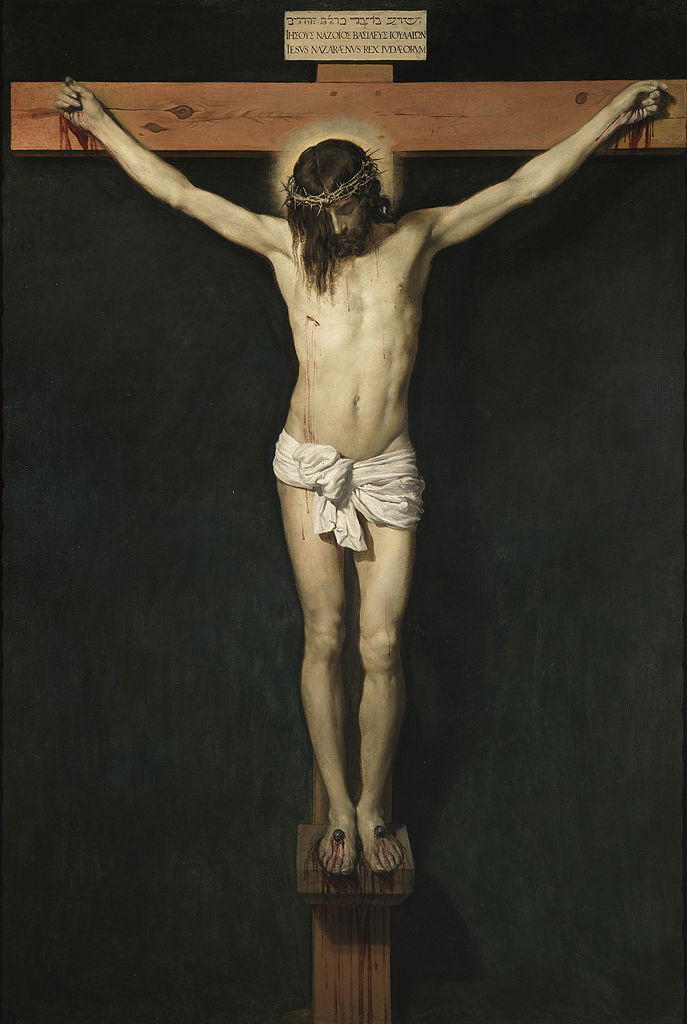
Cristo Crucifado by Diego Velásquez

Cristo Crucifado by Diego Velásquez

There’s lots that I could say today.

But I’ve decided I really won’t.

My words pale in comparison to the response that this day deserves. So just this: stumbled across this quote yesterday:

Jesus Christ is born in a stable. He has to flee to Egypt. He passes thirty years of his life in the shop of a craftsman. He suffers hunger, thirst, weariness. He is poor, scorned, abject. He teaches the Kingdom of Heaven, and no one listens to him. All the great and the wise pursue him, take him, and make him suffer frightful torments. They treat him like a slave, make him die between two thieves, after having preferred a thief to him. That was the life that Jesus Christ chose, and we, we have a horror of the slightest humiliation.

– François de Fenelon

Christian folk: find yourself a space today to sit in front of the cross of your Savior. Take some time to think on him, and to thank him.

Because no one really did at the time, and now we know better. Or should.

============================================

Basics

What he liked about his brother, he said, is that he made people become what they didn’t think they could become. He twisted something in their hearts. Gave them new places to go… His brother believed that the space for God was one of the last great frontiers: men and women could do all sorts of things but the real mystery would always lie in a different beyond.

(Colum McCann, Let the Great World Spin)

Just this: if we who follow Jesus would just set our hearts on helping people find the new places to go, the “different beyonds” in their lives, we would be doing some solid work in the world.

==================

Lent Reflection #6 :: Jesus Uncomfortable Healings

I’m probably alone in this, but sometimes I feel like Jesus has a funny way of healing people.

To my eyes and ears, Jesus’ healings have a hard edge to them.

For instance, we are told that one time Jesus heals a man with a “withered hand” on the Sabbath, and the religious experts are pretty ticked off about it (Mark 3v1-6). There are some interesting aspects to the story:

  • according to the text at least, the man hasn’t asked Jesus to heal him; in fact, Jesus initiates the whole process (in front of the community in the synagogue)
  • the man’s life isn’t at stake (even for Pharisees, saving life on the Sabbath was actually permitted)

There’s a sense in which Jesus is standing there, and commands the guy (who is not supposed to be in the synagogue), “Get in here and stand up in front of everyone so they can see what’s wrong with you.”

Can you sense the social awkwardness?

What begins to emerge is the possibility that Jesus is essentially using this man’s affliction and subsequent healing as an example, as a way to push the religious authorities into a corner (and to begin to plot Jesus’ death).

And all of this happens very publicly, in front of everyone. The man is healed, but first the man has to stand up in front of his community.

To me, it’s very tense. Why couldn’t Jesus have privately healed the man? Why couldn’t he have pulled the Pharisees and the Herodians aside and performed this act of political theatre in front of them alone?

Why subject the man to this public scrutiny?

A few chapters later, Mark relates the story of a woman who has been suffering—”bleeding”—for twelve years. Without going too deeply into social laws of the time, the cultural laws maintaining purity at this time were quite strict; this poor woman would have been strictly and severely ostracized.

So in a way you can understand her desperation to get to Jesus; to be made whole again. She reaches out her hand and grasps the edges of his cloak (or prayer shawl) and, “immediately”, we are told, her illness is gone.

Awesome. And then she goes away and is restored to life and community, right?

Almost. Not before Jesus very publicly calls attention to her. 

Before her ultimate restoration, Jesus makes sure the entire group of people knows that she is there, and that she has received a healing.

Again, part of me wonders why Jesus didn’t pull her aside, privately bless her and then restore her to the life.

Why the public display?

The last healing story actually comes out of John’s gospel. Jesus finds a man by a pool believed to have healing properties. The man had been there for thirty-eight years. Jesus asks him, “Do you want to be made well?”

The man explains why he can’t get into the pool in time, and Jesus responds by saying, “Get up! Pick up your mat and walk.”

For some reason, on top of all the very public displays of Jesus’ healings, this one has been sticking with me.

And it’s all because of the mat. 

I don’t know the mat looked like. If it was comfortable; if it was threadbare and worn; if it was donated. I don’t know any of the details.

But I do know what it represented.

It represented the man’s weakness.

It represented his brokenness.

It represented his need for restoration; for health.

And Jesus tells him to pick it up and take it with him. 

If I put myself in the man’s place, I would have longed so deeply to leave the mat behind. Who wants to carry around the reminder of our past? Our brokenness? Our shame?

But instead, Jesus tells him, “No: actually this is the thing you have to bring with you. I know you’d like to leave this part of your life behind, but people need to see this. They need to ask, ‘Hey what’s with the mat?’ And you have to tell them your story.”

Looking back over these three stories, Jesus’ there’s always another agenda operating around Jesus’ healings. They are never “the endpoint.” If they were, it’s possible for Jesus to be considered more of magician—a first century “House”—than the Messiah. The healings are there to make theological points, to tell stories, to point people towards God’s restoration agenda for the entire world. Not to say that it’s great to be healed, but we need to remember that God’s (and Jesus’) agenda is always bigger than our own individual situations, and the healings are always a part of that agenda.

So maybe Jesus has done something for you. Maybe there’s some brokenness in your past (gosh I know there’s some in mine).

And maybe what you really want to do is to leave your mat behind. 

But instead Jesus is telling you, “Pick it up; pick up your past. Pick up your brokenness, the things you’ve seen, the things you’ve done, and even though I have restored you, tell others about them.”

Obviously, just because you carry your mat with you does not mean that you’re still crippled. But somehow you still have to tell people about it.

Live your life in such a way that people go, “Hey what’s with the mat?”

What does your mat represent? Have you left it behind? I think in so many ways Jesus is saying to us, “Go back and get it; carry it with you. Not in a shaming way, but in a way that helps others.”

peace

*e

================================
Lent Reflection #5: The Cross Creates Communities

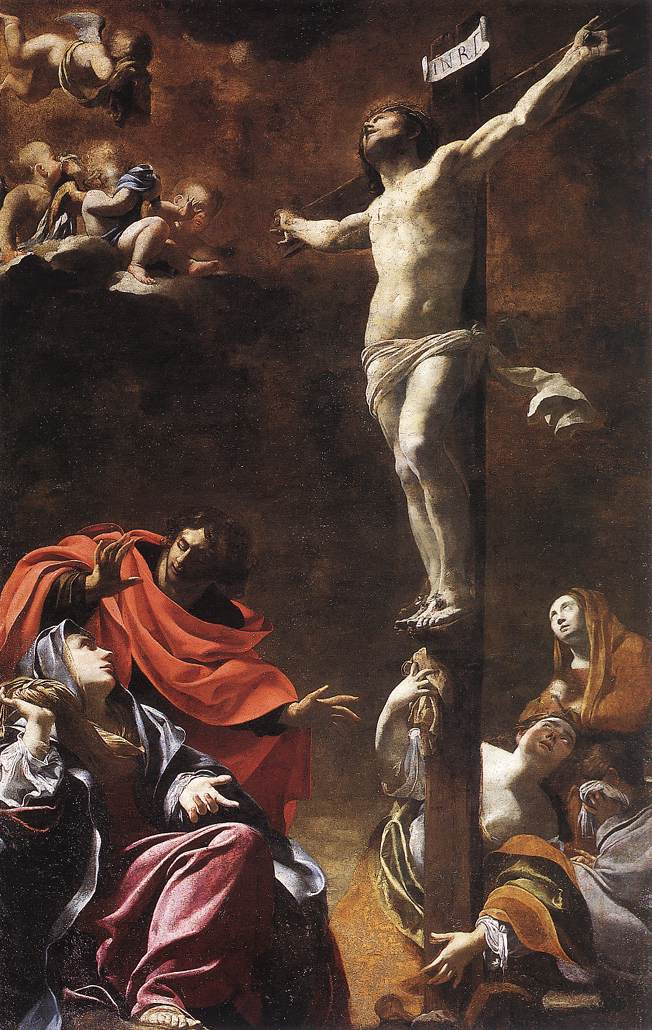
 (1622) by Simon Vouet; Church of Jesus, Genoa

The Crucifixion (1622) by Simon Vouet; Church of Jesus, Genoa

Jesus’ mother and his mother’s sister, Mary the wife of Clopas, and Mary Magdalene stood near the cross. When Jesus saw his mother and the disciple whom he loved standing nearby, he said to his mother, “Woman here is your son.” Then he said to the disciple, “Here is your mother.” And from that time on, this disciple took her into is house.

Mary is watching her son die. In his final moments, as a small community gathers around him, Jesus commends his mother to the care of one of the Twelve (possibly John, the author of this Gospel). He has to do this because at this point none of the rest of his family—not even his brother James—believes in him.

God has always had a people. From the beginning of his ministry, Jesus doesn’t just heal individuals, but he creates a community around himself. Even at the cross, we see Jesus gathering people and creating networks of care.

For some reason—and I really don’t know why—we resist so much of this. We pull away from community, sometimes because of time or priorities, sometimes because of hurts, sometimes because we don’t like what we’re hearing about ourselves.

But we really need to fight against this isolating tendency.

Because someday there will come a need: a phone all that changes everything; a meeting that dries up the future; an email that shakes the foundation of everything you are.

Someday, it’s going to be dark, not just outside, but maybe inside your spirit as well.

And then where will you turn?

We like to think that we exist in some glorious vacuum: some of us alone as individuals; some of us as nuclear families.

But the truth of the matter—even revealed at the Cross—is that we are in desperate need of other human beings.

So,  this Lent:

  • are you gathered around the cross of Jesus with other folks? are you committed to them, and they to you?
  • if not, is there something you need to do to restore yourself to that community?

This is one of the most beautiful songs I’ve ever heard about the Church, and this deep need that we have for community. Watch it and think—really think—about these words.

 "Shelter" by Jars of Clay
To all who are looking down, holding onto hearts still wounding

For those who’ve yet to find it, the places near where love is moving

Cast off the robes you’re wearing, set aside the names that you’ve been given

May this place of rest in the fold of your journey bind you to hope
You will never walk alone 
In the shelter of each other, we will live, we will live

In the shelter of each other, we will live, we will live

Your arms are all around us 
If our hearts have turned to stone there is hope, we know the rocks will cry out

And the tears aren’t ours alone let them fall into the hands that hold us
Come away from where you’re hiding set aside the lies that you’ve been living

May this place of rest in the fold of your journey bind you to hope
that we will never walk alone

If there is any peace, if there is any hope 
We must all believe, our lives are not our own
We all belong
God has given us each other
And we will never walk alone
© 2010 Bridge Building / Pogostick Music (BMI). All rights for the world on behalf of Pogostick Music administered by Bridge Building.

peace

*e

=============================

If You Want to Be a Disciple, Learn to Dance

How Music Works

How Music Works

I’ve been so excited to get this book, and so far it’s been pretty rewarding. I’m actually not a huge David Byrne fan, but I just love people who pursue—and think and write about—creativity with few borders and labels. Byrne’s career has been awesome to watch, while he veered from New Wave and Alternative with the Talking Heads into some kind of Latin/dance explosion and then beyond.

Typical for me, I read something that struck me as related to spirituality. He describes preparing for a tour with a choreographer:

“Noémie began with an exercise I’ve never forgotten. It consisted of four simple rules:

  1. Improvise moving to the music and come up with an eight-count phrase. (In dance, a phrase is a series of moves that can be repeated.)
  2. When you find a phrase you like, loop (repeat) it.
  3. When you see someone else with a stronger phrase, copy it.
  4. When everyone is doing the same phrase the exercise is over.”

I think this is a great way to pursue a spiritual, Gospel-shaped life.

God sings this song; it’s a song of redemption and restoration. A song of absolute love and acceptance.

Music is meant for response. The best songs grab something inside of us.

For Believers, this Gospel-song is the highest form of musical expression we could hear.

All of us are called to this melody, this tune that has been sung through the ages.

But after responding, our job is not yet done.

Two things cause an exercise like what Byrne describes to fail:

  1. When you take no notice of anyone else’s dance.
  2. When you refuse to acknowledge the strength of someone else’s dance.

We do not do this dance alone. It’s not enough to celebrate our own response; we are knit together in these communities where others are responding, where we can notice and celebrate their responses as well as ours.

If we don’t notice other people’s response to the Gospel, it can become too easy to think that our dance is the best (only?) response to the Gospel-song.

We lose our perspective. Our dance is all we know, and we may be convinced that it is the only way to respond to the Song, but we also start to notice or suspect that something is not quite right: our sense of joy, or peace, or love seems lacking. Maybe we’ve noticed that it has become difficult to admit failure, or to ask for forgiveness from people we’ve hurt.

It’s times like these we need to maybe lift our heads and notice that others are dancing too.

They are dancing through consistent and fervent prayer; through passionate worship; through diligent study; through compassionate service; through committed community.

But even then job isn’t done, because we also have to be willing to—in the words of the exercise—notice the “strength” of someone else’s dance, and then submit to the strength of their dance. 

So often our ego gets in the way of our growth. We desire growth, but aren’t always willing to sacrifice our ideas of “how life works”—our dance—to someone else’s, even when we recognize the strength and success of that dance. 

As people of faith, we recognize that Jesus has the strongest dance of all, and we need to adopt his movement into our lives. But more immediately there are people in our midst who are responding and moving to the Gospel song, and we should readily recognize when their dance is stronger than ours, and then adopt it.

We think we know how to pray/worship/study/serve, but maybe we notice that someone else’s dance in this area is stronger than ours.

Are we willing to set aside our “dance”—the way we pray, or worship, or study, or serve—and adopt theirs? 

To admit that maybe we’re not as strong as we think we are in this area?

To say, “I want to know more. TEACH ME.” 

As we learn from each other, we respond to the Gospel Song in an organic dance of discipleship. It may not always be in unison, but it stems from the deep place of community. \

Who can you learn from this week?

… and now the multi-media portion… here’s some footage of David Byrne with some of the choreography…

… Here’s another track. Tacky fire suit, but great track; great energy.

… and lastly, classic Talking Heads


Lent Reflection #4: Broken Bottles

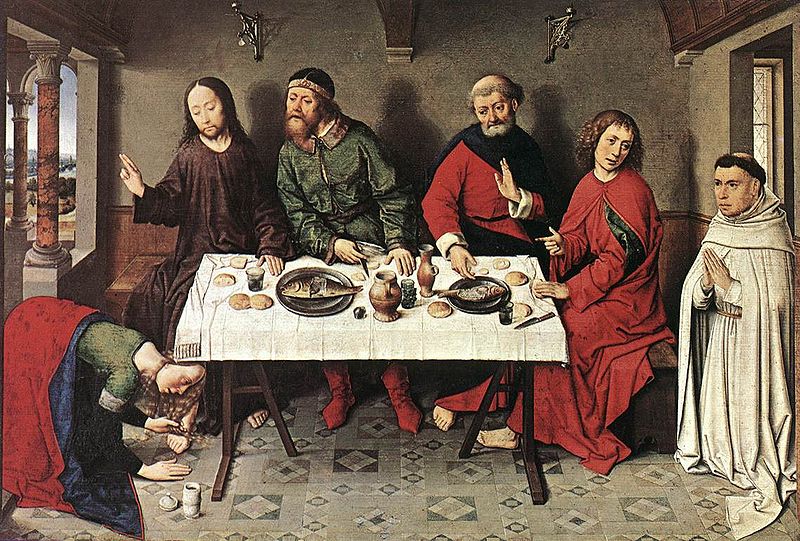
Christ in the House of Simon by Dieric Bouts

Christ in the House of Simon by Dieric Bouts

Shortly before Jesus is arrested, Mark records this dinner that he attends.

While he was at Bethany in the house of Simon the leper, as he sat at the table, a woman came with an alabaster jar of very costly ointment of nard, and she broke open the jar and poured the ointment on his head. But some were there who said to one another in anger, “Why was the ointment wasted in this way? For this ointment could have been sold for more than three hundred denarii, and the money given to the poor.” And they scolded her. But Jesus said, “Let her alone; why do you trouble her? She has performed a good service for me. For you always have the poor with you, and you can show kindness to them whenever you wish; but you will not always have me. She has done what she could; she has anointed my body beforehand for its burial. Truly I tell you, wherever the good news is proclaimed in the whole world, what she had done will be told in remembrance of her.”

SO. There is a lot going on here: The cost of the perfume, the identity of the woman, Simon, Judas, poverty, etc.

But I want to talk just for a minute about perfume bottles.

The contents of that bottle were valuable—nard we think was a pretty rare and valuable spice.

And they were to be offered to Jesus, to anoint him, to prepare him for burial.

In a sense what was in the bottle was going to be offered in worship to Jesus.

But first, the bottle had to be broken.

First, glass, or clay needed to be shattered. Only then can the gift flow out to Jesus’ feet. Only then can the fragrance of those gifts spread throughout the entire house, forcing people to take notice of something that is going on in the midst. Without the breaking, the bottle may remain attractive; it may be a really great looking bottle, and it may even be tempting to believe that the bottle of perfume is fulfilling its purpose by sitting on the shelf looking great.

But it’s not until the bottle is broken can the true beauty of its gift be received and shared. 

There is a strange tension in what we bring to Jesus as well. We all desire to bring him our best: our voices, our thoughts, our service, our hands and feet.

But before we can do that, we have to suffer the breaking.

I don’t mean a shameful breaking; I don’t mean a “breaking” in the sense that casts aside. I mean a breaking that merely releases what we have to give. A breaking that allows us to bring the deepest and truest gift of ourselves to the world and to Christ.

A releasing of our gifts for the sake of Jesus. A releasing of our gifts in such a way that those “in the house” with us—the people we are in community with, our brothers and sister—notice.

“Something has just happened.”

blessings

*e

==================================================

Lent Reflection 3 :: The Thing About Crosses, pt. 2

Last week, I wrote about the public nature of “bearing our crosses”; how they aren’t easily hidden, and are pretty obvious to people. I challenged you all to take up a cross with someone, and share it with someone. Maybe you did that; maybe you didn’t.

That’s the nature of the interwebs, I guess.

But I thought some more about crosses this week (it being Lent, and all), and something struck me from the other side of the equation. 

I remember sitting with a friend of mine once who was going through some really heavy, trying times. We were sitting outside at a local coffee shop (because where else do pastors hang out <snark>), and she was just crying and crying. Then she began apologizing because of the crying. It was a vicious circle.

I stopped her, as best I could, and said, “Please don’t apologize for your tears. You have to understand—for pastors, these tears are a precious gift to us, because they are your deepest fears and hurts. You are giving them to us to share and to care for, and they are precious to us. This is a gift; don’t ever apologize for your tears.”

In a letter to the church in Galatia, Paul the apostle wrote, “Carry each other’s burdens and so you will fulfill the law of Christ” (6:2 CEB).

I’m used to thinking about “burdens” in a very tangible sense (in fact, I preached on it once): bills, sicknesses, and physical needs. This is true and necessary, and it remains true and necessary. Reaching out to help people walk through life is no small thing, and every time we help our brothers and sisters, we are truly “fulfilling the law of Christ.”

But the main “burden” that Jesus tells us to carry for ourselves is the cross. 

(See where I’m going here?)

So as we (and the folks around us) take up our crosses—our own obvious instruments of pain and torture that we experience—at the same time, we need to be reaching out and helping others bear those same crosses.

So last week, I was thinking about what it takes to share the nature of our own crosses.

This week, I’m thinking about what it takes to bear others folks’ crosses.

Someday, someone may offer you the gift of their tears, their hurts, and their shame. How will you respond?

Will you treat it like a gift? A cross that you help carry?

Or an inconvenience, an embarrassment?

I guess in a way I’m saying that we don’t walk this journey towards Jerusalem alone; we need to help each other, and share what we can, so that we can all get there.

Like you didn’t know this one was coming….. 

But this is so very tasty too….


peace and blessings

*e

===============================================

Jesus is SO Down With Marvin…

I’m journeying through Mark’s gospel with some friends, and we were talking this week about 2v13-22. Essentially, Jesus goes to this guy named Levi (no relation to my son) who is a despised and outcast member of his culture, and invites Levi to follow him.

Then, as if that’s not enough, Levi throws a part for a bunch of his friends and invites Jesus to it. His friends are, well, colorful. Scripture says they were “tax collectors and sinners.” Again, tax collectors were seen as corrupt and greedy, less than moral. The word “sinners” here is even more interesting. There were two different Hebrew words (and concepts) for our word here. The first word was ‘am ha’ aretz. This essentially meant “people of the land”. They were simple people, people who weren’t interested in the rigorous obedience of the Pharisees or the political change of the Essenes or Zealots, but they weren’t necessarily awful. 

The other possibility, however, is slightly more scandalous. The second word is resaim. This word means the wicked. It means people who aren’t even the slightest bit interested in being good, much less holy.

To be clear, we’re not sure which word is being used here, but one thing is clear:

Jesus is with them, either way.

And what’s more—what is really freaking people out—is what Jesus hasn’t asked of these tax collectors and sinners…

… He hasn’t asked them to get their lives straight first.

… He hasn’t shamed them.

… He hasn’t berated them for their lack of morals or for their “bad behavior.”

… He has a party.

So when people come up to Jesus immediately after this and ask, “Why do John’s disciples and the Pharisees fast, but your disciples do not fast” (2v18), something very interesting is going on. You see, fasting itself was pretty common in Jewish culture; it’s actually common in many religious systems. There’s nothing wrong with fasting at all. But fasting typically has a specific connotation to it:

it’s associated with repentance. 

We’re told that John the Baptizer came “proclaiming a baptism of repentance for the forgiveness of sins” (1v4), and the Pharisees were desperate to see God act on behalf of Israel, so they pursued a pretty vigorous program of fasting and righteous (not so they could be buzzkills, mind you, but so God would come to Israel and set them free and bring His peace and shalom to His people).

But when Jesus shows up, he neglects the repentance part and goes straight to the party (his “repentance” in 1v15 isn’t so much about repenting of your sins as it is about rearranging your mind and your life to see the Kingdom in a new way).

He’s saying, “You don’t have to arrange your life to invite God into it; He will come into it just as you are. I don’t want to leave you unchanged; no one wants to be wicked, after all, but I’m coming to the party and you’re invited.”

So, incidentally, when Jesus talks about “unshrunk cloth” and “new wine” in verses 21-22, this is what he’s talking about: the “old way” is not  a bad way, but it really doesn’t fit reality anymore.

Jesus is here, and he’s having a party.

Are we inviting people to a party?

Or are we beating them up?

Or are we selling them “get-out-of-hell” insurance?

A friend of mine sent me this article this week, and it made me think of this passage of Mark and this blog post of mine.

Go read it, please.

….


Shouldn’t we be singing a better song?


I can’t help but read the words of the Grantland article and think about the way we do evangelism. Just reading the words in light of Jesus desire to throw a compelling party for people makes my heart ache for the way we should living with our friends.

Marvin said, “I asked God that when I sang it, would He let it move men’s souls.” 

Do we ask God to let us move men’s souls when we sing the Gospel song?

Or do we just ask for a sale?

Also note: lots of folks hated it. They were outraged. Marvin was corrupting, destroying the National Anthem.

But there other folks there too.

… and they heard that song, heard it in a new way, in a way that they never even know that they needed. Something welled up inside them. Everything that was old and tired about that song now seemed new and refreshing.

They got it.

And they wanted IN.

BLESSINGS.

*e


=======================================

Lent Reflection #2 :: The Thing About Crosses

Christ Carrying the Cross'', oil on canvas painting by Titian, 67 x 77 cm, c. 1565. Museo Nacional del Prado}} |Source =Museo Nacional del Prado |Author =Titian |Date =c. 1565 |Permission

Christ Carrying the Cross”, oil on canvas painting by Titian, 67 x 77 cm, c. 1565. Museo Nacional del Prado}} |Source =Museo Nacional del Prado |Author =Titian |Date =c. 1565 |Permission

After calling the crowd together with his disciples, Jesus said to them, “All who want to come after me must say no to themselves, take up their cross, and follow me.” (Mark 8v34)

I’m going to assume, for just a moment, that you know some of the details of what Jesus is talking about—that “taking up your cross” means taking up something that is very shameful and painful.

But there’s one more thing about crosses:

… they’re big.

You see, the thing about crosses (and taking them up) is that they are very difficult to hide. Crosses are just “out there” for all the world to see (one of the reasons that the Roman government reserved crucifixion for rebels and terrorists was so that they could very publicly proclaim, “Does everyone see what happens to people who choose to disobey Rome?”)

Most of the time, I feel like I get the part about carrying my own pain and shame, but what I miss is the idea about my cross being public, being shared with others. It’s one thing to acknowledge your pain and shame; it’s another thing entirely to choose to share it with someone.

It’s an easy assumption that we all have painful secrets; what would it look like for you to share them with someone during this Lenten season? What would it look like to really take up your cross in a public way?

Is there something you need to share?

Interestingly enough, as Jesus carries his own very real, very heavy cross to the place of his crucifixion, we’re told that the soldiers pulled a man out of the crowd and forced him, of all things, to help Jesus carry his cross.

Simon, a man from Cyrene, Alexander and Rufus’ father, was coming in from the countryside. They forced him to carry his cross. (Mark 15v21)

So maybe, just maybe, that as we make our crosses visible to others, we find that they will lend their shoulders, their strength, their faith to us, and make our walk just a little lighter.

p.s. I the title for this post was inspired by a song written by a good friend of mine named David Greco. He’s a great singer and songwriter, and an even better person. Please support his music and make him famous.


==========================================

Just Start Walking

By Alex S(User talk:Alex S).Alex S at en.wikipedia [GFDL (http://www.gnu.org/copyleft/fdl.html) or CC-BY-SA-3.0 (http://creativecommons.org/licenses/by-sa/3.0/)], from Wikimedia Commons

Jerusalem, by Alex S(User talk:Alex S).Alex S at en.wikipedia [GFDL (http://www.gnu.org/copyleft/fdl.html) or CC-BY-SA-3.0 (http://creativecommons.org/licenses/by-sa/3.0/)%5D, from Wikimedia Commons

Lent begins today, and many of us have already made preparations: we’ve prayerfully considered what we will surrender during this time, we’ve made arrangements for our fasts, we have sought out an Ash Wednesday gathering to be a part of.

All of these are good, good things.

But they’re not the best thing.

One of the verses that always gives me pause is located in Luke 9.

As the time approached when Jesus was to be taken up into heaven, he determined to go to Jerusalem (v51).

The Greek for this passage would read something a little more like: “He resolutely set his face to go Jerusalem.” The phrase indicates a sense of courage and determination. Moreover, it is also a reference to Isaiah 50v8:

The LORD God opened my ear; I didn’t rebel;
I didn’t turn my back.
Instead, I gave my body to attackers,
and my cheeks to beard pluckers.
I didn’t hide my face from insults and spitting.
The LORD God will help me; therefore, I haven’t been insulted.
Therefore, I set my face like flint, and knew I wouldn’t be ashamed.
The one who will declare me innocent is near. Who will argue with me?
Let’s stand up together. Who will bring judgment against me?
Let him approach me (vv5-8).

Jesus is on his way to Jerusalem, knowing what is waiting for him: insults, beatings, and attempts to discredit and shame him. He goes, however, with a steadfast faith in God’s call on his life, and a belief that ultimately God will vindicate him through the resurrection.

And here’s the deal:  his disciples are on the road to Jerusalem with him.

Lent is ultimately not about giving up chocolate, or fasting, or praying extra prayers, or attending gatherings, or anything. These are great—even necessary—tools, but for me Lent is ultimately about “setting my face” towards Jerusalem and journeying there with Jesus, with no agenda but to follow Him, and to attempt to be present, really present, through this last season of His ministry. 

As we begin our Lenten journey, don’t just commit to giving up something; don’t just commit to an extra gathering or devotion.

Commit to walking with Jesus on his road to Jerusalem. 

Commit to staying with him during his time of trial.

Commit to staying faithful to him when he is arrested. 

Commit to being with him at the Cross. 

And here’s the deal: He knows our weakness, just like he knew the disciples’. He knows that we will fall asleep, that we will look away, that we will deny him.

But he invites us anyway.


==============================================

Again, and again, and again.